City on Fire: A Boyhood in Aligarh is a memoir of love, home, and family. How has your understanding of home and belonging changed while writing this book?
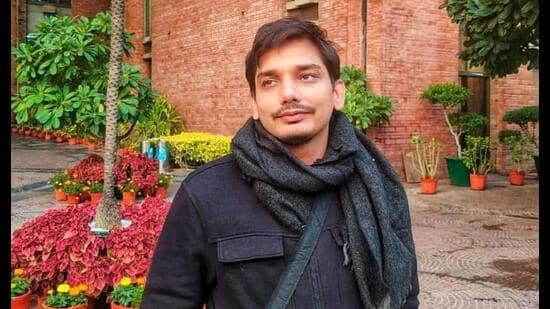
My understanding of the concept of home was destroyed and then remade. It was as if I was looking at myself, my family, my old house, even animals and trees around me with different eyes. I escaped into my own mind, but that was a bit comforting in those tragic times.
My
City on Fire: A Boyhood in Aligarh is a memoir of love, home, and family. How has your understanding of home and belonging changed while writing this book?
My understanding of the concept of home was destroyed and then remade. It was as if I was looking at myself, my family, my old house, even animals and trees around me with different eyes. I escaped into my own mind, but that was a bit comforting in those tragic times.
My mother and brother, two people locked inside with me during the pandemic, became characters — the way I hadn’t seen them before. They were now more than my family — they were complex people with intricate emotions and a story of their own. It was as if I was “spying” on my own thoughts and my perspective of the people I loved.
I also came to terms with the idea of belonging. For a long time, I tried to run away from my identity as a boy living in a Muslim ghetto. In elite consciousness, ghettos are looked at as places where lesser humans live. They are demonized so much in public perception, that these views often colour our perspectives of ourselves. It took a lot of reading to rise above the elitist nonsense. I could now accept my identity without judgment and it was incredibly freeing.
You have recorded what it means to be a Muslim growing up in an India gripped by communal tension. Is your writing also an act of hope and faith in a better future?
I see “hope” as critical and “despair” as being lazy. I firmly believe most privileged people “choose” to be disillusioned because they don’t want to make efforts to change things. If you choose hope, I do see it as the first step of changing things. But I do see most of the privileged indulge in self-congratulatory rhetoric, but very few follow it up with actions. On the contrary, the oppressed has no other choice than to be hopeful — sometimes that’s all they’ve got. It’s criminal to take it away from them.
I chose to believe that things can change. Muslims and all other disadvantaged sections need hope desperately because that’s the only way to come out of the mess that we are in. In that sense, being hopeless and losing faith is not just irresponsible, but also cowardly.
You write that riots in Aligarh were an inseparable part of your life, that violence was just another neighbour. Have the people of Aligarh accepted violence as a part of life?
Most of them continue to live in denial and have normalized that violence. But it’s not just Aligarh, it’s all of India. Most of us have become so insensitive to acts of violence, that it doesn’t evoke any anger or sadness in us. I do believe a society eventually becomes what we normalize. Right now, the murder of Muslims receives hardly any significant coverage in print and television media (unless the focus is on criminalizing the victims themselves).
Growing up in Upar Kot, violence was just another neighbour. Now it’s the elephant in the room. It spreads through an organized machinery and nobody seems to care apart from a few activists and the families of victims. Nothing good will come out of this bloodlust.
In Aligarh, Hindus and Muslims rioted and later became friends again. You write about communal tension being a spectrum, never really dying down. Are you trying to challenge the binary idea of the good and bad through this?
I meant it as a reference to the various degrees of violence in Muslim ghettos like Upar Kot. These places will evoke a response in elite consciousness only when there is actual physical violence, but otherwise these ghettos are victims of continuous, systematic and structural violence.
Just a week ago, 100 metres from my home, a “mentally unstable” man painted a religious war cry on a mosque. A week before that, a Muslim woman was “accidentally” shot down in my neighbourhood. Both these incidents sent waves of fear through Upar Kot. Then, there is the psychological violence that is mostly conveyed through symbols like saffron flags coming up in areas around us. Apart from that, there are Islamophobic songs being played loudly on loudspeakers around us, an aspect of cultural violence aptly captured by Kunal Purohit in his book on Hindutva Pop.
I also see a lack of hospitals, banks, schools and sanitation facilities as forms of structural violence. So while, in the elite consciousness, we are facing violence only when somebody is killed, Muslim ghettos always face some sort of violence. That’s what I refer to as a spectrum.
What role did the demolition of Babri Masjid play in your inner life? How did it change things around you?
I see the demolition of Babri Masjid as a symbolic moment for Indian Muslims – the moment when they realised that their rights and heritage were not as important as that of the majority community. For me, and most of the people in my family and neighbourhood, it was as if we were being humiliated and consigned to being second-class citizens.
In the subsequent years, I saw that the idea of “othering” gained strength and became normalized. It felt as if being allowed to live in India was an act of benevolence by the majority Hindus, not my right as a citizen of India. For me, it was a time of confusion: Didn’t my father, like many others, work here and pay his taxes as a citizen till he died? Didn’t monuments constructed by Muslims, now not seen as “Indian”, bring revenue to the Indian exchequer? Didn’t Muslims send money from the Gulf and bring foreign exchange to the country? However hard I tried to be Indian, the state seemed hell-bent on consigning my rights to the margins.
How did the Delhi riots of 2020 challenge your sense of safety?
Before 2020, even after growing up amid riots in my childhood in Aligarh, I somehow thought I was safe from them in a big city like Delhi. I now see that as being foolish. The Delhi riots shattered the illusion that I would be safe from religious violence in a metro city. And it’s not just me. Most Muslims, even elite ones, are now afraid of religious violence in urban spaces. The illusion that privilege will protect us is shrinking fast.
Please talk about your relationship with faith and how it caused friction between you and your father. Do you think the Left tends to be intolerant of religion and faith?
My relationship with faith is always oscillating. When I was a boy who was part of the Tablighi Jamaat, I began seeing my father as “less Muslim”, and that did affect my relationship with him, as I chronicle in my book. In today’s highly polarizing times (amplified by social media algorithms), I see so many relationships end because people have different politics. Everybody seems to think their politics is best, and the rest of the people don’t deserve to be engaged with. In a way, those who differ from them are bad human beings. I see that as dehumanizing, something so many progressive people, including me at times, indulge in.
The most intolerant and self-righteous in this regard are the Left. They will not engage with religion and believe it will vanish if they keep denying its hold on the minds of the people. They are living in utopian fantasies that they will never see fulfilled and refuse to even acknowledge what doesn’t align with this idealism. So they will refuse to talk about Muslim rights and will often try to portray Hindu-Muslim violence as just class conflict, even though class is just an aspect of the violence.
Why did you choose to tell the story of Aligarh and the story of Muslims navigating turbulent times in India? Was this story thrust upon you? What do you expect the reader to take away from your book?
I think Muslim writers have a very narrow window of topics they can write about. If I write about Hindu culture or Indian sensibilities or anything which is not “Muslim”, I can be easily discredited by the liberal Hindu intelligentsia. Some of them will even explain to me my own living experience and blame Muslims for their misery, ignoring the systematic marginalization. I also thought I was uniquely placed to tell this story, as Muslim ghettos as scenes of action are less explored in Indian literature (except as examples of places where women are repressed, even as the authors themselves refuse to see patriarchy in their own culture).
To some extent, the story was thrust upon me. But it was also a choice. I expect the reader to see that whatever they’ve been led to believe about Muslims through mainstream media is mostly horseshit. If you are not a Muslim living in a ghetto, you don’t understand anything about that place. So listen to Muslims when they tell their stories.
It is said that a well-written memoir reminds the reader of their own life, and your memoir does that. What were your literary influences?
My primary influences were Vivian Gornick (author, Fierce Attachments), Michel Foucault, James Baldwin, Arundhati Roy, Ocean Voung, Graham Greene, Basharat Peer, my friends Neyaz Farooquee and Manjiri Indurkar. I also watched a lot of cinema, and read a lot of memoirs and religious texts, apart from listening to music from different genres.
Sharmistha Jha is an independent writer and editor.
One Subscription.
Get 360° coverage—from daily headlines
to 100 year archives.
Archives
HT App & Website