After a period of sustained efforts in integrating artificial intelligence (AI) into creative apps for consumers and enterprises, Adobe is now marking a sharper pivot towards agentic workflows embedded in Creative Cloud apps, connectors to third-party large language models (LLMs) including OpenAI’s ChatGPT as well as Google Gemini, and opening up the local Model Context Protocol (MCP) across desktop apps allowing users to connect their choice of AI agents directly to projects. This is alongside significant feature updates across Adobe’s apps on desktop and mobile, as well as the widening scope of Firefly AI.
At the company’s annual MAX keynote, the direction—which sees Adobe further opening its otherwise tightly guarded ecosystem—becomes clear. There is now native support for MCP across its flagship desktop suite, including Illustrator, Premiere and After Effects. Adobe’s intention is to give creators the flexibility and choice of working with their own creative agents, called the Adobe Creative Agent, or with third-party AI agents. They insist that everything, be it layers, vectors, sequences or compositions, stays editable.
“Generative AI has made it easier to produce content. Agentic AI takes that further. With agentic AI, you can plan steps, coordinate tools, and carry out work towards a very specific outcome. You're always in the driver's seat. At Adobe, we're bringing that assistance directly into our apps with purpose-built agents grounded in decades of domain expertise across creativity, productivity, and customer experiences,” says Deepa Subramaniam, Vice President, Product Marketing for Creative Professionals at Adobe, in a briefing of which HT was part.
The idea is to transform creative tools, widen the scope of availability of Adobe’s tools to newer audiences, and orchestrate AI agents. Adobe hopes creatives will be able to navigate complex, multi-step tasks faster while maintaining precision, flexibility and creative control. For instance, the agentic workflows in Premiere could help video editors apply effects in every clip in a sequence at once. Or track masked subjects through different frames, or adjust colour as well as exposure, with a single command.
{{/usCountry}}The idea is to transform creative tools, widen the scope of availability of Adobe’s tools to newer audiences, and orchestrate AI agents. Adobe hopes creatives will be able to navigate complex, multi-step tasks faster while maintaining precision, flexibility and creative control. For instance, the agentic workflows in Premiere could help video editors apply effects in every clip in a sequence at once. Or track masked subjects through different frames, or adjust colour as well as exposure, with a single command.
{{/usCountry}}Adobe’s approach to agentic AI has a three-part foundation. First, there are purpose-built agents for each product, such as the Adobe Creative Agent in Firefly and Creative Cloud apps, or the Adobe Productivity Agent in Acrobat. Secondly, AI assistance using chatbots that people already use, and Adobe’s Connector—launched last year to allow it to work with ChatGPT, Claude and Gemini—plays a key role. “In these cases, the assistant does the orchestrating, while we provide the tools and skills to pull from,” says Subramaniam. Third, is the new MCP access to Adobe’s creative tools.
“The agent works locally on project files that stay editable, and the creative professional can step in at any moment for hands-on control. You bring the vision, perspective, and judgement, and agents help plan, coordinate, and carry out the work through a connector and 3rd party AI LLMs natively in our applications to the Adobe Creative Agent, and now opening up MCP local endpoints,” explains Subramaniam.
Individual apps also get substantial feature updates. In Premiere, there is a new Color Mode for streamlined grading in videos, a Generative Media Tool for generating video as well as sound effects or music for the timeline, and new AI tools to clean up and separate different sounds. Photoshop’s new features include Relight, Generative Restyle, AI Assisted Editor as well as improvements to the Remove Tool and Quick Compare.
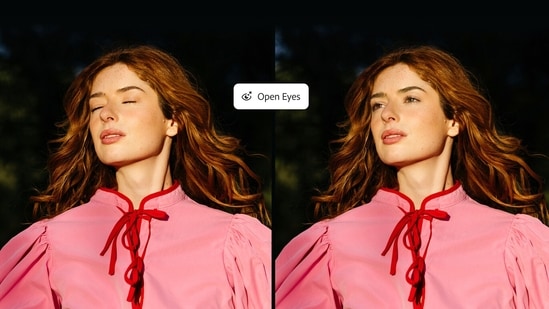
Lightroom, a favourite for photographers, gets finer precision control with a new feature called Glow for a soft, cinematic light effect in photos, as well as one-tap Blemish Removal, and the Open Eyes feature which is in public beta for fixing untimely blinks by subjects in a frame.
The Adobe Creative Agent is being expanded across Firefly within Adobe’s apps, there is a new Firefly Design model and a new Firefly builder in private beta that can turn prompts into an interactive environment for websites and apps. Firefly’s third-party model support for ideation, creation and scale includes OpenAI’s GPT-5.1 and GPT-4.1 mini, Google DeepMind’s Nano Banana Pro and Neo 3.1, Runway Gen5 and Aleph 2.0, LumaAI Ray3.14 HDR and Topaz Astra, to name some.
"Adobe MAX is where the global creative community comes to see what’s next, and this year shows how far AI can extend what creators can imagine and build. New tools, models and agents across Firefly, Creative Cloud and GenStudio, along with a growing partner ecosystem, give creators and businesses more speed, control and choice. India is part of this story on both fronts. India is one of the world’s most dynamic creator economies, and our teams here help build the innovation the world is seeing at MAX," says Abhigyan Modi, Senior Vice President, Document Cloud and Country Manager, Adobe India, pointing to the country's importance for Adobe's product roadmap.
Adobe’s announcements reflect a transition from seeing AI as a novelty to ultimately its production and process utility. By opening desktop software as endpoints for the Model Context Protocol, working with non-destructive edits, Adobe is making a pitch for the final control remaining with the creative professional. Adobe understands many professionals already have a preference and regular usage of ChatGPT, Gemini, or Claude for instance, and wants to leverage that by making creative tools available where the user is.