Cognitive warmup. Google DeepMind’s journey towards building relevant AI continues. It now has a model called WeatherNext AI, that will predict tropical cyclones sooner. This includes a cyclone’s track, intensity, and wind structure, and this up to 15 days in advance. To build this, AI researchers and engineers at Google DeepMind and Google Research, with expert forecasters at the National Hurricane Center (NHC), the Cooperative Institute for Research in the Atmosphere (CIRA), the UK Met Office, and weather agencies around the world.
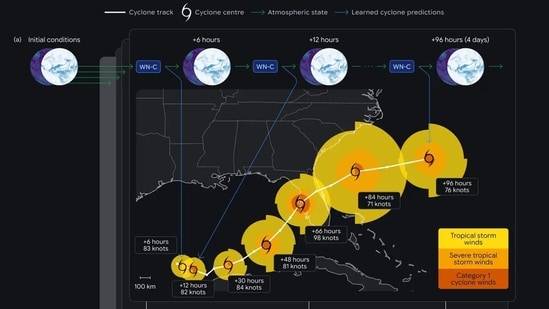
The WeatherNext team notes that predicting cyclones is usually complicated, because the track (that is, where it is headed) is dependent on a number of factors including changing atmospheric currents as well as very local conditions. “Our WeatherNext model bridges this gap by improving forecasting for global weather overall as well as cyclones. It is a single AI model that predicts a tropical cyclone’s track, intensity, and wind structure with state-of-the-art accuracy. It achieves this breakthrough through a unique combination of its training, architecture and approach to low resolution inputs,” they say.
The model has been trained on global weather and expert-curated historical cyclone observations—that is in total around 20 terabytes of global atmospheric data and historical observations to work with, across 5,000 historical storms.
WORKDAY: ENTERPRISES ARE USING AI ALL WRONG
When enterprise AI platform Workday puts together data about AI adoption and glaring gaps, it is only prudent to take cognisance and read through those findings. Workday’s latest report titled “The copy/paste economy: Why task-oriented AI is failing the enterprise in India” points out a key that may seem to have missed—despite the the influx of AI, human workers are bearing the brunt of disconnected systems. They become, what Workday calls, a ‘glue’ between disparate systems. Alongside, two more key points—embedded AI results in better value, and trust in AI is also dependent on efficiency of decision making.
“Indian employees believe in the power of AI to improve their work: 89% say AI is improving their work day experience. Drilling down into why, 69% say AI reduces the time tasks take, and 64% say AI has accelerated their work in a productive way,” notes Sunil Jose, President - Workday India, adding these numbers are far higher than the global benchmark for both metrics (61% and 54% respectively).
The report notes that while employees in India rate their day-to-day work positively, they’re also grappling with inefficient ways of working. “Much of their effort is spent compensating for disconnected systems that were designed before AI existed.” Most businesses are handing their employees task-oriented AI—think chatbots for drafting emails or tools to summarise meetings. While 64% of employees say this kind of AI has productively accelerated their work, it’s a band-aid solution.
A change in approach from organisations, many of whom while being confident about AI, still plug the tech into their workflows as an afterthought. The key is to address these challenges by including AI deeply within the systems.
“The goal is for AI to eliminate the unnecessary coordination that prevents people from doing their best work. Imagine AI monitoring business metrics and recommending actions before problems emerge. Routing approvals automatically across departments. Supporting financial close. Assisting with onboarding,” says Jose.
Workday points to a rather interesting metric. In Asia Pacific and Japan, employees in organisations that have deeply embedded AI into their core operation systems, report meaningful time savings. Task time is reduced by as much as 25%. The message for business leaders is clear: stop adding shiny new AI apps on top of otherwise dated, siloed systems. AI adoption is not worth it, unless human employees aren’t able to make best use of it.
OPENAI INSISTS IT IS DOING A LOT
A fine detail that is not lost on some of us, is that OpenAI never misses a chance to loudly share its user statistics—the latest is, before they get to the point of what’s new, is 1 billion weekly active users. Great. So, what’s new? Turns out, they are upgrading the default model in ChatGPT for Free users, giving Free users access to unlimited text chats, upgrading GPT-5.6 Sol in Chat for paid users, and giving everyone more control over how hard ChatGPT thinks. This can either be on-point, or vague, depending on how this works out for your interactions with ChatGPT.
For Free and Go users, the default model will now be the GPT-5.6 Luna. They insist this is a major improvement in factuality (guess we are closer to AGI than ever before?). OpenAI says responses containing at least one factual error were about 62% less common with GPT‑5.6 Luna than with GPT‑5.5 Instant (the previous default model) in an internal evaluation of financial, medical, and legal prompts requiring factual detail.
From this week, Free and Go users will also get unlimited text chats and a new Think button that lets users select higher reasoning for harder questions.
The paid tiers, Plus and Pro, will see improvements with GPT-5.6 Sol in ChatGPT’s Chat experience so that it’s optimised for everyday conversations and tasks, like quick questions, web research, advice, planning, writing, and decisions. OpenAI says this version of GPT-5.6 Sol delivers more focused answers with less unnecessary formatting and has a more consistent tone across different kinds of conversations and reasoning levels.
It’s apparently also designed to make fewer mistakes, particularly when answers need to be grounded in factual elements such as dates, numbers, sources, rules, or assumptions. That is because of better handling of sources to find answers. Plus and Pro users are getting a new slider for choosing how much thought ChatGPT puts into an answer. Wasn’t it always a good idea to think more, than you think is necessary?
Oh, and a final note. OpenAI this week also said it must slow down development of its upcoming Astra model, because it showed “significant advancements in agentic coding and cybersecurity,” which means OpenAI cannot exactly “rule out critical cyber capabilities.” The scheme is shaping up well. The we-are-so-powerful-we-deserve-all-the-funding-and-protection scheme.