If I had a ₹ for every time someone asked me about the Google Fitbit Air’s India availability before it was confirmed, I’d have had around ₹55,378 more in my bank account right now. Cool kids call it FOMO. Such was the level of excitement, and to be fair, somewhat a rarity for what is essentially a fitness tracking wearable.
Now, Google has finally launched this wearable in India. The Fitbit Air itself is priced at ₹13,999, while it also unlocks a new revenue stream called the Google Health Premium subscription, priced at ₹99 per month.
To be fair, the Fitbit Air can be used without this premium subscription, but a lot of the advanced health metrics, the personal coach, adaptive fitness plans, and sleep insights will require it. The Fitbit Air bundles three months of this subscription, but you’re paying after that.
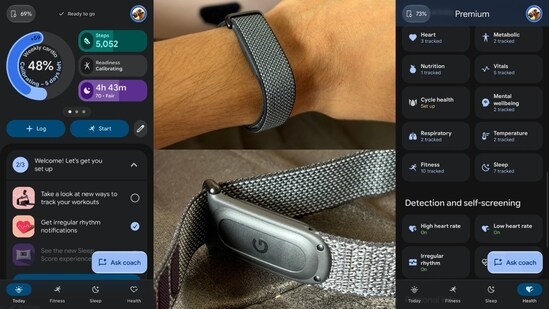
The idea here is a minimalistic design without a screen, which also translates into longer battery life and ease of understanding. It was surprising that for essentially a fitness wearable, this isn’t the most comfortable to wear. Hear me out—the tracker module hardware is far too long (though no complaints about the weight) and you’ll never align it properly on slim wrists. Secondly, it is purely uncomfortable to wear at night if you have a habit of sliding a part of your arm underneath the pillow when sleeping on your side. That said, it’s very light.
Also Read | Mivi One 5G and the changing affordable Android phone conversation
{{/usCountry}}Also Read | Mivi One 5G and the changing affordable Android phone conversation
{{/usCountry}}The biggest positive is the battery life. After four days and nights of tracking activity and sleep, this still retains a 45% charge. And it should easily deliver on Google’s claims of 7-day battery life on a single charge. It uses a proprietary charging dock, and the magnetic method holds the Fitbit Air securely enough.
That leads me to the point about the bands themselves.
These textile bands (four colour options—obsidian, berry, lavender and fog) should ideally be taken off and washed once a week, or you risk skin irritation once enough sweat and dust accumulates on this material. In due course, Google will have to contemplate a silicon finish for instance, because textile as a material absorbs moisture easily—and that can be uncomfortable in the summer months.
Google has positioned the Fitbit Air as a fitness-focused tracker, and the lack of a display means you’re not going to get distracted by synced message notifications or call alerts. To that point, this absolutely delivers with a wide spectrum of tracking including heart rate, resting heart rate, steps, breathing rate, energy burnt, steps walked, readiness and sleep tracking.
There is always an argument that you don’t need a fitness tracker or an app to tell you whether you’ve slept well or how ready you may be for the day ahead. While I absolutely agree with that, the idea here may be for every spec of data to create a bigger picture that the algorithmic coach will be able to plug into. This syncs with other fitness platforms including Apple Health on the iPhone, though I specifically left it off to keep separate containers for the Fitbit Air and Apple Watch data.
Before the potential and promise, I’ll talk about basic metrics first. The step counter seems to be somewhat off if you aren’t exactly marching with your hands moving. Pushing a shopping trolley or carrying big boxes around? Those steps may be missed—and I’m not sure what that really means for distance accuracy either. Sleep tracking is very good, if you are comfortable wearing a health tracker on your wrist at night—sleep score, sleep duration and the graph for deep sleep and nightly interruptions can give you a fair idea of your sleep patterns.
Also Read | Gravity, dust and regret: The cost of repairing a foldable smartphone
So is the automatic activity detection, which takes a few minutes to understand if you’re in the midst of a session, and puts everything together into a session recap. However, since the Fitbit Air doesn’t have GPS data to work with on the tracker, you’ll not have the context of an activity map or elevation changes, for instance. The heart rate reading seems to be a bit off (read, somewhat higher occasionally) when compared with an Apple Watch at different points in time—it doesn’t have the same quick response to changes in heart rate.
The Google Health app has the personalised AI coach functionality which is underlined by Gemini. It can optimise your current activity routine after learning your activity patterns over time. This will keep evolving as time passes. The one thing this chatbot-like AI coach will have to balance in due course is that tendency to validate a user’s pre-set thoughts (AI does that, often) versus not being overbearing about recommendations or suggestions. This will not be a concern for free users, because the coach won’t be everywhere in the Google Health app.
As someone said, history has a habit of repeating itself. Within this paradigm also fall the screen-less fitness trackers, which after years of being forgotten about, are somehow back in vogue. There is no arguing with the simplicity of getting the Google Fitbit Air going, and using it for everyday activity as well as health metric tracking. Particularly if you don’t want the complications of a typical smartwatch or a fitness band with a screen, which inevitably takes our fragile attention away. Great battery life gets you going for an entire week, and if you do continue with a paid subscription, Gemini powered summaries of how well you slept and how your workout was, may begin to elicit value.
Contrary to perception, the Google Fitbit Air isn’t exactly affordable. And it demands a subscription to unlock all functionality. But it is still a very relevant fitness tracker that does just that, particularly for people who don’t wear a smartwatch. Just that the Google Health app will feel akin to information overload for most users, at least until they get used to it.