E-Paper



Samsung Galaxy Z Fold7 review: By far, the most mature and refined foldable
It is easy to say that with the Galaxy Z Fold7, Samsung has finally delivered the foldable that always should have been

 Prefer HTon Google


A few generations in, the passage of time, and many a chapter of refinement written, it is easy to say that with the Galaxy Z Fold7, Samsung has finally delivered the foldable that always should have been. The idiom hindsight is always 20/20 more than applies here, to a fairly loud narrative that Samsung has somehow broken the shackles because it was forced to. It wasn’t. Nevertheless, good to see the back of those narrow-er Galaxy Z Fold designs, and the seventh generation’s wider one has been made possible purely because the design has been slimmed down significantly. So much so, when folded, it’s easy to forget this is a foldable at all. Perhaps it was the Samsung Galaxy S25 Edge that gave us a hint, unwittingly at the time, of the slimness diet Samsung was putting its phones through.
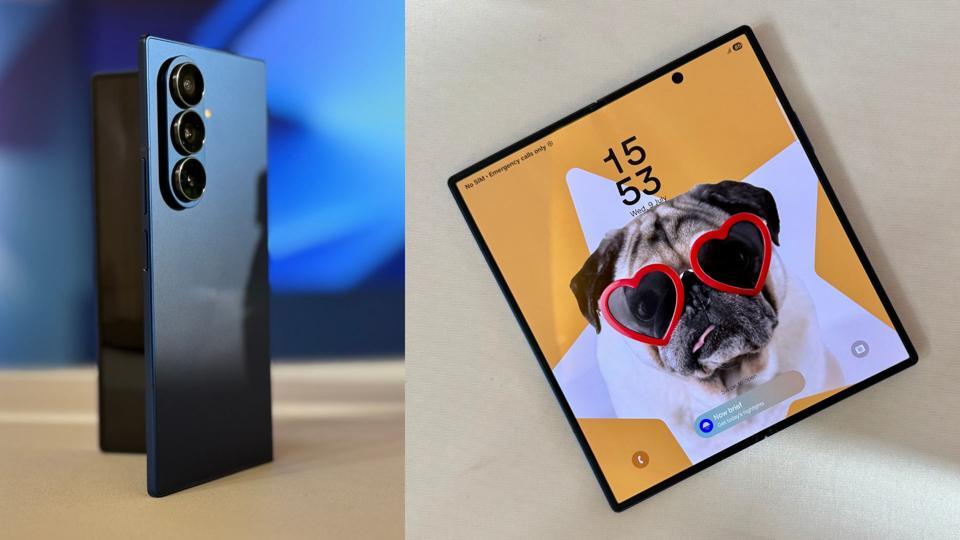
The headline changes to the Samsung Galaxy Z Fold7 include a larger (read, wider in terms of footprint) cover display, a bigger foldable main display, the current top-of-the-line Snapdragon 8 Elite chip specifically customised for Samsung, the 200-megapixel primary wide camera that also does duties in the Samsung Galaxy S25 Ultra flagship and a form factor that is significantly thinner (4.2mm and 8.4mm versus 5.6mm and 12.1mm folded and unfolded thickness) and lighter (215 grams vs 239 grams) than the previous generation Galaxy Z Fold6. The competition however isn’t that, or the Google Pixel 9 Pro Fold, but the latest crop of flagship Android foldable, such as the Honor Magic V5 (6.7mm and 14.3mm) which hasn’t been launched in India and Vivo’s upcoming X Fold5.
It won’t be long before you notice the Galaxy Z Fold7’s new, wider display format, and this is as welcome a change as any. The cover display, which gets its own titanium layer plate for support, now measures 6.5 inches with a 2520 x 1080 resolution compared to the Fold 6’s 6.3-inch, 2376 x 868 pixels screen. The big change is, it is wider, and therefore a lot closer to conventional smartphone displays in terms of typing and reading. So much so, the Galaxy Z Fold7 may actually feel like a traditional candy-bar form factor phone, when folded.
The foldable screen is now 8 inches, up from 7.6-inches earlier, and 2814 x 1968 pixels instead of 2160 x 1856 pixels. The tradeoff here is, the foldable no longer has support for the stylus, that is the S Pen. The layer that needed to find integration within the display for the S Pen to work for scribbling, noting, annotating and doodling jobs, has been done away with. Something had to be sacrificed in the quest for slimness, and this in my book, isn’t a significant elimination. There are enough devices within Samsung’s smartphone and tablet portfolio that do, and in a way helps the company push its ecosystem case.
The dimension, footprint, weight and display specific changes make for a collective that can only be described as extraordinary. The Galaxy Z Fold7 may feel unremarkably understated when folded, and equally brilliant when unfolded to derive on the full strengths of that large foldable AMOLED display. More often than not, you may find yourself using the cover display itself for most tasks, including replying to an email or message, quickly checking WhatsApp messages or even the unacknowledged whiling away of time on your Instagram feed (before reality strikes, again).
All of this does come at a cost. In India, prices start at ₹174999 but the value is that for a certain period of the foreseeable future, Samsung will ship upgraded 512GB storage variants instead of 256GB. 12GB RAM is consistent across variants, and there can be an argument that for this price and its perceived positioning, 16GB should have been a generational uptick. For early adopters, that may be the value proposition. But all said and done, the Samsung Galaxy Z Fold7 is now by far and away the most expensive foldable smartphone you can buy in India, at this time. It is nevertheless a significant annual inflation, with the Galaxy Z Fold6 in the summer of last year, priced at ₹164999 onwards for the 12GB+256GB combination.
That 200-megapixel upgrade for the primary camera (alongside a 12-megapixel ultrawide and 10-megapixel telephoto) finally puts the foldable on the flagship platform, something that hasn’t been the case in previous generations. You begin to wonder, why wasn’t that the case till now? The limitation here is, instead of 5x optical zoom, it is limited to 3x. The ultra wide, particularly in terms of scenarios you may call upon it for, seems a big step down in terms of megapixels and therefore potentially detailing.
This primary sensor absolutely delivers across lighting conditions, and the photography results do seem to suggest the Galaxy Z Fold7’s image processing seems to be handling light better, and details are more consistent — I draw this based on a comparison of the initial builds of the Galaxy S25 Ultra, which leaned a little too much towards AI processing, something that was eventually balanced out with updates.
Beyond the core specs and the resulting experience, little details that matter have been ticked off too. The Armor Aluminum frame lends the foldable phone an extremely premium in-hand feel. The Armor FlexHinge closes thinner, and that’s visually apparent, with no gap when folded. Earlier generations had that disconcerting gap, and the risk of damage was high. That’s gone now. Some of you may, as I did, notice that the unfold still isn’t completely flat and there is a very slight hint of a “V” there.
Samsung, rightly so, isn’t letting up on the AI integration. Google Gemini integration, Circle to Search and Samsung’s own Galaxy AI suite remain as front and centre on the Galaxy Z Fold7, as they have done on the flagships this year. It may not mean much, but the Gemini Live interface as it floats across the 8-inch foldable screen, feels more intuitive here, than it has on any other device till now.
For a phone that costs ₹174999 onwards, it is difficult to use the word “value” for the Samsung Galaxy Z Fold7. But then again, this book style foldable form factor isn’t, at least in Samsung’s scheme of things, isn’t a mainstream device. This is still, if it’s the right word, delivering ultimate snob value for those who flaunt it. Yet without doubt, the utility of foldable while at it, has increased manifold over the years. It is a concerted effort of the software and hardware at work. There’s a lot of substance to go with that style. Speaking of which, the Blue Shadow is the colour to consider the most, amidst the troika that also has Silver Shadow and Jet Black as options.