E-Paper



Some PLI schemes need tweaks, 4 of 14 sectors are ‘on track’: Niti Aayog
Large-scale electronics, pharmaceutical drugs, telecom and networking products, and food products have done well, the report said

 Prefer HTon Google


Several Production-Linked Incentive (PLI) schemes need course correction, and Niti Aayog will review each programme to see how it can be improved, top officials from the government think tank said on Thursday as it released an impact assessment across 14 sectors.
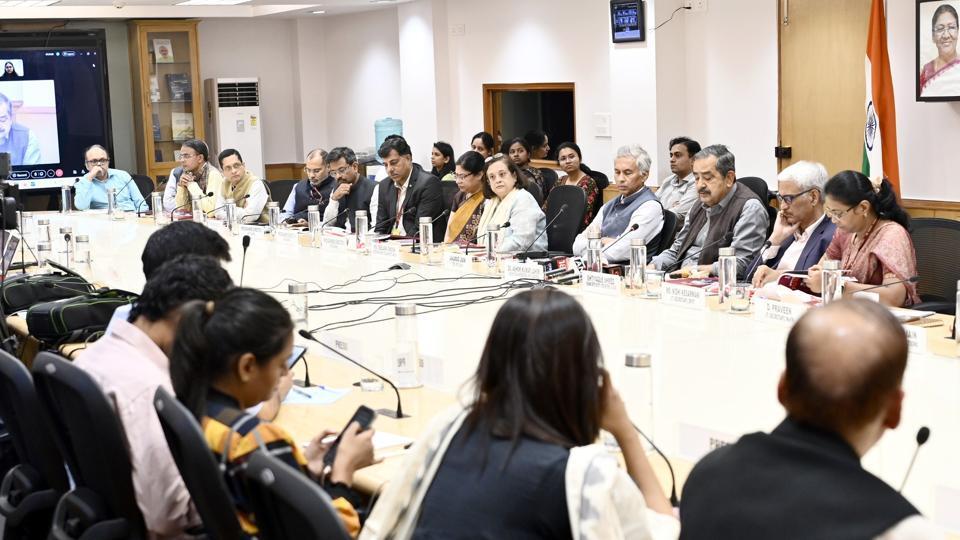
“Some PLIs need tweaking. The concerned ministries will look into it,” Niti Aayog chief executive officer Anurag Jain said at an event to launch the report in the national Capital. Vice Chairman Ashok Kumar Lahiri added, “The report also records variations in various sectors. Every sector has not done equally well. Niti Aayog will look at every scheme and see how it can be improved.”
The report, prepared in collaboration with the Indian Institute of Management (IIM), Ahmedabad, said four of the 14 sectors under the PLI schemes have done well - large-scale electronics, pharmaceutical drugs, telecom and networking products, and food products.
The report rated each scheme on four measures - investment, production, jobs and exports. For each measure, a sector was marked “on track” (green), “partial impact” (yellow), “evidence of impact not sufficient” (orange) or “data unavailable” (blue). Only four sectors were rated “on track” (green) on all four.
The report assessed whether the sector’s growth went beyond what the industry would have achieved without the scheme. Since the schemes are only about halfway through, a sector was considered on track if it had reached at least 50% of its full-term target. The schemes have completed about 58% of their total time, it said.
The report covers results up to March 2026.
18.5% of PLI money paid
The PLI schemes cover 14 sectors in all - large-scale electronics, bulk drugs, medical devices, pharmaceuticals, IT hardware, telecom and networking products, automobiles and auto components, ACC batteries, drones, textiles, white goods (ACs and LED lights), solar PV modules, food products and speciality steel.
The government has paid ₹35,354 crore to companies so far, which is 18.51% of the total budget of ₹1.91 lakh crore. The report said this is because money was paid only after companies met their targets. Officials said the production has been going on for three years on average, but payments have been made for only two.
The report said companies have invested ₹2.40 lakh crore so far, about 76% of the target, with production and sales having reached ₹22.66 lakh crore, or 64% of the target. But they have lagged in creating jobs. Only 8.49 lakh jobs have been created, against a target of 30.19 lakh, or 28%.
Mobile phones are the biggest success. Phone exports rose from ₹22,868 crore in FY21 to about ₹2 lakh crore in FY25, while phone imports fell by 77%. But the report noted that most of this work is assembling imported parts. India also started exporting more bulk drugs than it imports, earning a ₹2,280 crore surplus in FY25.
Some sectors are lagging. Textiles and speciality steel have used less than 4% of their budgets. The report says the steel scheme’s design “has been faulty”. In the auto sector, 67,820 jobs have been created against a target of over 1.48 lakh. The report also points out that the telecom scheme has no rule on using local parts, so companies can import all their components and still get incentives.
Two schemes, advanced chemistry cell (ACC) batteries and high-efficiency solar PV modules, are still in their gestation period.
The report suggested that the government should also boost demand for these products, for example through government purchases. It also said ministries must “urgently” follow a common method for collecting data on jobs, production and exports.