Nearly three decades after its establishment, the Punjab government has framed service rules for contractual employees of the Punjab State Bus Stand Management Company Limited (PUNBUS), addressing a long-pending demand of its workforce.
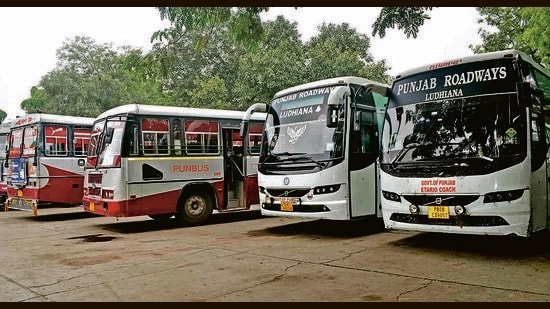
The proposed rules, finalised following protests by employees, will now be placed before the state cabinet for approval.
The new service framework is set to introduce clear career paths and defined working conditions for PUNBUS’ nearly 4,000 employees. The state-run transport operator, which currently runs a fleet of about 1,500 buses, previously lacked formal regulations governing employee advancement.
A senior transport department official confirmed that the service regulations had been finalised and would be submitted to the cabinet for its approval.
Modelled on the service regulations of the Pepsu Road Transport Corporation (PRTC), the proposed framework envisages a structured career progression for contractual employees through a two-tier system. Employees recruited under Category-II can move to Category-I after completing two years of satisfactory service. They can subsequently be considered for regular employment after completing another three years of satisfactory service in Category-I, subject to prescribed qualifications and eligibility criteria.
Promotions will be governed by the principle of seniority-cum-merit, taking into account employees’ qualifications and experience. Until they enter the regular cadre, employees in the contractual categories will continue to be governed by the terms and conditions of their respective contracts.
{{/usCountry}}Promotions will be governed by the principle of seniority-cum-merit, taking into account employees’ qualifications and experience. Until they enter the regular cadre, employees in the contractual categories will continue to be governed by the terms and conditions of their respective contracts.
{{/usCountry}}Established in 1995 as a subsidiary of Punjab Roadways, PUNBUS was set up to facilitate fleet expansion, raise commercial loans for procuring buses and modernise public transport operations in the state. Despite operating for nearly 30 years, the company did not have a comprehensive service framework for its employees, a gap that had repeatedly triggered protests over service conditions and promotional avenues.
Punjab’s government-run public transport network is operated through three entities — Punjab Roadways, PUNBUS and PRTC — with a combined fleet of approximately 3,500 buses serving the state and neighbouring regions. While Punjab Roadways operates through 18 depots and PRTC through nine, PUNBUS largely uses Punjab Roadways’ infrastructure and personnel to run its services.
Both Punjab Roadways and PRTC have established service regulations governing their employees. PUNBUS, however, had remained without a dedicated service framework, making the proposed rules a significant development for its contractual workforce.