While welcoming the new reforms being considered by the GST Council, Haryana chief minister Nayab Singh Saini on Thursday moved three proposals seeking yet another one-time relief in the time limit for filing appeals against orders relating to the 2017-18 to 2019-20 financial years, and the cancellation of registration with retrospective effect.
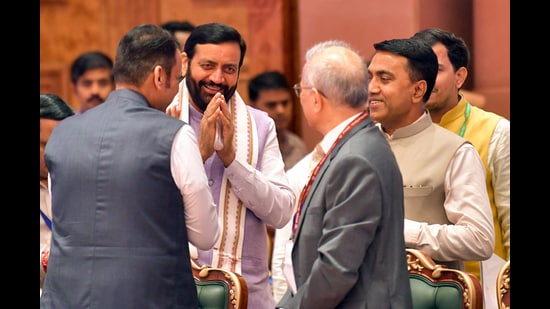
“Goods and Services Tax (GST) is a strong example of cooperative federalism in the country. Any reform that makes the system simpler for honest taxpayers while safeguarding revenue takes the country closer to the resolve of Viksit Bharat...Haryana will continue to work with the Centre and all states to fulfil the resolve of Viksit Bharat,” Saini said on Thursday while participating in the 57th meeting of the GST Council held in Delhi under the chairpersonship of Union finance minister Nirmala Sitharaman.
Saini said that even though Haryana is a small state, accounting for around 1.3% of the country’s total geographical area and around 2% of its population, the state collected gross GST of ₹10,097 crore in September 2026. “This is the fifth-highest collection among all states and accounts for more than 7% of the country’s domestic GST,” he said.
During the meeting, the CM put forward three proposals. In his first proposal, Saini suggested providing another one-time relief in the time limit for filing appeals against orders relating to the initial years of GST.
{{/usCountry}}During the meeting, the CM put forward three proposals. In his first proposal, Saini suggested providing another one-time relief in the time limit for filing appeals against orders relating to the initial years of GST.
{{/usCountry}}In November 2023, an opportunity to file appeals was provided for a limited period. In Haryana, there are 646 such cases in which appeals were rejected solely due to delay. These cases involve a demand of ₹567.43 crore.
“Behind these figures are taxpayers who want their cases to be heard on merits. A fair and sensitive tax system should consider their difficulty,” he said, adding that under the previous notification, an appeal was not permitted against a demand that did not include tax.
“Our suggestion is that the proposed relief should cover every kind of demand, including tax, interest and penalty. It should also cover cases where there is no tax component and the demand relates only to interest or penalty. For this limited relief, the council may consider recommending a special procedure under Section 148,” Saini said.
The second proposal related to difficulties arising from enforcement actions being undertaken simultaneously by central and state GST authorities. Saini said that taxpayers often have to face summons, investigations, inspections and other actions from both tax administrations on the same or interconnected issues.
He said that they are required to spend time and resources repeatedly submitting documents and presenting their case. “There should be a clear and practical mechanism for administrative coordination,” he said, proposing that a technology-based mechanism be developed for this purpose.
The CM put forward another proposal concerning cancellation of registration with retrospective effect. He said that under the existing law, the officer has the power to cancel registration from a date determined by the officer. There should be a condition attached to this power that registration should not be cancelled for a period for which there is evidence that the taxpayer had made supplies of goods or services. Such cancellation also puts at risk the input tax credit of genuine buyers who purchased goods or services from that taxpayer during that period, he said.
Welcoming new reforms being considered by the GST Council, he said that their objective is to usher in a new era of taxation based on system-driven risk assessment. These reforms also promote technology-enabled decision-making. He said that the proposals to increase the use of automation and technology in the processes of registration, amendment, cancellation and refunds are welcome and Haryana supports them.
“This will save the time and energy of tax officials, enabling them to focus on more productive tasks such as preventing tax evasion. It will also enhance transparency and make the system easier for genuine taxpayers,” he said and also supported the proposal for a simplified registration process for small taxpayers.
Haryana tops India with 22% SGST revenue growth: Saini
Saini said that in 2025-26, Haryana’s State Goods and Services Tax (SGST) revenue, including the state’s share in IGST settlement, increased from ₹39,743 crore to ₹48,289 crore. This 22% growth was the highest among all states, against the national average of 6%, he said, adding that during the first six months of the current year, state GST revenue has reached ₹29,108 crore. During the corresponding period last year, it stood at ₹23,058 crore. This represents a growth of 26%, which is the second-highest among the states, against the national average of 16%.