With 86 mm rain in just about 90 minutes at the Sector 39 observatory, Chandigarh roads were left inundated up to the berm, forcing residents to wade through knee-deep water even as two-wheeler riders were seen pushing their stalled vehicles while cars developed snags and clogged up the already choked roads.
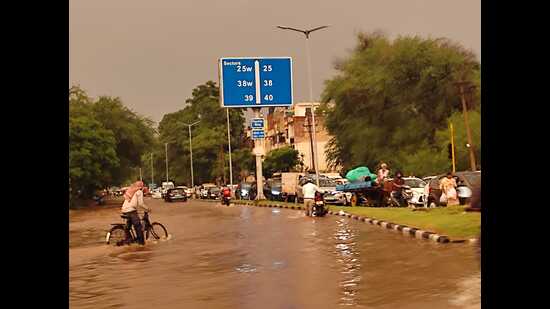
Massive traffic jams were seen, especially in the western sectors around Sector 38, 39, 40, and along the Madhya Marg in the North. Sectors 8, 9, 10, 18, 21 and 35 also reported massive snarls due to the unprecedented rain.
Many residents reported that their commute, which would take them about 20 to 30 minutes on a regular day, turned into hour-long ordeals. At several places, traffic police were spotted maneuvering the traffic as the traffic lights were turned off.
The downpour also caused widespread damage as a bridge inside Rose Garden collapsed and several trees were uprooted across the city.
The water levels in Sukhna Lake also rose close to the danger mark of 1,163 feet, following which, UT engineering department officials opened one of three floodgates to release the excess water into the Ghaggar through Sukhna Choe. Officials said the district administrations of the neighbouring districts were alerted before opening the floodgate.
This is the second time this season that a floodgate at Sukhna was opened – earlier it was opened for 12 hours on Wednesday. The department has also deployed its personnel at the regulator end, besides keeping tabs via closed-circuit television (CCTV) cameras, to assess the situation real-time.
{{/usCountry}}This is the second time this season that a floodgate at Sukhna was opened – earlier it was opened for 12 hours on Wednesday. The department has also deployed its personnel at the regulator end, besides keeping tabs via closed-circuit television (CCTV) cameras, to assess the situation real-time.
{{/usCountry}}5 Mohali villages cut off
Barely a day after the public works department (PWD) restored connectivity on the Jayantimajri–Gura–Kasoli link road, the bridge collapsed again on Thursday leaving five villages — Gurha, Bhagindi, Kasoli, Jayanti Majra, and Karondewala, completely cut off. The villages are located in Jayanti Majri block of Mohali district. The bridge had previously collapsed on August 4. Kharar PWD executive engineer Vivek Dureja said teams equipped with manpower and machinery had been deployed to restore connectivity. “Temporary access has been resumed to facilitate traffic movement, and a permanent solution will be implemented soon,” he added.
Airport observatory recorded trace rain
While the India Meteorological Department (IMD) had to sound a red alarm – highest of the four coloured warning system– amid the heavy rain and thunderstorm on Friday evening, the airport observatory recorded only trace rain. Scientist at IMD Chandigarh Shivinder Singh explained it was more of a localised phenomena. “However, since the rain spell happened in the space of around two hours, this made it a very intense spell of rain. Such a high rate of rainfall leads to severe waterlogging and more problems than the same amount of rain recorded over 24 hours rather than two hours.”
IMD Chandigarh director Surender Paul said, “The downpour was caused by the mercury rise over the past two days, which led to high humidity.”
Singh said another stronger system is expected around Monday. Despite the rain, the maximum temperature rose from 34.8°C on Thursday to 35.8°C on Friday, 2.4 degrees above normal. The minimum temperature rose from 23.5°C on Thursday to 26.2°C on Friday, 1 degree below normal. Over the next three days, the maximum temperature will remain around 33°C while minimum temperature will remain around 25°C.