E-Paper



Allegations fly thick and fast as Omar Abdullah, Mehbooba Mufti continue to spar
Former CMs Omar Abdullah and Mehbooba Mufti are in a war of words over the Jamaat’s decision to contest the J&K elections

 Prefer HTon Google


Former chief ministers Mehbooba Mufti and Omar Abdullah have found themselves locked in a war of words in the lead-up to the assembly polls. Now, Islamic terms like “halal” and “haram” have made their way to the discourse.
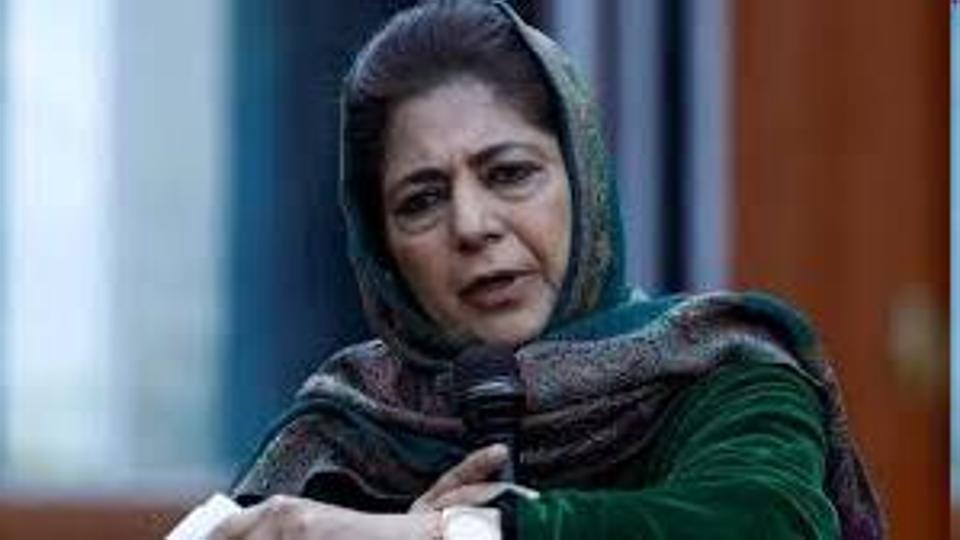
Mufti, the Peoples Democratic Party president while talking to media, alleged that the National Conference (NC) was the first to use the terminology with vice-president Omar taking a jibe at the banned Jamaat-e-Islami (JeI)for deciding to fight the upcoming assembly elections, saying what was once “haram” was now being considered “halal”.
Broadly, in Islamic terminology, “halal” is a permitted practice while “haram” is anything prohibited.
“I am surprised that NC considers J&K as its ‘saltanat (kingdom)’. They started the ‘halal/haram’. In 1947, when Sheikh Mohammad Abdullah (NC founder and Omar Abdullah’s grandfather) was made chief administrative officer, then the election was ‘halal’. When he became prime minister, it was again ‘halal’. When he was removed, for 22 years, elections became ‘haram’... And when in 1975, he became chief minister, elections became ‘halal’ again for him,” Mufti said when asked about Omar’s statement on Jamaat.
Mufti went on to add that elections are “halal” when they are elected to power and “haram” when they lose. She added that the JeI was not fighting the elections for the first time in Jammu and Kashmir: “Syed Ali Geelani was a part of the election process way back.”
“But who made the elections ‘haram’ for JeI in 1987 or for MUF (Muslim United Front)? NC rigged the election in 1987 as they wouldn’t want any third force in the elections as they had already made up with Congress. Rigging closed the doors of elections for other parties with MUF,” she said.
Jamaat was the key party of the MUF, an amalgam of different parties against NC, in the 1987 elections which later alleged that elections were heavily rigged. The alleged rigging caused disaffection among a section of the populace in the valley setting the conditions for a full blown insurgency in J&K in 1989.
The members of JeI, banned by the Centre in 2019 for five years owing to its alleged ties with militant groups, have now again decided to fight the assembly elections. At least five former members have filed nominations in the first phase for which elections will be held on September 18.
Omar had earlier welcomed Jamaat’s decision to fight elections but took a stance against their stand of boycotting elections during militancy. “It was previously said that elections are ‘haram’. Well, better late than never. Now, elections are considered haram and everyone is encouraged to participate. We have always said that whatever happens should be through democratic means. The change in Jamaat-e-Islami’s political stance over the past 30-35 years is not a bad thing,” he had said.
Former Srinagar mayor Junaid Azim Mattu, who recently quit the Apni Party, castigated both NC as well as PDP for their contradictions in declaring what is “halal” and “haram”.
“More recently, the ULB (urban local body) polls in 2018 were “Haraam” for the NC and PDP both — polls which they boycotted to make some point which clearly didn’t save us from the constitutional assault of 2019,” he said.
“The traditional mainstream as a whole is full of contradictions. Contradictions in other States have political consequences — in Kashmir they cost lives and rob entire generations of peace and stability. And this is a cost incurred on the hapless people of Kashmir by our traditional mainstream — proclaiming things to be Halal when it suits them and Haram when it doesn’t,” Mattu said on X.
Jamaat’s proximity to PDP had been a topic of discussion in the past, with the 2002 elections seeing opponents allege that Jamaat’s backing had helped PDP form a coalition government with Congress under the leadership of Mufti Mohammad Sayeed.