
 E-Paper



City Beautiful’s clean air rank plummets to 31
Chandigarh’s Swachh Vayu Survekshan rank slides nine spots from 22nd position last year; national capital Delhi fares better, ranking 11th


Despite the pollution control committee and municipal corporation’s ongoing plans to enhance the city’s air quality, Chandigarh has fallen to a disheartening 31st place out of 47 cities with population over 10 lakh in the Swachh Vayu Survekshan 2024.
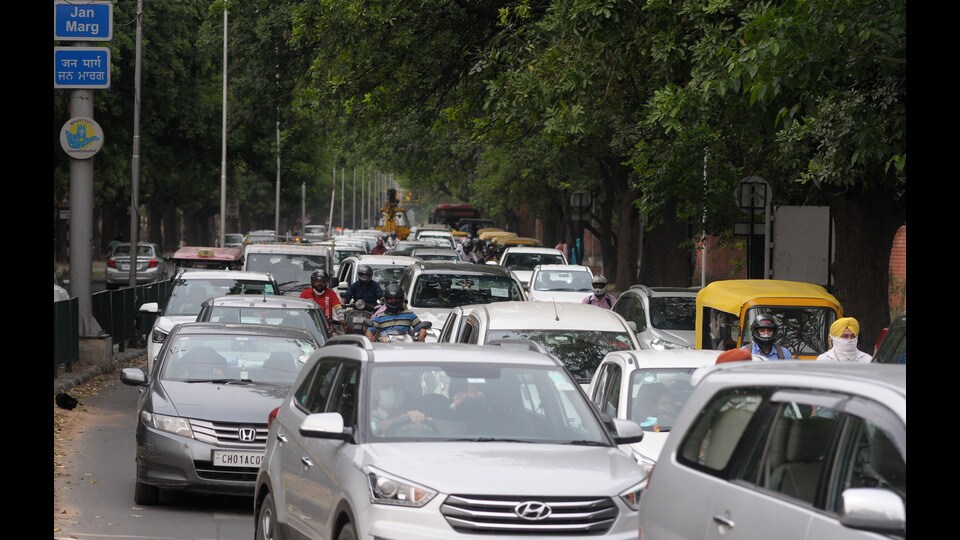
This marks a significant drop from its already dismal 22nd position last year, slipping nine spots.
The Union ministry of environment, forest and climate change released the results on Saturday, coinciding with International Day of Clean Air. These rankings are aimed at helping city authorities comprehend their city’s progress and achieve targeted actions towards cleaner environment.
The survey is conducted by the Central Pollution Control Board under the ministry’s National Clean Air Programme (NCAP), assessing cities’ performance over a financial year.
According to the ministry’s report, in cities with over 10 lakh population, Surat bagged the first spot, followed by Jabalpur and Agra. National capital Delhi performed better than Chandigarh, ranking 11th.
In Punjab, in the same population category, Ludhiana and Amritsar ranked 35th and 43rd, respectively.
The top city receives a cash prize of ₹1.50 crore, the second place gets ₹1 crore and the third spot earns ₹50 lakh.
According to the environment ministry, the rankings are not based on the measurement of air quality parameters but on actions taken by the cities to improve air quality in different domains and the improvements resulting from these steps.
A total of 130 cities were surveyed, divided into three categories based on population.
Apart from 47 cities in the first group having population more than 10 lakh, 43 were in the second group having population between 3 and 10 lakh and 40 in the third group with population less than 3 lakh.
The cities’ civic authorities had submitted self-assessment reports on the actions taken by them under the NCAP.
The self-assessment report was based on eight parameters: biomass and municipal solid waste burning (20 marks), road dust management (20), management of dust from construction and demolition waste (5), control of vehicular emissions (20), measures to abate emissions from industries (20), measures to check other emissions (10), public awareness programmes (2.5), and improvement in PM 10 concentrations in the past one year (2.5). The total marks were 200. The parameter-wise scores are yet to be released.
Chandigarh’s score drops by 18 marks
This year, Chandigarh scored 156 marks, down from 174 last year, contributing to its drop from 22nd to 31st place. Surat led with 194 marks, Jabalpur came second with 193 and Agra was ranked third with 190.
This bleak rank is a setback for Chandigarh, where the local pollution control committee and municipal corporation (MC) has been devising plans to improve air quality, which has shown high concentration of particulate matter over the years.
On its end, MC has been working on setting up fog fountains at three major roundabouts under its jurisdiction to contain air pollution, especially post Diwali, as rotaries see high traffic volume, where traffic is slow and emissions are maximum.
The shortlisted roundabouts are all on Udyog Path, including the Sector 17 ISBT chowk, Sectors 18/19/20/21 chowk and Sectors 27/28/29/30 chowk. Through fog fountains, atomised water is used to settle down vehicle emissions and road dust.
Three years ago, even the Chandigarh Pollution Control Committee (CPCC) had installed a 24-metre-tall air purification tower at Transport Area in Sector 26. But despite an electricity bill running up to ₹30,000 per month, the project proved to be a damp squib, proving effective only for a few metres close to the tower. Thus, the city is unlikely to get more such towers in future.
Also, with the efforts of the UT department of forest and wildlife, half of the City Beautiful is now under green cover, as per a Forest Survey of India report. The cover, which encompasses all forms of vegetation within the city and the Sukhna Wildlife Sanctuary, went up from 41% to 50.05%, growing by 9% in the six-year period between 2017-2023.
The department distributes saplings free of cost to local residents, encouraging active participation in enhancing the city’s green environment, thereby improving the air quality.
Besides under the Greening Chandigarh Action Plan (GCAP) prepared annually by all relevant agencies, including the forest department, horticulture wing of the UT engineering department and MC, each department sets an annual target for plantation to boost the city’s greenery.
However, though the administration is working on various projects to cut down vehicular emissions, including rolling out an Electric Vehicle policy; road dust, which contributes to the city’s air pollution as much as vehicular emissions, is being ignored, as per CPCC officials.
Road dust is generated while sweeping dry roads and a cloud of dust can also be seen during cleaning by MC vehicles, if driven faster than 10km per hour on dry roads. Movement of vehicular traffic, including electric vehicles, also contributes to a large percentage of road dust, whose management constitutes 20 marks in the annual Clean Air Survey.


