Ahead of Diwali, air quality across several districts of Haryana, particularly in the National Capital Region (NCR), has deteriorated significantly despite restrictions on older, polluting vehicles. The rising AQI readings highlight that vehicular emissions are just one part of a larger pollution crisis driven by industrial emissions, construction dust, waste burning, crop residue burning, and stagnant weather conditions.
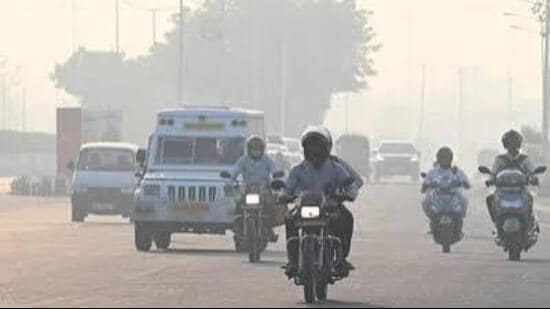
According to the Central Pollution Control Board (CPCB) data provided for the period, six cities in Haryana have recorded Air Quality Index (AQI) levels above 300, placing them in the “very poor” category, while several other cities have reported readings above 200, indicating “poor” air quality.
The worsening situation has raised concerns over the effectiveness of the measures being implemented to control air pollution, particularly in the NCR districts of Gurugram, Faridabad, Sonepat, Jind, and Jhajjar.
Among the worst-affected cities, Bahadurgarh recorded an AQI of 365, followed by Jind at 354 and Ballabgarh at 353. Kaithal registered an AQI of 326, Gurugram 322 and Manesar 318. All six cities have entered the “very poor” category, reflecting a substantial deterioration in ambient air quality.
The situation is equally concerning in several other parts of the state, where air pollution has crossed the 200-mark threshold. Panipat recorded an AQI of 295, while Ambala and Rohtak registered 294 each. Bhiwani reported an AQI of 280, Hisar 278, Charkhi Dadri 245, Dharuhera 243, Kurukshetra 239, Sonepat 237 and Yamunanagar 237. Karnal also reported an AQI of 218, placing it in the “poor” category.
{{/usCountry}}The situation is equally concerning in several other parts of the state, where air pollution has crossed the 200-mark threshold. Panipat recorded an AQI of 295, while Ambala and Rohtak registered 294 each. Bhiwani reported an AQI of 280, Hisar 278, Charkhi Dadri 245, Dharuhera 243, Kurukshetra 239, Sonepat 237 and Yamunanagar 237. Karnal also reported an AQI of 218, placing it in the “poor” category.
{{/usCountry}}With Diwali approaching, the possibility of a further deterioration in air quality due to firecrackers, agricultural residue burning and unfavourable weather conditions has added to the concerns of residents and environmental experts.
Air quality worsens despite strict vehicle restrictions
The deterioration comes despite regulatory measures aimed at reducing vehicular emissions in the NCR. Restrictions on the movement of BS-III petrol and BS-IV diesel light motor vehicles have been imposed in high-vehicle-density districts, including Gurugram and Faridabad, under pollution-control measures.
Such restrictions have also been extended to Sonepat under the revised GRAP framework approved by the Commission for Air Quality Management (CAQM) in September 2026. However, the restrictions are intended to reduce emissions from older vehicles, which are considered a significant source of particulate matter and other air pollutants in densely populated urban areas.
However, the worsening AQI readings indicate that vehicular emissions are only one component of the larger pollution challenge. Industrial emissions, construction activities, road dust, waste burning, agricultural residue burning and unfavourable meteorological conditions also contribute to deteriorating air quality across the region.
Satellite data reveals 4,333 stubble-burning incidents across 7 states
Agricultural residue burning continues to be one of the key seasonal concerns. According to the latest data from the Consortium for Research on Agroecosystem Monitoring and Modeling from Space (CREAMS), satellites detected a total of 4,333 stubble-burning incidents across seven states between September 15 and November 3, 2026. Punjab accounted for the highest number of incidents at 2,196, followed by Rajasthan (838), Madhya Pradesh (708), Uttar Pradesh (359), Uttarakhand (178), Haryana (52), and Delhi (2).
There were 798 residue burning events across the six study states on November 3 alone. According to the CPCB bulletin, an AQI between 201 and 300 indicates “poor” air quality, which can cause breathing discomfort to people exposed to the polluted air for prolonged periods. The “very poor” category, ranging from 301 to 400, can cause respiratory illness upon prolonged exposure, even among otherwise healthy individuals.