
 E-Paper



Himachal braves troubled waters in bid to revive fish population
Fish production has drastically declined after last monsoon flooding in rivers, reservoirs and farms

 Prefer HTon Google


One year after flooding wreaked havoc along the banks of major rivers and its tributaries, Himachal’s fisheries department is making strenuous efforts to revive the exotic fish population in the different rivers.
Looking to rejuvenate the aquatic ecosystem and boost angling tourism, the department has released over 21,000 rainbow trout fingerlings into the Pabbar river, a tributary of the Yamuna.
Notably, around 6,020 fishermen in the state depend directly on reservoir fisheries for their livelihood.
Pabbar emanates from the 14,830 feet high Chanshal Pass in Rohru subdivision before merging with Tons, another tributary of the Yamuna at Kuddu. Trout was introduced in Pabbar River by the chief conservator of forest Glover in 1938 and has thrived in the river along with local Schizothoracids since.
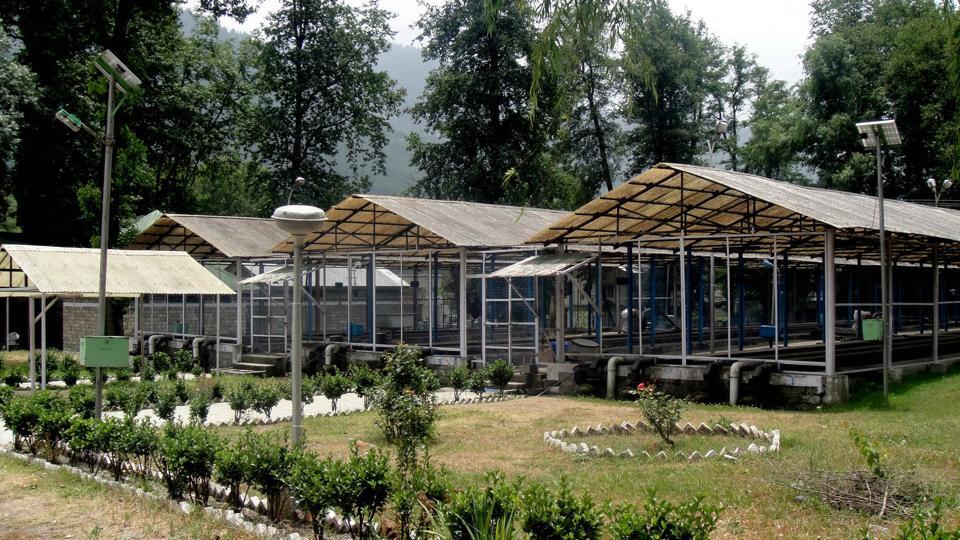
The department had set up a farm in Dhamwari to help improve the fish population, but it was destroyed in last monsoon’s flooding.
There are in all 12 fish seed farms under the department’s control, of which, six are trout farms and another six carp farms. Trout farms have been set up in Patlikuhl in Kullu district, Barot in Mandi district, Holi in Chamba, Dhamwari in Shimla , Sangla in Kinnaur. A majority of them, however, also bore the impact of flooding.
After the flooding impacted the fish population, the department has been making efforts to revive the fish production in the reservoirs, dams and rivers and introduced 16,000 fingerlings of rainbow trout near Dhamwari in Rohru
“Our intention is to rejuvenate all possible fisheries resources in the state so the ecosystem balance and biodiversity is maintained and sustainable livelihood is provided to the people living in the remotest areas,” fisheries secretary Priyatu Mandal said, adding that the department was working hard to reach every nook and corner of the state.
“Our aim is to provide technology for trout fishing and farming in the remote areas of the State so that the livelihood of people residing there can be improved,” he added.
The fisheries department released another 5,200 fingerlings at Gosango at the remote Dodra Kwar on the Rupin river, another tributary of the Pabbar. The feat required the team to traverse the challenging Chanshal Pass, situated at an altitude 14,830 ft.
“The successful completion of the mission underscores the department’s dedication to comprehensive ecological restoration, even in the most hard-to-reach areas,” assistant director fisheries Nitin Mahant said.
Sensing an opportunity
The Pabbar Trout Farmers Self-Help Group, a voluntary organisation, welcomed this move.
“Angling tourism will bring more footfall and awareness for the farmed fish also being produced in the region. We requested the department to arrange a training for fish processing for our group as trout is a highly perishable commodity and collective processing will really help the farmers make their ventures profitable,” committee vice-chairperson Yashwant Chauhan said, adding that angling sites for recreational fishing have also come up at spots.
The fishery is a crucial sub-sector and the state government has given priority to the promotion of pisciculture. To further facilitate the efforts, the state introduced the Himachal Pradesh Fisheries Rules, 2020.
By strategically harnessing these resources, the state aims to significantly increase fish production through capture, culture and culture-based capture fisheries.


