The ambitious project of the Hindustan Petroleum Corporation Limited (HPCL) to set up a second generation (2G) bio-refinery, a first-of-its-kind project in India, to tackle the problem of paddy stubble burning in Punjab, has missed two deadlines of commissioning.
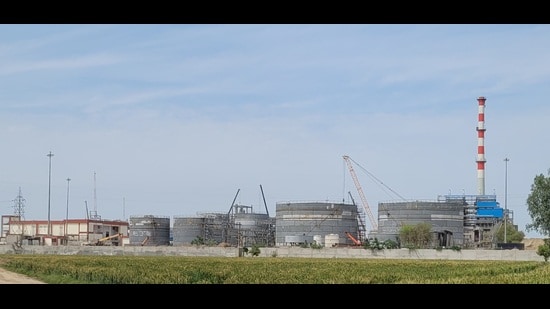
Coming up at Naseebpura village, about 20 km from Bathinda district headquarters, the ₹1,400 crore bio-refinery is designed for the utilisation of paddy straw for ethanol production for blending with petrol under the Central government’s programme.
Paddy sowing has commenced in Punjab on June 11. Residue management of the key kharif crop remains a burning issue every year. A sizeable section of farmers resort to burning stubble of non-basmati varieties, triggering air pollution in October-November every year.
The Centre as well as Punjab and Haryana have come up with solutions for in-situ management, involving incorporation of stubble into the soil, and ex-situ management involving lifting stubble from fields and supplying it to stubble-based industrial units.
The HPCL project is aimed at a model initiative to push ex-situ management of the rice straw. The designed production capacity of this 2G ethanol plant is 100 kilo litre (KL) ethanol per day. For this purpose, 570 MT of paddy straw will be utilised per day or two lakh tonnes annually when the plant operates at its full capacity.
Official sources said the plant was first scheduled to start by March-end but then the HPCL postponed it to June 1. The HPCL sourced about one lakh tonne paddy stubble in 2023 but to date it is unable to start operations.
{{/usCountry}}Official sources said the plant was first scheduled to start by March-end but then the HPCL postponed it to June 1. The HPCL sourced about one lakh tonne paddy stubble in 2023 but to date it is unable to start operations.
{{/usCountry}}Bathinda agriculture officer Baljinder Singh, who is coordinating to extend support to the mega project, said on Wednesday that the HPCL had not shared the reason behind the delay. “The department of agriculture is ready to support in sourcing paddy stubble from farmers to make the plant functional as it is aimed at offering a green solution for disposal of the crop waste,” he said.
Meanwhile, HPCL officials associated with the project said they had not been authorised to issue any press statement. HPCL’s executive director (communications) Rajeev Goel did not respond to repeated messages about the delay. At the same time, officials familiar with the project said the HPCL was expected to handle paddy residue produced from about 40,000 hectares in the Bathinda district.
After procuring approximately one lakh tonnes of biomass, the HPCL is planning to double the stock for smooth operations. “This unit is still in the testing phase and it may take another 2-3 months to be operational. Its success can be adopted by other states and agencies to convert the waste biomass into an asset for the petroleum sector,” said a functionary, requesting anonymity.