
 E-Paper



Loose soil, soft rocks make Shimla vulnerable, expert team finds
, the five member expert committee constituted by the state government to ascertain the reason for sinking of land said the town suffered heavily because of loose soil strata


With rain-triggered landslides bringing Shimla to its knees, the five member expert committee constituted by the state government to ascertain the reason for sinking of land said the town suffered heavily because of loose soil strata.
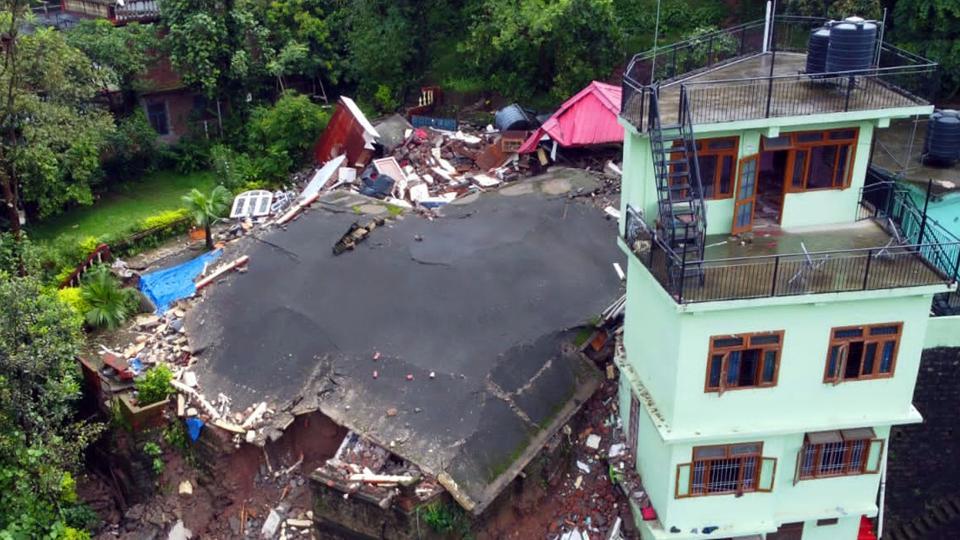
The panel, formed after 17 lives were lost in landslide after landslide in Sangti on August 15, on Thursday shared the preliminary findings.
The committee has so far visited as many as eight sites, which include the sinking zones, Krishna Nagar, Majithia House, Fagli, Tuttikandi , Shivpuri, Jutogh opposite Saint Edwards School, Sangti where 17 persons were buried in a landslide.
Speaking of the findings, a member of the panel said, “Actually, in different places the factors behind the sinking of land are different. We have studied that up to a large extent soil strata are also responsible for sinking of lands.”
“Like in Krishnanagar area we found the Black soil which has coal and ash like content in it that we are studying,” he added.
The member who did not wish to be named said Shimla has many water bodies in the fracture and people have constructed houses and buildings on it, adding that the majority of the rocks in Shimla were metamorphic.
Elaborating, the member said, “Metamorphic rocks evolved from their original igneous, sedimentary, or earlier metamorphic form over time. They are formed when the rocks are subjected to high heat, high pressure, hot mineral-rich fluids or, more commonly, some combination of these factors.”
Himachal Pradesh Council for Science, Technology and Environment (HIMCOSTE) principal scientific officer Dr SS Randhawa had been appointed as the coordinator of the committee.
Other members include state geologist Puneet Guleria, representatives from public works, jal shakti department, the municipal corporation and a representative from the Shimla deputy commissioner’s office.
The committee has been tasked with submitting its comprehensive report to the government within a week. This report will be a pivotal source of information for the formulation of a robust policy aimed at mitigating and preventing the devastating impact of landslides in Shimla.
According to a notification issued by revenue department’s principal secretary Onkar Sharma, the government is steadfast in its commitment to safeguarding the residents and the region’s infrastructure from the ominous threat posed by landslides.
The need for proactive measures is highlighted by studies conducted by the National Disaster Management Authority, revealing that a substantial area of 38,000 sq km in the state is susceptible to landslides. Of this, around 7,800 sq km is deemed to be at high risk.


