Around 10,000 small and medium industrial units in 72 mixed land use (MLU) localities, where residential, commercial and certain industrial activities coexist, face uncertainty as the policy permitting their operation expires on September 30. Industry leaders are seeking an extension, saying the units cannot be relocated without suitable industrial land and any disruption could affect lakhs of workers and the city’s larger cycling and sewing-machine industries.
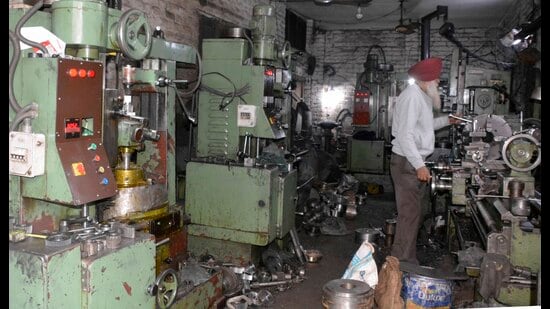
The units manufacture essential components for larger factories, particularly those in Ludhiana’s cycling and sewing-machine industries.
Industry leaders said the small factory owners lacked the financial capacity to shift to new industrial areas without government support.
Federation of Industrial and Commercial Organisation (FICO) president Gurmeet Singh Kular said industry representatives had approached the state government for an extension but had not received a response. He said they had been seeking a meeting with Industries and Commerce Minister Aman Arora for the past four days, but the proposed meeting had been repeatedly postponed.
The issue dates back to 2008-09, when the SAD-BJP government introduced the policy after industrialists complained of difficulties in running units established in residential areas. The policy gave such industries 10 years to relocate while the government prepared master plans and developed alternative industrial areas.
“The Akali Dal government brought this policy then to enable smooth functioning of these factories that form the backbone of the city’s industrial power,” Kular said.
{{/usCountry}}“The Akali Dal government brought this policy then to enable smooth functioning of these factories that form the backbone of the city’s industrial power,” Kular said.
{{/usCountry}}The government was expected to develop an alternative industrial area around Ludhiana where these units could relocate. Dhanasu was identified as a possible alternative, but the industrial area could not be developed within the stipulated period.
The Congress government subsequently extended the deadline by five years in 2018-19. The AAP government granted another three-year extension in 2023-24. The latest extension expires on September 30, 2026.
“If the policy isn’t given an extension, the pollution control board will start shutting down these factories soon,” Kular said.
He said the immediate solution was to extend the policy, while a suitable industrial area should be developed around Ludhiana in the long term. Kular said the state budget this year had no provision for the latter, but the government could at least extend the existing policy.
Kular said any disruption to these units could not only put lakhs of workers out of work but also affect larger factories that depend on them for essential components.
Chamber of Industrial and Commercial Undertakings (CICU) president Upkar Singh Ahuja said there was uncertainty over the future of the factories and urged the government to introduce a new policy. “These are very small factory owners. These people do not have the capacity to shift to a new industrial area, so it would be prudent if the government was to declare the areas where these factories exist as an industrial area,” Ahuja said.
After September 30, units that have not relocated could face difficulties in obtaining or renewing their Consent to Operate (CTO) from the Punjab Pollution Control Board (PPCB), according to industry representatives.
Industry organisations, including FICO, are seeking a permanent policy for established industrial pockets in MLU areas, maintaining that these units cannot be expected to relocate without suitable industrial land being made available.
State minister for industries and commerce Aman Arora did not immediately respond to calls and messages seeking comment.