
 E-Paper



Lumpy skin disease: Punjab sees 160 cattle deaths, 12,000 infections in a month
In Muktsar, about 100 cattle have died due to lumpy skin disease -like symptoms while 1,000 animals were found infected, said senior veterinary officer Dr Gurdit Singh


BATHINDA : Five heads of cattle have died every day in Punjab due to lumpy skin disease (LSD) since July 4 this year, when the first such case was reported in the state. According to the database of the state animal husbandry department, an average of 400 cases of the disease caused by a virus called Capripoxvirus, were reported every day from various districts till August 4.
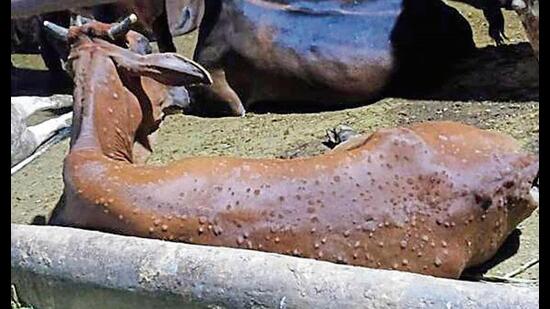
In Muktsar, about 100 cattle have died due to LSD-like symptoms while 1,000 animals were found infected, said senior veterinary officer Dr Gurdit Singh. “Teams are working to contain the situation,” he added. It is for the first time that Punjab has witnessed the LSD outbreak that affects livestock. Experts say it is premature to conclude when the disease can be controlled fully.
Malwa region is the worst hit as the entire state, except Rupnagar and Kapurthala, is under the grip of this highly contagious disease.
Officials said cases are pouring in every day and the trend suggests that mainly cows are getting infected by the virus and the buffalo population has a marginal LSD infection rate.
Dr Ram Pal Mittal, joint director of animal husbandry department and the state nodal officer to contain the outbreak, said till now 12,000 confirmed cases of LSD have been reported, in which 160 cattle died due to infection till Thursday.
“Fazilka and Bathinda were the first to report confirmed LSD cases on July 4. Since then, livestock population in the rest of the state started showing symptoms of the disease. Treatment of animals should be undertaken as per the symptoms,” said Mittal. LSD infects cattle mainly through vectors such as blood-feeding insects.
The main symptoms are fever in animals, discharge from the eyes and nose, salivation from the mouth, soft blisters like nodules all over the body, reduced milk production, and difficulty in eating, which sometimes lead to death of animal, said the experts.
Mittal said field inputs suggest that cattle in the gaushalas or cattle sheds are responding better to the treatment than the livestock kept at dairy farms or homes.
“Mortality rate due to LSD is about 1% and dairy farmers need not panic. They should stick to recommendations of the department to keep animals in hygienic conditions and restrict movement of new animals or humans managing the livestock,” added Mittal.
Official information says Muktsar, Fazilka and Barnala are the worst-hit districts.
Deputy director of the animal husbandry department Dr RK Chhabra, who is posted in Fazilka, said 28 cattle have died in one month in the district that shares boundaries with Rajasthan.
“Of all deaths, 17 cattle were at various gaushalas. These mortalities may be related to ailing animals as LSD lowers immunity levels,” said Chhabra.
Head of Bathinda’s animal husbandry department, Dr Rajdeep Singh said farmers should sanitise cattle sheds by eliminating vectors through the application of insecticides and spraying disinfectants. The farmers should isolate infected cattle immediately from the healthy stock and contact the nearest veterinarian for treatment of the infected animal, Dr Singh added.


