Jammu and Kashmir chief minister Omar Abdullah on Friday said the union territory’s perception problem was a legacy issue of the past three decades and invited companies to set up global capability centres (GCCs) in the union territory.
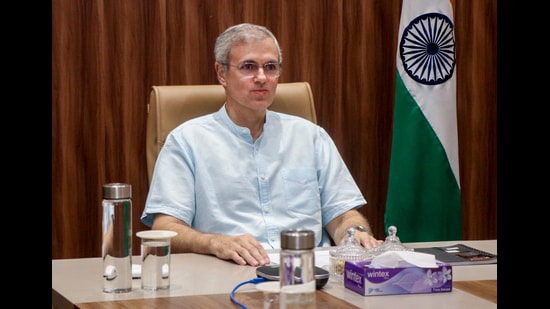
Omar was speaking while virtually addressing a two-day J&K global capability centres summit 2026 organised by the Indian Institute of Management (IIM) Jammu, in collaboration with the J&K government and Nasscomm as knowledge partner.
Recalling an interaction between former CM Mufti Mohammad Sayeed and Infosys founder N R Narayana Murthy at an investment event organised by NASSCOM in Srinagar during 2002-2005, Omar said the latter had then linked investment to peace and stability in the region.
“Mufti Sahib, in his speech, told Narayan Murthyji that now that you are here, please set up something of Infosys in J&K. And Narayan Murthy Sahib replied... you give me six days of peace and calm and on the seventh day I’ll come and invest,” Omar said while addressing a workshop on GCCs virtually.
“Thankfully today, we don’t count our periods of calm in days, we don’t count them in weeks, we don’t even count them in months. I think it’s safe to say that we count them in blocks of years,” he said. Omar said the success of creating a business-friendly environment should not be measured by the number of centres established immediately, but by the beginning of a sustainable investment journey.
{{/usCountry}}“Thankfully today, we don’t count our periods of calm in days, we don’t count them in weeks, we don’t even count them in months. I think it’s safe to say that we count them in blocks of years,” he said. Omar said the success of creating a business-friendly environment should not be measured by the number of centres established immediately, but by the beginning of a sustainable investment journey.
{{/usCountry}}Acknowledging the perception challenges facing J&K, the CM said these were rooted in the region’s past and not its present, adding that the government was making efforts to change the narrative through economic development and investment.
He said J&K could learn from the experiences of other regions and use its late entry into the GCC sector to its advantage.
Drawing a parallel with the evolution of railway services in India, he said J&K had entered the railway network with the Vande Bharat trains, bypassing earlier stages of development.
“Coming late to the party is disappointing, but it’s not always disadvantageous. We can learn from the experiences of others. We don’t have to reinvent the wheel. We just have to use it better,” he said.
He said J&K was not in a position to compete immediately with established IT hubs such as Hyderabad, Bengaluru, and Chennai, but could explore opportunities to attract GCC investments in competition with tier-II and tier-III cities such as Jaipur, Pune, and Mohali.
He said the UT had inherent advantages, including a network of reputed educational institutions that produce talented young people with a strong academic foundation.
Institutions such as IIT Jammu, Shri Mata Vaishno Devi University, the University of Jammu, the University of Kashmir, and the Islamic University of Science and Technology were producing talented youth, he said.
However, due to a lack of adequate opportunities, many of these young people were compelled to seek employment in the GCC sector outside Jammu and Kashmir, he added.