With thousands of protesting farmers marching towards Delhi on their tractors and trucks, well-stocked for a long haul, Punjab’s industry is wary of a repeat of their 2020-21 agitation during which roads were blocked and trains stopped.
The state industry was hit hard by the 13-month-long stir against the farm laws, and the disruptions caused by the standoff between farmers’ Delhi Chalo call and the Haryana police, which is trying to stop them from heading to the National Capital, over the past two days, have refreshed their memories of the tough times they faced three years ago. According to industry associations, the blockades on national highways have started affecting the movement of goods, and a re-run of those protests will hurt the industry and businesses in the state.
Upkar Singh Ahuja, president, Chamber of Industrial and Commercial Undertaking (CICU), said the industry has already started feeling the heat. “In the auto sector for instance, we supply auto component to tractor, car and two-wheeler companies located in other parts of the country. They have become unsure whether their supply requirements will be met on time or not. We are already getting queries,” he said, raising a red flag. Punjab has more than 5,000 companies manufacturing auto components.
PHDCCI’s Punjab chapter chairman RS Sachdeva said that there was panic in industry in the state due to risks associated with farmers getting into protest mode. He said the road closures and the resultant detours are leading to more time and distance for movement of raw material and finished goods. “The supply chain has started getting affected and productivity will also be hit very soon if the protests escalate,” he said, urging the central government and farmers to resolve the issue through dialogue at the earliest to avoid a repeat of the earlier stir.
{{/usCountry}}PHDCCI’s Punjab chapter chairman RS Sachdeva said that there was panic in industry in the state due to risks associated with farmers getting into protest mode. He said the road closures and the resultant detours are leading to more time and distance for movement of raw material and finished goods. “The supply chain has started getting affected and productivity will also be hit very soon if the protests escalate,” he said, urging the central government and farmers to resolve the issue through dialogue at the earliest to avoid a repeat of the earlier stir.
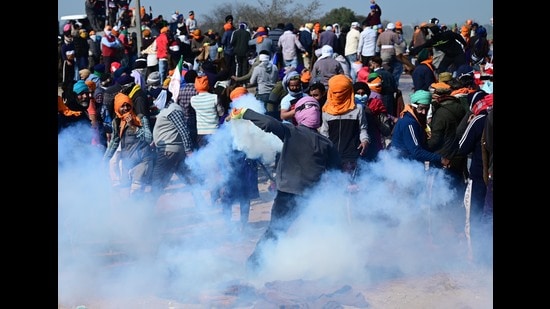
{{/usCountry}}However, the ongoing agitation led by the Sanyukt Kisan Morcha (non-political) and Kisan Sangharsh Mazdoor Morcha appears set to intensify after the police in Haryana fired tear gas on farmers marching to Delhi to stop them from entering the state. Several other farmer unions, which were not part of the Delhi Chalo plan, have decided to hold protests on rail tracks and at toll plazas on Thursday to show their solidarity. While BKU (Ugrahan) has announced that its activists would sit on rail tracks at seven places in Punjab, another group, the Samyukt Kisan Morcha, has decided to make the toll plazas free for three hours. BKU (Ugrahan) and SKM, which comprises 37 farmer organisations, had led the 2020-21 stir. The state industry had suffered heavy losses then.
CII’s northern region export task head Amit Thapar said the move to block rail tracks will only make things worse, especially for the industry units in Ludhiana. “We were hoping this (stir) does not continue for long and does not affect goods movement, but this is bad news. If these blockades prolong, the supply chain will get disrupted. Not a good sign for exports,” he said, echoing the dominant mood in the industry.
Badish Jindal, chairman of Federation of Punjab Small Industries Association (FOPSIA), said that customers are cagey and logistics and raw material costs have started going up. “The protest is led by Punjab farmers for their rights, but it should not hurt industry in the state. We have conveyed this to SKM,” he said.