
 E-Paper



Punjab monsoon session from August 3 to 10
Bills to amend anti-sacrilege law, cap school fee hikes likely to be introduced; the decision to convene the 13th session of the 16th Punjab Vidhan Sabha next month was taken at a cabinet meeting on Tuesday

 Prefer HTon Google


The monsoon session of the Punjab Vidhan Sabha, during which the state government is expected to introduce a bill to amend the anti-sacrilege law, will be held from August 3 to 10.
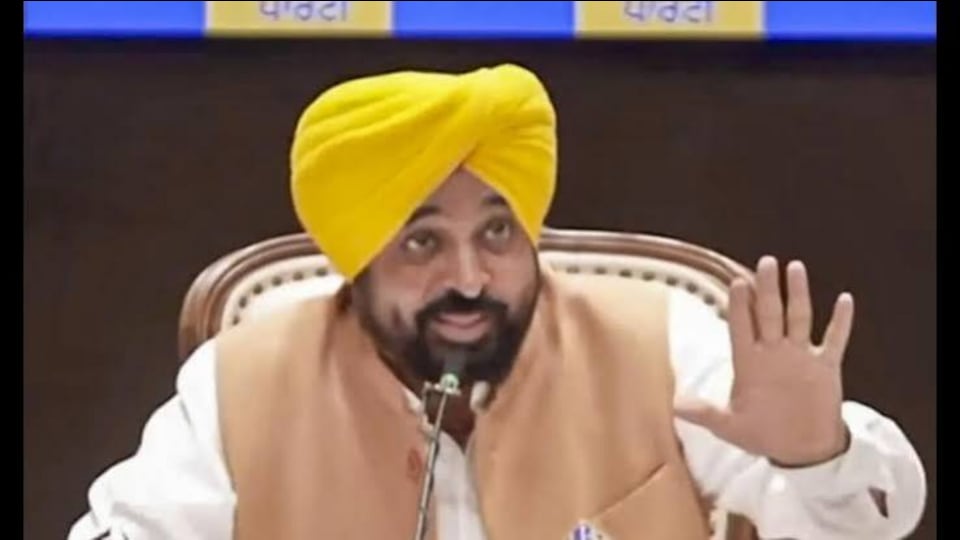
The decision to convene the 13th session of the 16th Punjab Vidhan Sabha next month was taken at a cabinet meeting held here on Tuesday under the chairmanship of chief minister Bhagwant Mann. Under clause (1) of Article 174 of the Constitution of India, the governor is empowered to summon the state legislature to meet at such time and place as he deems fit.
Addressing a press conference after the cabinet meeting, Mann said the state government had referred the suggestions made by Akal Takht acting jathedar Giani Kuldeep Singh Gargaj regarding the newly enacted Jaagat Jot Sri Guru Granth Sahib Satkar Act to the Punjab advocate general for legal opinion. “We are talking to the Shiromani Gurudwara Parbandhak Committee on this issue. The Akal Takht’s suggestions have been sent to the advocate general’s team for legal opinion. If the AG recommends, we will make the changes,” the CM said in response to a media query.
The anti-sacrilege law, passed by the state assembly on April 13 and subsequently assented to by the governor, provides for stringent punishments, including imprisonment up to life and fines up to ₹20 lakh for criminal conspiracy to desecrate a “saroop” of the Guru Granth Sahib. However, some clauses of the Act drew objections from the Akal Takht and some other Sikh organisations. On June 29, the Akal Takht gave a one-month ultimatum to all Sikh MLAs to remove objectionable provisions from the Act and suitably amend the law. The directive was issued after a two-hour hearing, where legislators cutting across party lines appeared before the five Sikh high priests to explain the lack of consultation with the SGPC and other religious institutions prior to the bill’s passage.
Mann also said that several bills would be taken up during the upcoming session. The state government is also likely to introduce a bill in the upcoming monsoon session to replace ‘The Punjab Regulation of Fee of Unaided Education Institutions (Amendment) Ordinance, 2026’.
Nod to police recruitment rules
The cabinet also gave nod to amend the Punjab Police Rules, 1934 for doing away with direct recruitment at sub-inspector (SI) rank in Punjab Police. It was also decided that direct recruitment will take place at ASI rank for 30% in district, intelligence, investigation and Technical and Support Services (TSS) cadres, and 10% in the armed cadre. Earlier, SIs were recruited by way of direct recruitment up to 50% of the posts. ASIs are the IOs of most cases and are the backbone of investigation, so direct recruitment at this rank will bring fresh, highly educated talent as IOs to the police station, according to an official release.
Cabinet sub-committee for VB-G RAM G
Another decision was regarding the constitution of a cabinet sub-committee for implementation of Viksit Bharat Guarantee for Rozgar and Ajeevika Mission (Gramin) Scheme in Punjab from July 1 under the provisions of the Viksit Bharat - Guarantee for Rozgar and Ajeevika Mission (Gramin) Act, 2025. The rural development department has been authorised to issue the scheme notification and operational guidelines from time to time. The cabinet also gave nod for establishment of “Integrated Innovation and Startup Centre” at Kalkat Bhawan, Mohali, to give impetus to industry. It will be based on Korea’s Pangyo Techno Valley model, which integrates incubation, research, startup acceleration and industry collaboration under one ecosystem.
Desilting rivers, drains
The cabinet also gave a nod to extend the time for allowing desilting of rivers and drains by the NHAI for utilisation of excavated material for national highway projects. It had earlier taken this decision to allow NHAI, but the implementation of desilting operations was adversely affected due to delayed operationalisation of sites, forest clearance issues, local issues and others.


