Even though Punjab has so far rolled out the Intelligent Traffic Management System (ITMS)-based automatic e-challan system in only three cities—Mohali, Jalandhar and Ludhiana—the state has witnessed an unprecedented surge in electronic traffic enforcement. Fuelled primarily by AI-powered surveillance in these cities, the number of e-challans issued for traffic violations has increased nearly 28-fold over the past five years.
However, the rapid expansion of digital enforcement has been accompanied by a sharp rise in unpaid penalties, with outstanding e-challan dues touching ₹159.31 crore as of July 30, 2026, according to data tabled in the Rajya Sabha.
Data released by the Union ministry of road transport and highways on Wednesday shows that Punjab issued 57,892 e-challans in 2021, 53,745 in 2022 and 72,195 in 2023. The figure then jumped more than fivefold to 3.98 lakh in 2024, before soaring to 20.47 lakh in 2025 following the phased rollout of AI-based enforcement. As of July 30, 2026, the state had already issued 15.95 lakh e-challans across three cities, indicating that this year’s tally is likely to approach last year’s record.
Punjab introduced its first AI-based Intelligent Traffic Management System (ITMS) in Mohali on March 6, 2025, making it the state’s first city to adopt automated traffic enforcement. Jalandhar followed in October 2025, while Ludhiana became the third city in May 2026. Amritsar is now the next city where the technology is being rolled out.
{{/usCountry}}Punjab introduced its first AI-based Intelligent Traffic Management System (ITMS) in Mohali on March 6, 2025, making it the state’s first city to adopt automated traffic enforcement. Jalandhar followed in October 2025, while Ludhiana became the third city in May 2026. Amritsar is now the next city where the technology is being rolled out.
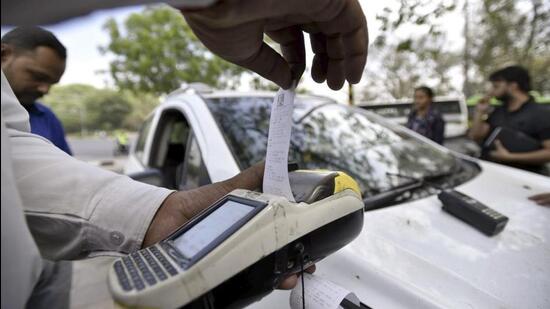
{{/usCountry}}An e-challan is an electronically generated traffic violation notice that replaces the conventional paper challan. It is issued either manually via handheld devices or automatically through AI-enabled surveillance cameras under the ITMS, which can detect offences such as riding without a helmet, overspeeding, red-light jumping, wrong-side driving and triple riding.
Helmetless riding tops violations
In three districts with the AI-enabled traffic enforcement system, helmet violations account for the largest share of offences. In Mohali, nearly 70% of all AI-generated e-challans were issued for riders or pillion riders not wearing helmets. Ludhiana has reported a similar trend, with helmetless riding emerging as the single biggest traffic violation detected by the ITMS.
While enforcement has become stricter, recovery of penalties has failed to keep pace. Pending e-challan dues stood at ₹7.50 crore in 2021, declined to ₹4.56 crore in 2022, and rose marginally to ₹5.13 crore in 2023. However, the outstanding amount increased sharply to ₹27.97 crore in 2024, before skyrocketing to ₹158 crore in 2025. As of July 30, 2026, unpaid penalties had climbed further to ₹159.31 crore, raising questions about the effectiveness of the recovery mechanism despite the widespread adoption of digital enforcement.
Although Punjab has recorded one of the fastest increases in e-challan issuance, its numbers remain well below those of larger states. Uttar Pradesh leads the country with 1.93 crore e-challans in 2025, followed by Kerala (1.01 crore), Delhi (96.13 lakh), and Tamil Nadu (89.41 lakh). Among neighbouring regions, Haryana issued 52.36 lakh e-challans, more than double Punjab’s tally, while Himachal Pradesh recorded 13.32 lakh and Chandigarh 8.07 lakh.
The Centre informed Parliament that the e-Challan system is now operational in 34 states and Union Territories, with only Telangana and Lakshadweep yet to adopt it. To strengthen compliance, the government has amended the Central Motor Vehicles Rules, 1989, prescribing timelines for the issuance, service and payment of e-challans, while also enabling motorists to contest challans online.
The amended rules also empower authorities to restrict specified vehicle- and driving licence-related services for motorists with unpaid challans. Further, the e-Challan platform now maintains a digital history of traffic offences linked to both vehicles and driving licences, enabling authorities to identify repeat offenders.
From January 1, 2026, motorists who commit five or more traffic violations in a calendar year may face disqualification of their driving licence. However, the Centre clarified that since police and public order are state subjects, the implementation of the e-challan system and recovery of pending penalties remain the responsibility of the respective state governments and Union Territory administrations.