Dengue has claimed its first victims in Chandigarh this year, the UT health department confirmed on Thursday after three people succumbed to the virus.
The deceased include a 31-year-old man from Kishangarh, a 50-year-old man from Sector 16 and a 42-year-old woman from Sector 27.
These are also the first dengue fatalities in the city since 2019.
The infection also claimed two more lives in Mohali, where this year’s toll has reached 20.
The latest fatalities in the district are a 30-year-old woman from Sector 81 and a 42-year-old man from Lohgarh, Zirakpur.
Mohali has confirmed 18 deaths in October alone, while two people died in September as well, when the dengue cases first started spiralling. No fatality has been reported in Panchkula so far.
142 new infections in tricity
Meanwhile, 142 fresh infections were reported in the tricity on Thursday. Worst-hit by the disease, Mohali led with 93 cases, while 35 and 14 patients were found infected in Chandigarh and Panchkula, respectively.
With this, Mohali’s tally this year has climbed to 1,848 – a 292% jump from last year’s count of 471.
Chandigarh has detected 508 cases so far, almost double than the 265 cases in 2020.
{{/usCountry}}Chandigarh has detected 508 cases so far, almost double than the 265 cases in 2020.
{{/usCountry}}Dengue infections are steadily multiplying in Panchkula as well, as 380 patients have already contracted the infection this year, 387% higher than 78 a year ago.
High-risk areas
Most of the cases in Chandigarh are being reported from congested rural areas and colonies. On Thursday, 19 cases came from Manimajra, five from Mauli Jagran, two from Bapu Dham, while the remaining were scattered across Sectors 21, 41 and 52, Dhanas, Kishangarh and Kajheri.
Among the high-risk localities identified in Mohali are Phases 3B2, 4, 5 and 7, Sectors 70 and 71 in urban areas, besides villages Balongi, Badmajra, Mataur, Jujhar Nagar and Sohana.
Cases are also being reported from Dera Bassi, Zirakpur and Kharar.
Fogging intensified
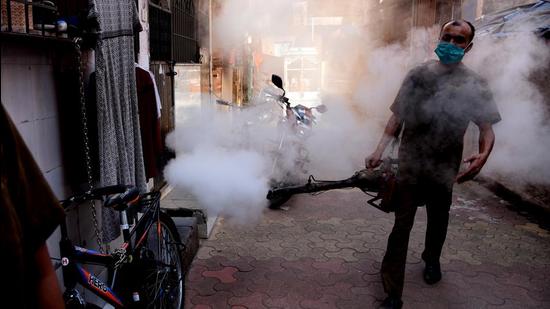
Mohali municipal corporation commissioner Kamal Kumar Garg said due to the steady rise in cases, fogging in all affected areas had been intensified. Over 3,100 people have been challaned in the district this year for not clearing stagnating water, a breeding ground for dengue-causing mosquitoes.
Dr Suman Singh, director, health services, Chandigarh, said the UT health department conducted fogging in 44 areas on Thursday and challans were issued to people wherever mosquito larvae were found.
“So far this year, 8,052 notices have been issued to the violators and 447 have been fined,” she added.
In Panchkula, 20 beds have been increased at the Civil Hospital in Sector 6 due to increase in patient inflow.
“We have added more beds and more doctors have also been deployed. No patient is being turned away. Our teams visit all areas where dengue cases are detected, for source-reduction activity,” said Dr Mukta Kumar, civil surgeon, Panchkula.