Chandigarh is a city we know through its drawings. Sectors, grids, hierarchies of roads, designated markets, green belts — almost every function was given a place. Yet the recent response to the auction of commercial sites at the new Sector 39 grain and vegetable market raises an interesting question about what happens after those places are assigned.
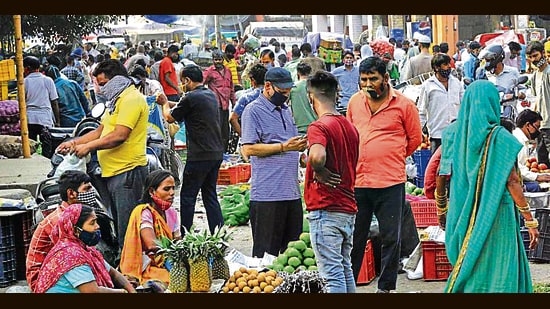
Of the 23 SCO sites put up for auction, only one received a technical bid. The reasons may be economic or logistical, but the contrast is interesting. Across Chandigarh, commerce routinely appears in places never formally designated for it. A food cart appears outside a busy market at dusk. A fruit seller settles where pedestrians naturally slow down. Buying and selling extends beyond shop boundaries and into the spaces around them. In a city where space was so deliberately assigned, why does commercial activity still find places of its own?
Where people go, commerce follows
Urban plans can determine where a market will be built. What they cannot determine quite as precisely is where someone will stop for tea at six in the evening. Street commerce understands this intuitively. Vendors appear near offices at closing time, outside markets with established footfall and along pedestrian routes. Their locations are rarely arbitrary. They respond to movement.
Chandigarh’s designated vending spaces offer an interesting counterpoint. A recent inspection of the Sector 53 vending zone found none of the 329 vendors allotted sites there operating from the location. The zone had basic facilities, but officials noted its distance from residential activity; vendors have sought relocation.
{{/usCountry}}Chandigarh’s designated vending spaces offer an interesting counterpoint. A recent inspection of the Sector 53 vending zone found none of the 329 vendors allotted sites there operating from the location. The zone had basic facilities, but officials noted its distance from residential activity; vendors have sought relocation.
{{/usCountry}}This does not necessarily make the designated zone poorly planned, nor does it make vending elsewhere desirable. It simply demonstrates something easy to overlook on a drawing: a physically available space and a commercially viable one are not always the same thing.
What makes a market?
At a much larger scale, Sector 39 raises a related question. The new grain and vegetable market is intended to eventually accommodate activity from the established Sector 26 mandi. Yet the latest auction of 23 SCO sites received only one technical bid. Economics may partly explain the response. The reserve price for each site increased from ₹3.70 crore in the previous auction to nearly ₹5.30 crore following revised collector rates.
It would therefore be simplistic to read the auction as a verdict on the location or its planning. But it does make one wonder: what actually makes a market? Sector 26 is not merely a collection of shops. Over decades, it has accumulated wholesalers, retailers, transporters, customers, suppliers, routes and routines. A market, viewed this way, is partly infrastructure and partly habit.
The roadside vendor operates at the opposite end of this scale. Instead of attempting to create footfall, the vendor finds where it already exists. One begins with space and waits for activity; the other begins with activity and finds space around it.
The city after the drawing
Perhaps Chandigarh’s informal layer is most interesting when viewed neither as a failure of planning nor something to romanticise, but simply as evidence of a city continuing to evolve after its drawings were completed. There are legitimate reasons to regulate public space. Pedestrian access, sanitation, traffic, safety and the rights of other users cannot disappear from the conversation simply because an informal use is popular.
But there is also information in the places people repeatedly choose. An empty vending zone, a market that spills beyond its edges or an established commercial ecosystem that proves difficult to relocate all tell us something about how urban space is actually consumed.
Perhaps the Chandigarh that was drawn and the Chandigarh that is lived are not opposing cities at all. One provides the order. The other keeps revealing how that order is actually used.
aashna.gakhar@gmail.com
(The writer is a Chandigarh-based architect and interior designer)