The water levels in the Ranjit Sagar dam and the Bhakra dam are lower by 69 feet and 30 feet, respectively, compared to that of the corresponding day last year. The water levels in the Bhakra, Ranjit Sagar and Pong dam reservoirs are crucial for irrigation and power generation in the region.
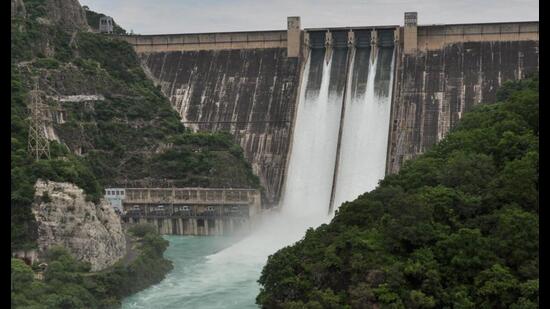
There was a 14% decline in the snow cover during the last winter in the river basins of the Chenab, Ravi, Beas and Sutlej in the Himalayas. The Bhakra reservoir relies heavily on snowmelt during summers.
This year, due to the prolonged heatwave ending in June and scattered rainfall in the region, the power demand and supply have increased than last year. All four units of the Ranjit Sagar dam have been operating during the daytime and peak hours, especially when thermal units trip.
The Central Water Commission (CWC) monitors the live storage status of 20 reservoirs used for hydroelectricity projects. According to the CWC weekly report of July 11 released on Friday, the water level in the Bhakra reservoir is 37% of its live capacity, down by 19% compared to last year’s 56%. At Bhakra dam, which lies on the Sutlej in Himachal Pradesh, the water level is 1,597.20 feet, down from last year’s level of 1,627.90 feet, a decrease of about 30 feet. The upper limit of filling for the Bhakra reservoir is 1,680 feet. According to the daily report, the Bhakra inflow is 33,638 cusecs, compared to 105,949 cusecs last year.
In Punjab, the only reservoir is the Ranjit Sagar dam project that has a capacity of 600 MW. Its current storage level is 31%, down from last year’s 80%. The normal storage level is 53%. The water level of the Ranjit Sagar dam, located on the Ravi in Punjab, is 1,644 feet (501.2 metres), down from last year’s level of 1,713.5 feet (522.4 metres). The maximum permissible level of the dam is 1,731.5 feet. The water inflow on Friday was 9,785 cusecs, compared to 40,855 cusecs on the corresponding day last year.
{{/usCountry}}In Punjab, the only reservoir is the Ranjit Sagar dam project that has a capacity of 600 MW. Its current storage level is 31%, down from last year’s 80%. The normal storage level is 53%. The water level of the Ranjit Sagar dam, located on the Ravi in Punjab, is 1,644 feet (501.2 metres), down from last year’s level of 1,713.5 feet (522.4 metres). The maximum permissible level of the dam is 1,731.5 feet. The water inflow on Friday was 9,785 cusecs, compared to 40,855 cusecs on the corresponding day last year.
{{/usCountry}}At Pong dam, the water storage level is 24%, down from 67% last year. Its current storage level is 1,315.2 feet, which is 48 feet lower than last year’s level of 1,363.4 feet on the corresponding day. Pong dam is located on the Beas river in Himachal Pradesh.
These three dams have a combined irrigation potential of 1,024 lakh hectares and an installed hydropower generation capacity of 2,375 MW.