
 E-Paper



Wildbuzz | A many-splendoured bird
Two great crested grebes, a species whose history occupies pride of place in the origins of the modern conservation movement, have graced the Sukhna lake by casting their silvery reflections in its placid waters

 Prefer HTon Google


The Sukhna lake has been graced by a bird whose elegance and actions leave the observer enraptured. Two great crested grebes, a species whose history occupies pride of place in the origins of the modern conservation movement, have graced the lake by casting their silvery reflections in its placid waters.
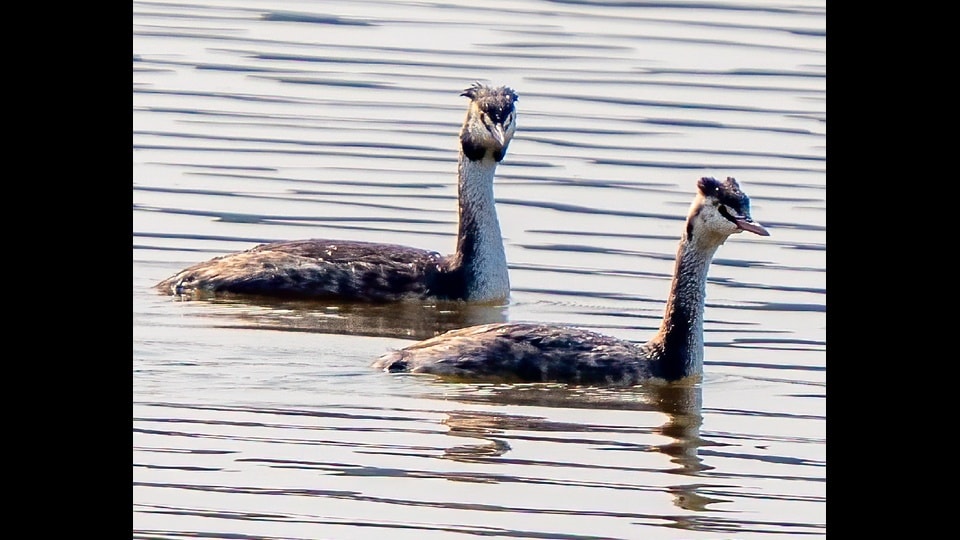
It is an uncommon winter migrant. Just a few are fleetingly seen as grebes dive frequently and surface after what seems an eternity. Literally, the Houdini avians! Their webbed feet are placed far back in the body to facilitate diving and swimming. Grebes hunt fish and aquatic invertebrates.
In the late 19th century, these birds were nearly hunted to extinction in Britain because of their elegant head feathers. It was a “murderous millinery”, as ladies sported grebe plumes on their hats. An estimated 200-300 million birds (including grebes and snowy egrets) were killed annually across the globe for the fashion industry.
Then, two groups of bird-loving ladies got together in 1891 to successfully “fight the fashion fad” in Britain. The groups went on to form the Royal Society for the Protection of Birds (RSPB), which is currently one of the globe’s leading avian conservation NGOs and has been associated with the funding, conservation and captive breeding of critically endangered Indian Gyps vultures. It is heartening to note that the grebe has escaped from the coffin of fashion wardrobes and is today a flourishing species, whose geographic range extends over Eurasia, parts of Africa and Oceania.
Blessed with carmine-red to crimson irises, these beautiful grebes display fascinating habits: (i) nests are either floating or anchored to aquatic vegetation/the wetland floor; (ii) they swallow their own feathers and feed them to chicks to form a protective plug in their stomachs that prevents sharp fish bones from piercing their intestines and aids in digestion; and (iii) their utterly charming courtship rituals in the breeding season defy a wordy description.
In war, science & the spirit
It is eloquently stated that “modern science owes a lot to dogged determination in difficult circumstances”. Research underway in Britain on botanical specimens collected by soldiers during the First World War (1914-18) illustrates this vividly.
As many as 6,700 specimens have been identified till now in the collections held by the Natural History Museum, London, and the Royal Botanic Gardens of Kew and Edinburgh.
Last Wednesday, November 11, marked Armistice Day in remembrance of the end of WWI and in honour of soldiers who laid down their lives. More than 1.4 million soldiers and non-combatants from the Indian sub-continent volunteered for WWI, of whom 74,187 died.
In popular consciousness, what is etched is the emotional legacy of war: poppies, roses and irises pressed into soldiers’ letters from the trenches to the beloved. However, less known are soldiers of a scientific background who persisted with their botanical quest during the chaos of war. William Turrill, a Kew botanist serving as a British Army doctor, gathered 550 plant specimens from the Salonika Front in Greece during WWI. Some specimens were lost while being shipped home due to a German submarine attack.
On the other side were botanists such as Karl Heinz Rechinger, who collected specimens in 1942 from Crete while serving on attachment to Nazi Germany’s Wehrmacht. However, Rechinger’s collections suffered heavily in an air bombing of the Berlin herbarium in March 1943.
Or, rewind to Napoleon, who dispatched his chief gardener from Paris to select prize specimens when his army invaded Italy and Spain!
All this falls in the emergent field of polemobotany, i.e., the study of plants affected by, spread through, or used in warfare and military activity. For soldiers, pressing and gathering plants served as a psychological distraction from the weariness of war, while for science, it provided botanical insights into war zones. War collections lent a glimpse into the wildlife of a landscape where life was being lost but where the botanist’s spirit held resilient. Such collections are rapidly being digitised by museums for world view. They are instructive for ecological restoration of war-ripped landscapes, discovering new species and facilitating multidisciplinary studies.
vjswild2@gmail.com


