
 E-Paper



Wildbuzz | A wanderer to the horizon
Jennifer Nandi’s books are about what the journeys made of her, of her ardour for uncertainty by voyaging to a finger put on a map, the inner life of a woman traveling alone, and translating her wonder of people, places and nature into words

 Prefer HTon Google


Delighted cackles broke out just a stone’s throw from the quaking Siswan-Baddi highway, accompanied by her theatrics. Shielded by high walls and trees, above the cackler on a Semul tree were black drongos chipping in with merry chirps. A barking deer’s alarm call sounded in the jungle below. Leopard? As twilight advanced by a star and a crescent moon, the nightjars sang paeans to the demise of daylight. On the impassive wooden door of the lady’s loo, a huntsman spider (as large as a human palm and which does not weave webs to catch prey) swung on frequent movement.
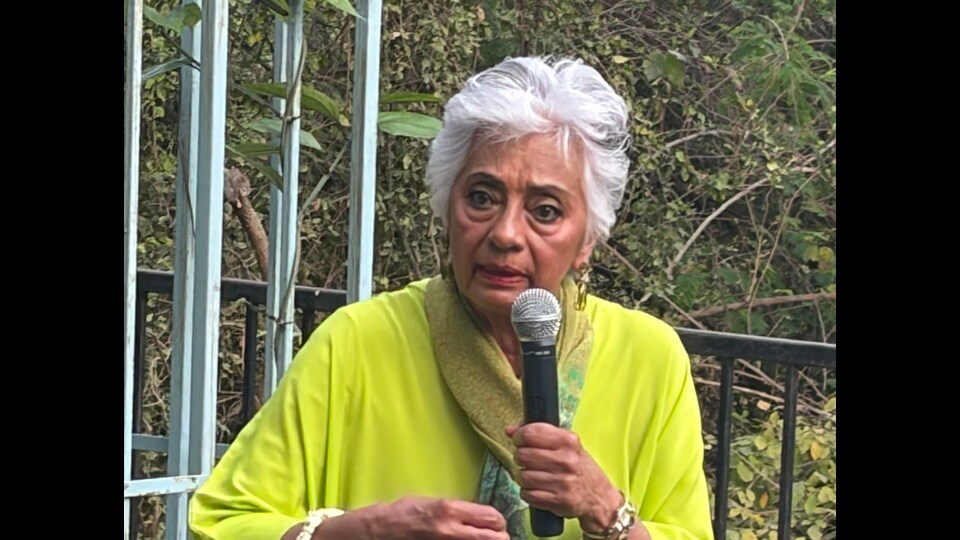
The cackler was Jennifer Nandi, India’s only professional lady nature guide to the remote outbacks of the North-east, Ladakh’s Snow leopard cliffs, Kashmir, Spiti et al. She was speaking on her latest book, ‘Ink on the Move’, last Sunday at a launch event curated by Antler Woods, Siswan, a nature retreat converted from an erstwhile shikar lodge. Nandi’s maiden book, ‘No Half Measures’ released in 2024, hit Amazon’s No.1 in the ‘Wildlife and Travel’ category.
Nandi’s books are about what the journeys made of her, of her ardour for uncertainty by voyaging to a finger put on a map, the inner life of a woman traveling alone, and translating her wonder of people, places and nature into words. At 74, Nandi is fighting fit, her skin taut with minimal wrinkles and unstirred by ripples of imminence.
Driven by a primeval vitality, Nandi reminds one of the medieval legend of a prized captive female northern goshawk (Shah Baaz), whose spirit could not be quelled by the noble falconer.
At the same time, Nandi disarmingly confesses to being a show-off and to an incorrigible indulgence in theatrics to sell her books (it pays, she says!). Widow of a navy officer and the daughter of another one, Nandi had the gall to tell her two fatherless children that they better strike out on their own as she had been beckoned by the call of the wild. In doing so, Nandi swam out from the shores of social compliance and “lady goodness” into unknown seas, devoid of an isle on the horizon.
An artist asks who beheads whom
Could we imagine a human life in the guise of a sun-browned Mumbai fisherwoman, tirelessly chopping heads of sea fish for sale, and herself headless? It is art, which can portray absurdity on the surface and yet convey subtle meanings and empathy for both the fisherwomen and the fish they so mechanically and unemotionally guillotine.
Trupti Shivaji Wagh, a young artist who relentlessly scours Mumbai’s spilling-over-with-life lanes for ideas, portrayed this in a painting titled, ‘Fisher Women’. Wagh’s signature style is to paint “headless/beheaded” subjects.
‘Fisher Women’ was on display last week at the Punjab Kala Bhawan, Chandigarh, as part of the 12th Annual Women’s Artists’ Exhibition. It was held under the aegis of Artscapes and supported by the Union ministry of culture. Over 1,000 entries were received from India, Greece, Turkey, Czechoslovakia, England, Poland, Russia and Sweden. Following a selection process, 100 artworks were exhibited and ₹3 lakh distributed in awards by Haryana Governor, Prof AK Ghosh.
The suffering of fish is the most “bezubaan” of all, and over-fishing a conservation concern. “I am myself a vegan. I observed fisherwomen and an urge gripped me to depict their lives artistically. I saw fishes strung upside down without a thought to their dignity or right to life. Their heads chopped off and dumped as if they were some vegetables. It disturbed me,” Wagh told this writer.
Though ‘Fisher Women’ did not bag an award, it arrested the gaze, invited contemplation and churned thought and morality. Wagh’s work is a testament to the power of art in fostering connections, inspiring change and shaping cultural narratives.
(vjswild2@gmail.com)


