
 E-Paper



From inspiration to influence: How India is leading the global luxury playbook this year
For decades, global luxury borrowed from India’s colours, crafts and cultural codes. Now, Indian designers are taking the lead. Take a look

 Prefer HTon Google


From Sabyasachi’s landmark partnership with The Metropolitan Museum of Art to Manish Malhotra's iconic debut at Paris Fashion Week, a new generation of India-first voices is taking centre stage worldwide. Indian luxury is no longer seeking global recognition — it is shaping the global conversation.
On and around the runway
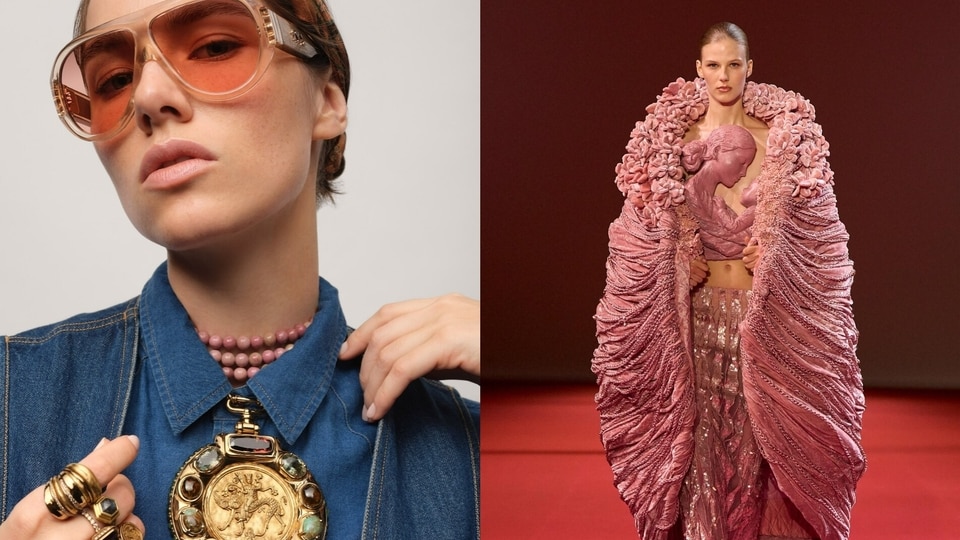
The most visible proof of this shift is unfolding on global runways and front rows. From Bhavitha Mandava becoming Chanel’s first Indian Global House Ambassador after opening Mathieu Blazy’s debut Chanel show, to male models like Yug Sanjay Devalia and Aryan Prakash having walked for Dior menswear, Indian models are breaking into top-tier global houses. Off the runway, Indian designs are being sported by international stars. Cardi B sparked a social media frenzy in Rahul Mishra’s Devi collection, inspired by 2,300-year-old Indian temple art, and Taraji P. Henson commanded the front row at Gaurav Gupta’s Spring/Summer 2026 couture presentation at Paris Couture Week with a dramatic, sculptural gown.
“Twenty-five years ago, Western luxury brands weren’t really looking East. They looked at us as an interesting cultural reference rather than as a serious force in global luxury. The nature of the conversation has now changed. Earlier, when an international celebrity wore an Indian designer, the story was often about the novelty of seeing Indian craftsmanship on a global celebrity. Today, the conversation is increasingly about the designer’s creative vision, craftsmanship and place within global fashion,” says luxury brand consultant Rajan Narayan, Lonely Cloud Consulting about the shift that seems to be happening.
Financial sovereignty
Behind this global expansion lies a shift in how Indian fashion operates. Over the past few years, strategic investments from retail giants and equity firms in labels like Sabyasachi, Manish Malhotra, and Tarun Tahiliani, have supported couturiers to fund global expansion. Armed with institutional capital, professional management, and global scale, Indian designers are equipped with the financial muscle to secure real estate in Beverly Hills and Manhattan.
Unapologetic, heritage-driven storytelling.
At the Paris Haute Couture Week in 2026, Rahul Mishra’s Fall couture line Devi: The Eternal Muse drew inspiration from feminine, rock-cut temple architecture, for dense, thread-embroidered couture. Manish Malhotra made a historic debut at the same fashion event with Maa, honouring his late mother through protective cocoon silhouettes and bangle-inspired drapes. In January, Gaurav Gupta’s Spring/Summer 2026 line in Paris, was rooted in Advaita, the ancient Indian philosophy of non-duality.
“There is a growing appreciation of the hand — of the time, skill and human intelligence involved in creating something. India has an incredible vocabulary of embroidery, surface techniques, textiles and hand processes, and we are reaching a point where these techniques can be pushed to create extremely sophisticated contemporary expressions. Our visibility as a cultural identity is changing; our fashion industry is now close to 40 years old; it is mature enough that Indian fashion should be appreciated globally on its own terms,” says Course Leader - Fashion, professor, Ashish Dhaka (UDIT).
Equal partner collaborations
Year 2026 also marked a pivotal transition for creative partnerships. After dressing prominent faces for the Met Gala red carpet, Indian luxury titan Sabyasachi recently inked a landmark multi-year deal with The Metropolitan Museum of Art in New York. Abraham & Thakore tied up with French lifestyle platform L’Atelier 1664 for a capsule line titled Sari’torial, inspired by 1664 Blanc beer. Meanwhile, Prada responded to backlash over its uncredited Kolhapuri-inspired sandals with a fully funded three-year training programme for 180 artisans across Maharashtra and Karnataka, alongside a collaborative limited-edition ‘Made in India’ footwear collection. Clearly, global heritage institutions and legacy luxury houses are no longer just sourcing from India; they are treating Indian designers as co-creators.
Explaining these collaborations, associate fashion professor, Shipra Kukreja at UDIT says, “Organisations such as the Ministry of Culture and the Ministry of Textiles in India — and even international cultural institutions such as The Met — have the power to play an important role in establishing stronger guidelines around what constitutes appreciation and what constitutes appropriation, especially in 2026. In 2026, I see an opportunity to change the terms of the conversation, from India being a source of craft and labour for international luxury to India being recognised as a source of design knowledge, cultural knowledge and creative authority in its own right. The future of luxury will increasingly be about different cultural ideas meeting, interacting and creating something neither culture could have produced in isolation.”


