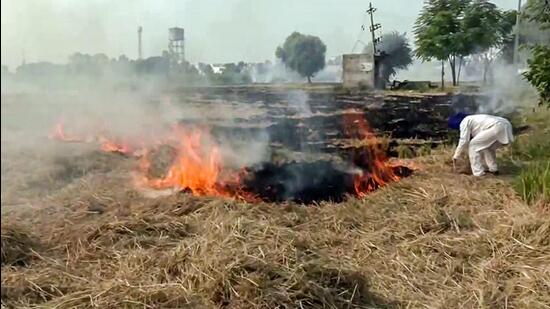
Paddy harvesting, which began roughly a fortnight ago, has resulted in a surge in cases of stubble burning—rising 30% between September 15 to October 4, compared to the corresponding period last year—according to centralised data from the agriculture ministry-backed Indian Agricultural Research Institute (IARI).
Read here: Centre allocates ₹600 crore to curb stubble burning
The federal agency is mandated to track the burning of crop residue in Punjab, Haryana, Uttar Pradesh, Delhi, Madhya Pradesh and Rajasthan, which causes an annual spell of toxic smog across north India during winters. The national capital particularly witnesses severe levels of pollution and smoke from crop-residue fires.
Data from the Consortium for Research on Agrosystem Monitoring and Modelling from Space (CREAMS), an arm of IARI, shows a total of 989 fire incidents between September 15 and October 4, against 663 in the previous year, a jump of over 49% in the six states. By November, fire incidents increase to nearly 60,000, according to data from past years.
In these farm belts, farmers set paddy stalks to fire after harvesting rice around October to clear their fields for their next crop, wheat. Paddy is grown during summer and harvested in autumn.
{{/usCountry}}In these farm belts, farmers set paddy stalks to fire after harvesting rice around October to clear their fields for their next crop, wheat. Paddy is grown during summer and harvested in autumn.
{{/usCountry}}During this period, fires to clear harvest leftovers release millions of tonne of smoke, carbon dioxide stored in plant biomass, and other toxic gases into the atmosphere. Some environmentalists reckon this to be the deadliest spell of pollution in all of South Asia.
According to the data till October 4, Punjab accounted for 656 stubble-burning incidents, the highest, followed by Haryana’s 166. Uttar Pradesh had 74 cases, Madhya Pradesh 47, Rajasthan 45 while Delhi has had a single case.
The CREAMS facility operates its own “X & L-band” satellite ground stations to receive direct remote-sensing images from a range of international satellite constellations, along with a geospatial laboratory with advanced computing capabilities. These features allow the centre to detect farm fires fairly accurately, said an agriculture ministry official requesting anonymity.
Read here: 41 farmers challaned for stubble burning in Kurukshetra
Stubble burning worsens the air quality in most northern cities. Last year, between October 24 and November 4, Delhi recorded a peak AQI of 488, Ghaziabad reported an AQI of 493, and Greater Noida recorded 480. A reading above 400 means the air is hazardous.