Commuting in Delhi can be a harrowing experience -- especially if it rains. On August 21 last year, for instance, when the capital saw heavy rainfall of 139mm, commuters were forced to spend an additional 71% commuting time stuck in traffic snarls, according to a global traffic index report by TomTom released on February 10.
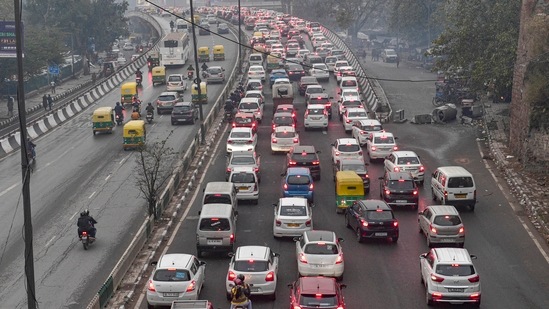
Traffic congestion in Delhi typically peaks during the monsoon months, with September being the worst with 56% more average commuting time than other months, said the report. Roads in Delhi are not designed to handle more than 50mm of rain in a day, the Public Works Department said in a August 2021 report.
The situation is unlikely to improve any time soon. Delhi continues with an outdated 1975 drainage master plan to manage its 426.55km of natural drainage lines and 3,311.54km of engineered stormwater drains. An enhanced drainage system remains stuck a decade after work started on it.
The PWD is in the process of appointing a consultant who will survey the key basin areas to identify problem areas that will then be acted upon by authorities, an official said on condition of anonymity.
The problem, however, is not limited to water logging and drainage. Unsustainably high vehicle density, poorly managed roads, and rampant encroachments add to the problem, experts said, and things will only worsen as congestion levels rise once again after pandemic restrictions are lifted.
{{/usCountry}}The problem, however, is not limited to water logging and drainage. Unsustainably high vehicle density, poorly managed roads, and rampant encroachments add to the problem, experts said, and things will only worsen as congestion levels rise once again after pandemic restrictions are lifted.
{{/usCountry}}Delhi is the 11th most congested city in the world according to the TomTom Traffic Index that maps 404 cities in 58 countries.
As life returns to normal and traffic increases, the city needs to immediately implement pending transportation policies, said Anuj Malhotra, a transportation expert and member of a home ministry expert panel on decongesting Delhi’s roads.
“A parking policy was notified, but its provisions like parking management districts, need to be implemented on war footing. Similarly, the walking policy and walkability plans are yet to be enforced,” Malhotra said. “Additionally, more buses are required to increase the supply side requirements.”
At present, Delhi has about 6,900 buses, the highest the city has ever had so far. Previously, bus fleet in Delhi was at its strongest with 6,342 vehicles in 2010 when the national Capital hosted the Commonwealth Games.
A Delhi government spokesperson said at least 2,830 more buses will be added until mid-2023. Of the 2,830 buses, 2,130 will be pure electric buses and 700 will be CNG buses. This will also be the last set of CNG buses Delhi government will buy. After this, only e-buses will be procured, the spokesperson added.
Delhi also needs to discourage the use of private vehicles to reduce congestion, experts said. Although roads remain limited, the appetite for new vehicles and parking space continues to grow. Till 31st January 2022, the government data shows, Delhi had some 13.4 million registered vehicles, which is more than the registered vehicles in Mumbai, Chennai and Kolkata taken together. The city transport department estimates that around 7.77 million of these are in use. Added to this is the huge number of vehicles from satellite cities of Noida, Gurgaon, Faridabad and Ghaziabad using the capital’s roads everyday.
Given the number of vehicles on the capital’s road, congestion is inevitable, said Anumita Roy Chowdhury, executive director at the Centre for Science and Environment, an advocacy group, and a member of the team that drafted city’s parking policy that was notified in 2019.
“Clearly, the obsessive focus on excessive road building and widening, while allowing unlimited free parking is eroding spaces for public transport, walking and cycling. This has not worked and needs immediate course correction,” Roy Chowdhury said. “We need to scale up integrated public transport services, walking and cycling along with taxation and parking measures to recover congestion and pollution costs from personal vehicles to restrain their usage.”
Roy Chowdhury also advocates modification in city planning to bring in more people to live close to the transit lines to reduce dependence on personal vehicles.
Two years after the Delhi Development Authority notified rules for a pedestrian-friendly makeover of Delhi’s streets, the policy remains on paper. The municipal corporations have also failed to enforce parking area management plans and dynamic parking rates despite the rules being notified on September 23, 2019, after direct intervention of the Supreme Court.
While high vehicle density remains a key hurdle, yearlong housekeeping tasks of resurfacing roads, pothole repair and removal of encroachments have significant impact on vehicular flow, Delhi residents rue.
Basic housekeeping in the capital has deteriorated, said Atul Goel, president of United RWAs Joint Action, a collective of residents’ associations.
“Maintenance of arterial as well as inner colony roads lies in shambles. Forget about resurfacing, even basic patchwork and pothole repair work is lacking,” Goel said. “On the one hand, we are talking about mobility planning, and walkways, but we are unable to prevent encroachment on even existing pathways, forcing people to walk on roads, which hampers traffic flow and increases risks of accidents.”
Authorities remove encroachments regularly, municipal officials said, but road repairs have been impacted due to a financial crisis faced by the municipal corporations.
High congestion levels have made commuting in city unreliable, said Sewa Ram, professor of transport planning in the School of Planning and Architecture.
“Even when people are travelling using Google maps (which display congestion levels), they are ending up taking longer than the expected time,” Ram said. “Delhi Traffic Police needs to identify the new emerging congestion hot spots and plan their strategy accordingly.”
Segregating traffic moving to residential neighbourhoods and industrial areas in the city and interstate traffic to and from the cities in the national capital region will be key in reducing the congestion, he said.
Authorities also need to reduce the time taken to clear out roads when buses and cars breakdown, he added. “Even the national highways and expressway have poor management when vehicles and buses break down and it leads to pile up of vehicles on the entire corridor.”
Congestion management in the capital needs a holistic approach, with frequent updating of mobility plans and capacity management of arterial and other roads, said S Velmurugan, chief scientist at the Central Road Research Institute.
He advocated the introduction of tough fiscal measures like congestion pricing in areas such as Connaught Place, and the walled city . The present rate of ₹20 per hour of parking is unjustified and should be raised, he said.
The draft masterplan 2041 for Delhi advocates the use of congestion pricing. Road owning agencies should notify specific areas in the city as congestion pricing zones through the use of technology in the form of RFID tagging, it has suggested.
Enforcing the new parking policy should be the first step before introducing congestion pricing, Malhotra said.
“Parking management is the first tool,” he said. “At this stage, Delhi does not need additional roads, but optimum utilisation of the existing network. Even opening up colony gates and allowing traffic to pass through internal roads should be done.”
Stay updated with all top Cities including, Bengaluru, Delhi, Mumbai and more across India. Stay informed on the latest happenings in World News along with Delhi Election 2025 and Delhi Election Result 2025 Live, New Delhi Election Result Live, Kalkaji Election Result Live at Hindustan Times.
Stay updated with all top Cities including, Bengaluru, Delhi, Mumbai and more across India. Stay informed on the latest happenings in World News along with Delhi Election 2025 and Delhi Election Result 2025 Live, New Delhi Election Result Live, Kalkaji Election Result Live at Hindustan Times.