If a pilot project of planting 14 types of grass in the Asola Bhatti Wildlife Sanctuary that aims to restore its ecological landscape is a success, the Delhi government may consider including grasses in its annual greening targets.
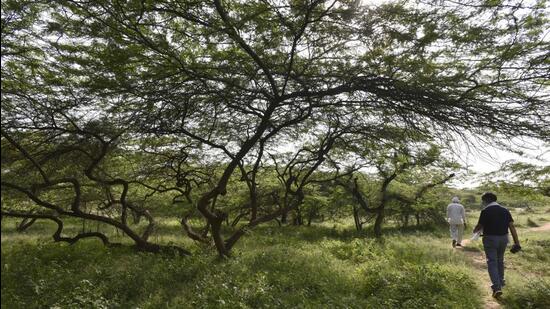
Grasses are already returning in parts of the sanctuary where human footprint has reduced, according to a senior forest official in the south division.
“We are already seeing grasslands return in places where boundary walls were strengthened, but plantation work of shrubs and grasses will begin in areas near the check dams, as there is already high silt and water availability,” said the official. “Open spaces need to be filled by shrubs and grasses, which form an equally important part of a forest, and grasses will be able to grow in places where trees will simply not be able to grow.”
Although there are no immediate plans for a policy change that incorporates grasses in the greening target, it will be looked at following this pilot project, another forest official said. “It is possible in the future that greening agencies will be asked to plant grasses along with saplings and shrubs, especially along pavements,” the official said, requesting anonymity.
Delhi’s green cover has been increasing over the past decade and now stands at 23.06% (342.2 sq km) of its land area, according to the latest India State of Forest Report. It was 21.9% in 2019 (324 sq km).
{{/usCountry}}Delhi’s green cover has been increasing over the past decade and now stands at 23.06% (342.2 sq km) of its land area, according to the latest India State of Forest Report. It was 21.9% in 2019 (324 sq km).
{{/usCountry}}Focusing on grasses and the creation of grasslands will be the next step in reviving the ecological landscape in the sanctuary, which has recorded the presence of ungulates such as the spotted deers, nilgais, black bucks and hog deers as part of an ongoing census, said Sohail Madan, centre manager, Bombay Natural History Society at Asola.
“Around 14 different types of grasses have been identified, each of which are important in their own way for the ecology,” Madan said. “Not only will they sustain the browsers and grazers, but will also make it easier for reptiles and smaller mammals to thrive.
The grasses to be planted include Buffel grass, Johnson grass, Mauritian grass, Daabh, Crowfoot grass, Kash, Munj, Needle grass, Lemon grass, Dhoob, Vertiver and Rat tail grass, among others.
Grasses not only support herbivores, but increase microbial activity, which is important for a number of ecosystem processes, according to Faiyaz Khudsar, scientist in-charge at the Yamuna Biodiversity Park.
Grasslands are crucial in open forests, providing enrichment to the soil and a food source to grazers, said Pradip Krishen, an environmentalist and author of the book Trees of Delhi.
“In a dense forest, grasses will not grow too easily, as they will not receive enough sunlight, but in open forest and open expanses of the Aravallis, grasslands are important for all sizes of mammals, rodents and reptiles,” Krishen said. “Different areas need to be studied carefully before determining the type of grass that can grow there and this can be replicated in other places of the sanctuary.”
Stay updated with all top Cities including, Bengaluru, Delhi, Mumbai and more across India. Stay informed on the latest happenings in World News along with Delhi Election 2025 and Delhi Election Result 2025 Live, New Delhi Election Result Live, Kalkaji Election Result Live at Hindustan Times.
Stay updated with all top Cities including, Bengaluru, Delhi, Mumbai and more across India. Stay informed on the latest happenings in World News along with Delhi Election 2025 and Delhi Election Result 2025 Live, New Delhi Election Result Live, Kalkaji Election Result Live at Hindustan Times.