
 E-Paper



Delhi homeless shelters packed to the rafters amid record-breaking winter
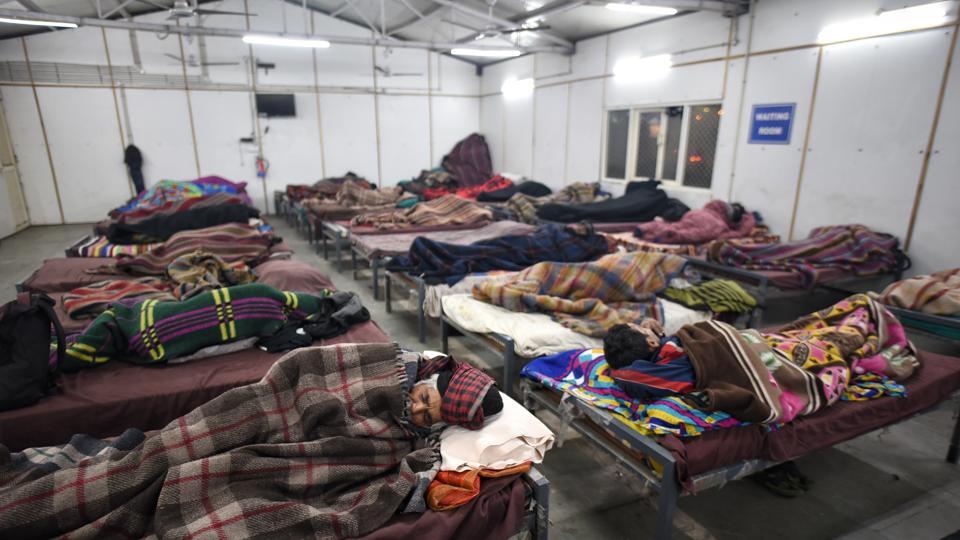
The Delhi Urban Shelter Improvement Board has set up 209 permanent shelters in the capital. In addition, temporary shelters are also set up every year.

 Prefer HTon Google


On Tuesday, the coldest January day in nine years, 88-year-old Chotelal Birla had just a bedsheet to ward off the chill from the cold pavement. Swathed in a thin worn blanket, he, like countless others in the national capital, is braving the harsh winter from a footpath near the Tibetan Market in Kashmiri Gate.
Physically challenged, Birla relies on alms from passersby for a living and has no permanent roof over his head. Every evening around 9pm, he heads to the footpath where he retires for the night, after having been turned away by shelter homes brimming with people. “These shelters get full by 6-7pm these days, sometimes even before that. By the time I wrap up and go there, there is no space left and I’m turned away,” said the octogenarian, as he lay next to 10-15 others on the footpath in Kashmiri Gate on Tuesday night.
On Tuesday, all weather stations in the national capital recorded their maximum temperatures 10 to 11 degrees Celsius below normal. The Safdarjung Observatory recorded a maximum temperature of 12.1 degrees Celsius, which was the lowest on a January day, after 9.8 degrees Celsius recorded on January 3, 2013.
Also Read | Biting chill but familiar winter fog eludes Delhi, least since 2008
The first come, first served policy of shelter homes is a disadvantage for people like him, says Birla. “We earn ₹10-50 a day, and it is not possible to reach the shelter by early evening. Even when there is space, preference is given to those who have been using the facility for years. We have no option but to spend our nights on the footpath,” he said.
Sixty year-old Lalu, a daily wage earner, shares the pavement with Birla. Those in the shelter get warm food, a blanket and bed, he says, while individuals like him, who take refuge in the open, have to pass the winter cold and hungry.
“The government doesn’t provide us any food and neither is there a public washroom in the vicinity. Life is tough on the road and we don’t sleep here out of choice. When we are repeatedly turned away from shelter homes, where else do we sleep?” said Lalu.
Winter this January has been particularly unyielding. Delhi is currently in the middle of the sixth longest spell (since 1951) when the day temperature has remained significantly lower than what is considered normal for time of the year, according to the India Meteorological Department data. Wednesday marked the 12th day this month when the maximum temperature has remained below 17 degrees Celsius.
Sunil Kumar Aledia, executive director of the Centre for Holistic Development, an advocacy group that works with the homeless and migrant workers in the city, said a survey conducted by the organisation between January 1-24 showed that as many as 145 homeless individuals have died from the biting cold this winter.
Aledia said temporary shelters were only a stop gap measure and a permanent solution was needed for the homeless. “We need permanent building structures. These tin structures (shelter homes) are neither sustainable nor equipped with clean facilities. The first come, first served policy only ensures that people are forced to sleep in the open if they are unable to reach shelters on time. The number of shelters is anyway way less than the number of homeless -- they number in their thousands,” said Aledia.
The Delhi Urban Shelter Improvement Board (DUSIB) has set up 209 permanent shelters in the capital. In addition, temporary shelters are also set up every year. DUSIB member Bipin Rai said that while 60-70 temporary camps were set up every year, this year, 220 camps have been set up year and 30 more are on standby.
“Based on need assessment, we set up temporary camps as and when required,” said Rai.
He rejected claims that 145 homeless have died in the cold and called the data fake. “There is no basis to the data. Every time, the organisation comes up with shocking numbers to create “sensation”. Our rescue vans work throughout the night to take individuals to shelters,” said Rai.
The government was constantly working on improving the facilities in shelters, he insisted, but some people chose to sleep on pavements, he claimed.
“We cannot force people to take shelter. There are some who prefer to sleep in the open, in the expectation of donations from Good Samaritans,” he said.
On Tuesday night, HT visited two shelters, in Kashmiri Gate and Sarai Kale Khan. Most inmates there said while space was limited, they were happy to have a roof over their heads when the mercury fell this low.
Damyanti Devi, of Bihar, has been living in the shelter home next to Nizamuddin Metro station for the past year after arriving in Delhi with her husband, who is suffering from a kidney ailment and is getting treated at AIIMS.
“We cannot afford to pay rent. I cannot complain as I have a place to rest at night. Sometimes, NGO workers also visit us and help us procure expensive medicines for the treatment of my husband,” said Devi.
While meals were provided twice a day, the number of toilets was limited due to which sanitation was poor, she said.
Rai said the number of individuals at the Sarai Kale Khan facility has increased lately and the government is cognizant of the need for more washrooms. “We are aware that there is some crisis, particularly during the morning hours. We are working on the addressing the shortage,” he said.
Indu Prakash Singh, a member of the Supreme Court-appointed state-level shelter monitoring committee, said the DUSIB had been told to prepare more shelters this time. He said food was being provided at shelters along with other facilities such as blankets and beds. “We don’t think that there is a bias against people when it comes to admittance in shelter homes. Whenever required, the DUSIB does set up shelters,” said Singh.


