E-Paper



PWD initiates process to set up drain master plan for Delhi
The move will be crucial to help rid the Capital of its annual water-logging woes during the monsoon, the officials said

 Prefer HTon Google


The Public Works Department (PWD) has initiated the process to hire companies to study Delhi’s drainage network, recommend interventions for the same, and oversee the implementation of its upgradation, officials aware of the matter said on Sunday.
The move will be crucial to help rid the Capital of its annual waterlogging woes during the monsoon, the officials said. The Delhi government had appointed PWD as the nodal agency for the implementation of Delhi’s drainage master plan in 2021.
Delhi has 201 natural drains, divided into three natural drainage basins — Najafgarh basin with 123 drains, Barapullah basin with 44 drains, and the Trans-Yamuna basin with 34 drains.
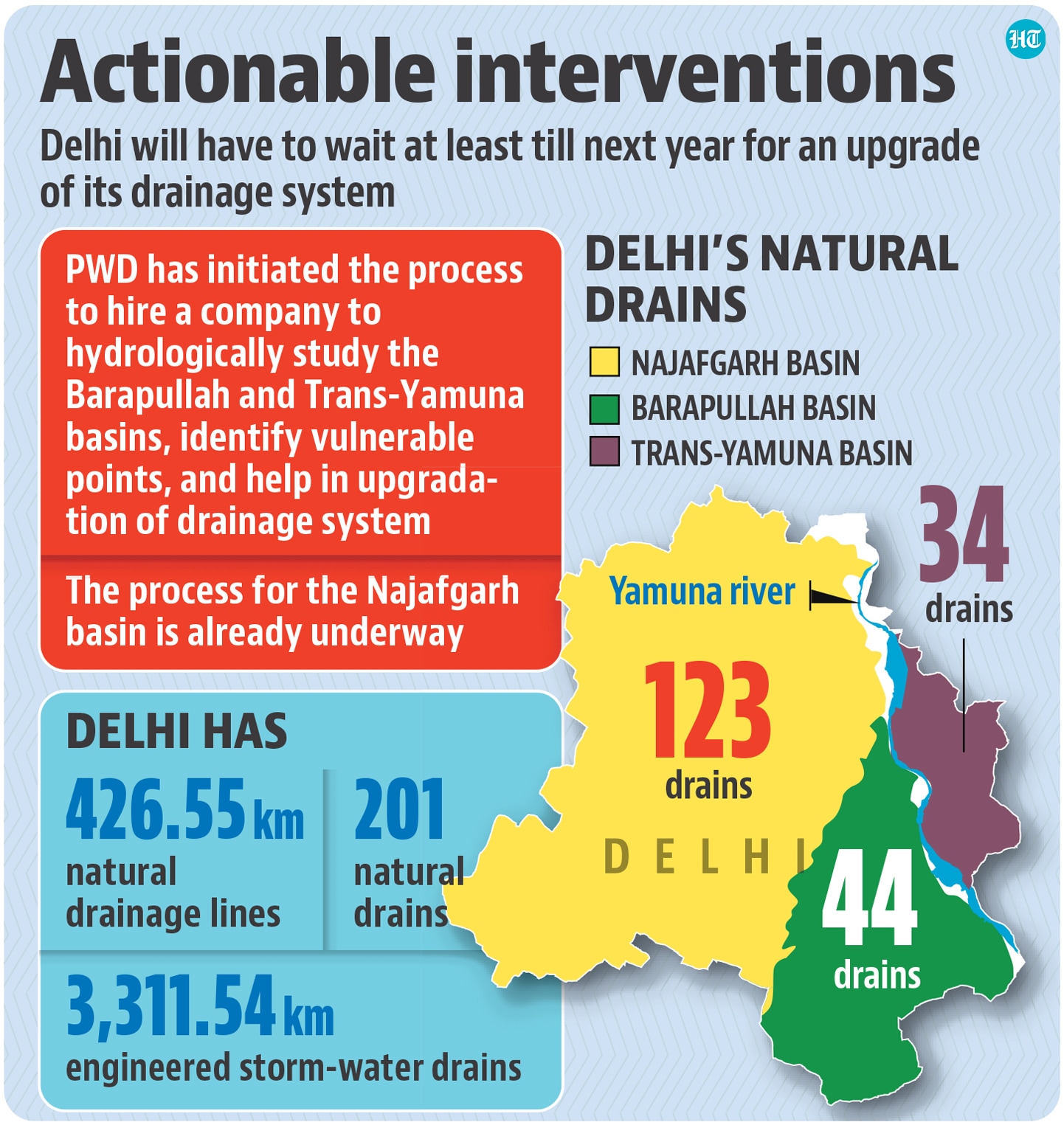
On Friday, the PWD invited bids to hire companies that will oversee a master plan for the drainage network in the Barapullah and Trans-Yamuna basins, senior agency officials said, adding that it is already in the final stage of hiring a consultant to revamp the Najafgarh basin.
“The process to hire a consultant for the Najafgarh basin was started last year, and bids have been finalised. We were waiting for a sanction of administrative expenditures, and the award letter will be issued next week. The consultant will focus on turning a July 2018 report by the Indian Institute of Technology, Delhi on the drainage master plan into actionable interventions and tackling waterlogging at vulnerable sites,” the official said, requesting anonymity.
A second PWD official associated with the project said consultants for the Najafgarh basin will be finalised next week, while the other two basins will get consultants by the end of May. “A period of six months has been provided to the consultant for carrying out topographical surveys, field surveys and a hydraulic study of their respective basins, as well as the finalisation of a report providing solutions in their respective drains. One year has been provided for the execution of the work to remodel the drainage network, and the impact of these interventions will be studied in the subsequent monsoon for validation of the solutions,” the official said.
According to PWD estimates, the city’s drainage system can cater to 50mm rainfall over a 24-hour period. Anything more than that overwhelms the system, resulting in the flooding of arterial roads.
In 2009, the then lieutenant governor, Tejendra Khanna, had asked civic agencies and all stakeholders to prepare a new masterplan for Delhi’s watershed and drainage system. In 2018, the IIT-Delhi report recommended that the practice of puncturing sewer lines and draining sewage into storm drains to deal with blockages should be stopped, and the separation of the sewage and storm water drain system should be prioritised.
However, a technical panel of the government rejected the report in August 2021, calling it generic and raising multiple issues, including discrepancies in the data given to IIT-Delhi.
The process to upgrade Delhi’s drainage master plan is likely to take up to a year, but in the interim, the PWD has said that it has completed corrective steps in the capacity enhancement and finding engineering solutions for 13 critical waterlogging points in the Capital.
Last week, PWD minister Atishi said the agency has identified 165 waterlogging spots and five hotspots across Delhi, directing the department to complete the desilting of drains before the monsoon, and seeking a weekly report from them.
The five waterlogging hotspots are -- New Rohtak Road, under the Zakira Nagar flyover, the Loni Road roundabout, near the Jahangirpuri Metro Station, and the Karala Kanjhawala Road. Various measures have been taken by agencies at these hotspots, including increasing the capacity of existing pump houses, and the modification or construction of drains.
PWD is currently desilting these drains, with the first phase likely to be completed by May 31. During the monsoon, PWD’s central control room will also monitor serious water logging areas through 24-hour CCTV surveillance, officials said.