
 E-Paper



Delhiwale: Bedil’s man in Dilli
Sharif Husain Qasemi, Delhi’s expert on Persian poet Bedil, reflects on his life and influence while enjoying chai in his book-filled home.

 Prefer HTon Google


Every morning, at seven, this elderly man gets up from his bed. While the household is asleep, he tiptoes into the kitchen, quietly making a cup of chai.
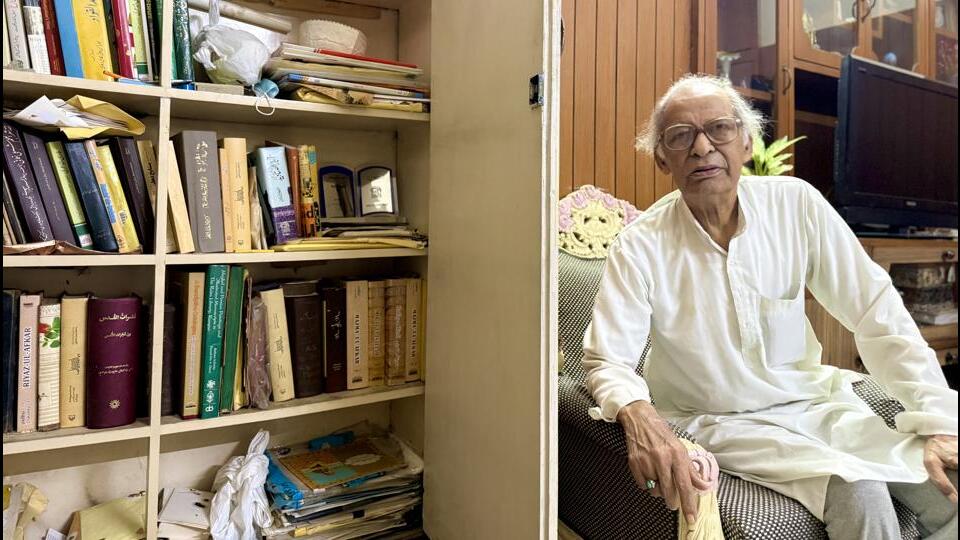
The illustrious Sharif Husain Qasemi is Delhi’s only expert on Bedil, the 18th century Persian poet notorious for being so difficult that he was considered difficult even by the great Ghalib, himself notorious for his difficult Persian poetry. Indeed, the most acclaimed of Sharif Husain’s 20 books is titled “A Master Catalogue of the Manuscripts and Published Editions of the Works of Mirza Abdul Qadir-e-Bidel.”
This evening, the scholar is at home in his book-filled Nizamuddin East bungalow. He retired 15 years ago as a professor of Persian from Delhi University. Reclining on a sofa, Sharif Husain offers Chainaram’s coconut barfi to his visitor. Somewhere within the house is professor’s wife, Zakira, who retired as professor of Persian from Jawaharlal Nehru University. The drawing-room chitchat gradually shifts to Sharif Husain’s lifelong muse. “One can work out what life is by reading Bedil, he was a philosopher poet.” These casually uttered words are phrased with elegance, as if the speaker were reading from a nicely edited book.
“Bedil was born in today’s Jharkhand,” says the professor. “At his prime youth, he shifted to Delhi, which was the greatest centre of the patronisation of Persian poetry in India.” The professor explains that Bedil’s poetry and prose, all of which he wrote in Delhi, made him a significant figure in the entire Persian-speaking universe. Today, he says, Bedil commands a cult status in Iran, Afghanistan, and in many Central Asian ‘tans. Literary institutions are named after him in those lands. Tehran annually hosts Urs e Bedil, attended twice by the professor.
Between sips of pheeki chai, Sharif Husain concedes that Bedil would express even ordinary ideas in a difficult way. But Bedil had a great command of the Persian language, he asserts, and the poet coined innumerable phrases that did not exist earlier in Persian literature. “Persian language writers who are writing today turn to Bedil’s innovative phrases and novel ideas to compose their own modern works.” The professor pauses, before starting a new sentence. “Bedil did to Persian what Joyce did to English language.”
These days, us Hindi-speaking Delhiwale are barely aware of Bedil, although he lies buried in our city. This is in contrast to the other legendary Delhi poet. Mirza Ghalib’s Persian poetry isn’t read either by most Delhiites, but his life and legends are richly irrigated into Dilli’s contemporary ethos. The professor agrees, remarking: “Ghalib started writing his poetry by imitating Bedil.”
He now gets up and steps out of his bungalow, slowly strolling along the neighbourhood’s peaceful lanes, arms crossed behind his back. You would imagine that he was continuing to dwell on 18th century poetry and poets. He finally stops by a cigarette kiosk.

Stay updated with all top Cities including, Bengaluru, Delhi, Mumbai and more across India. Stay informed on the latest happenings in World News along with Delhi Election 2025 and Delhi Election Result 2025 Live, New Delhi Election Result Live, Kalkaji Election Result Live at Hindustan Times.


