Sign in

Door-to-door campaign, RSS helped BJP win big

A BJP functionary, who wished to remain unnamed, said that the previous Khattar government’s policy of fair recruitment across Haryana ensured that people rejected the Congress

Updated on: Oct 9, 2024, 05:52:06 IST
Share
Share via
  • facebook
  • twitter
  • linkedin
  • whatsapp
Copy link
  • copy link

Gurugram:

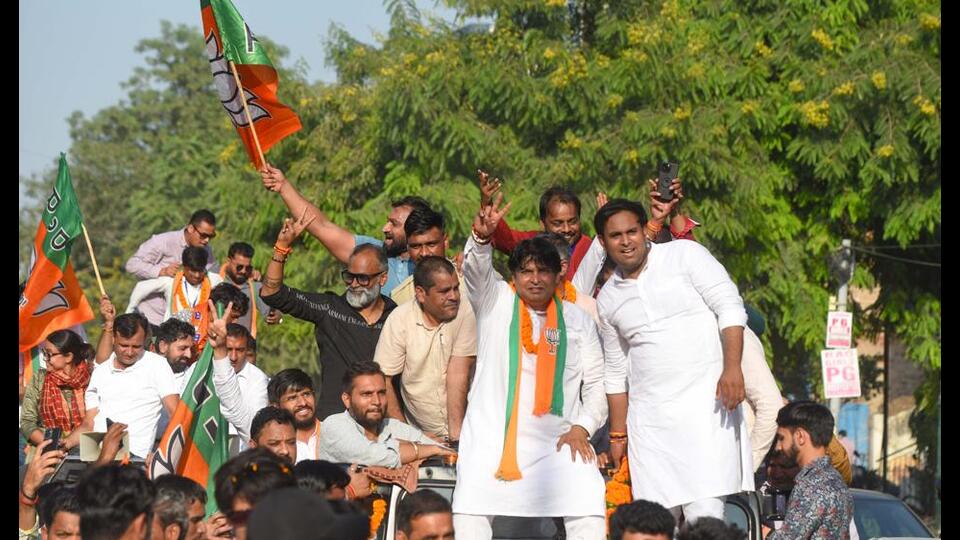
Mukesh Sharma, Bharatiya Janata Party candidate from the Gurgaon seat after his poll victory in Gurugram on Tuesday. (HT PHOTO)

Large-scale door-to-door campaigning over the last month played a key role in helping the Bharatiya Janata Party (BJP) beat anti-incumbency in south Haryana, party workers said. This, coupled with close coordination between BJP functionaries and Rashtriya Swayamsevak Sangh (RSS) workers, propelled the party to its third win in a row on Tuesday, they said.

The BJP also attributed their victory to efforts made by senior party leader and former chief minister Manohar Lal Khattar.

Kamal Yadav, BJP district president, Gurugram said, “Everyone voted in favour of BJP but credit must be given to former CM Manohar Lal Khattar, who campaigned actively in Gurgaon and all other areas along GT Road to ensure the Punjabi community voted for BJP.”

Another BJP functionary, who wished to remain unnamed, said that the previous Khattar government’s policy of fair recruitment across Haryana ensured that people rejected the Congress.

A senior RSS functionary based in Gurugram, said his organisation and the BJP campaigned for the elections in a very planned manner.

“We normally conduct door-to-door meetings with people for only five days, during which we motivate them to cast their votes in the interest of the nation. This time, however, the BJP was finding it difficult to contest the election, so thousands of RSS swayamsewaks associated with shakhas across the state were mobilised, and they held door-to-door meetings for almost one month, which played a key role in swaying the mood of the voters,” the RSS functionary said, on condition of anonymity.

He said that RSS and BJP leaders held regular review meetings, and discussed steps to be taken in constituencies where the party needed more support.

“We exchanged information and supported the BJP on ground level. Regular samiksha baithaks (review meetings) were held with BJP leaders, where feedback was shared. Prior to the elections, the RSS also played a key role in ticket distribution,” he said.

Arun Yadav, who heads the BJP social media team in Haryana, said that hard work of RSS and BJP workers played a key role in mobilising and creating awareness among voters. “We were able to convince the voters that only the BJP could provide a clean government, which put focus on merit and did not discriminate on the basis of caste and community. A great role in this was played by party and sangh karyakartas by working together, “ he said.

  • Abhishek Behl
    ABOUT THE AUTHOR
    Abhishek Behl

    Abhishek Behl is a Special Correspondent with Hindustan Times, Gurugram bureau. With over a decade of experience in journalism, he reports on Gurugram's rapid urban transformation, covering the city's changing infrastructure, governance, and planning landscape. His reporting spans major civic agencies, such as the Gurugram Metropolitan Development Authority (GMDA), Department of Town and Country Planning (DTCP), Haryana Shahari Vikas Pradhikaran (HSVP), and the National Highways Authority of India (NHAI). Behl has reported on key urban development issues such as RRTS projects, metro expansion, road and highway projects, water supply, drainage, mobility, environmental concerns, land use planning, affordable housing, and the city's real estate sector. He closely tracks policy decisions, infrastructure implementation, and their impact on the city and its residents. He also covers regulatory action against illegal constructions, urban flooding, traffic management, and initiatives aimed at improving civic services and sustainable development. Behl has also written on political developments in south Haryana, focusing on elections and governance. His journalism is driven by fact-based reporting, ground-level coverage, and an understanding of the social and economic dynamics of Gurugram. Apart from work he is a cyclist and a cricketer and a resident of Palam Vihar since 2010.Read More

  • Leena Dhankhar
    ABOUT THE AUTHOR
    Leena Dhankhar

    Leena Dhankhar is Senior Editor and Bureau Chief, Gurugram, at Hindustan Times, where she has spent over 17 years chronicling the transformation of one of India's fastest-growing urban regions. From starting her career as a crime reporter to leading the Gurugram bureau, her journalism has been defined by investigative reporting, in-depth storytelling and an unwavering focus on public interest. Over nearly two decades, she has reported extensively across crime, politics, civic governance, elections, real estate, environment, courts, sports, education and entertainment, covering Gurugram, Faridabad, Nuh and Palwal. Her reporting has exposed several major scams and systemic failures, including insurance frauds, waste management irregularities, illegal arms manufacturing units in Nuh, illegal mining in the Aravallis, organised crime networks and governance lapses affecting millions of residents. Known for her investigative work and exclusive stories, Leena has reported on high-impact national issues, including the Nicaragua charter flight carrying Indian migrants that was turned back amid allegations of human trafficking, exposing the growing network of illegal immigration rackets. Her work has also focused on gang wars, prison administration, juvenile crime, women and child protection systems, the functioning of the Juvenile Justice Board and Child Welfare Committee, and environmental challenges such as pollution, waterlogging and deteriorating civic infrastructure. Beyond hard news, Leena has extensively documented Haryana's rich heritage, forests and wildlife, bringing attention to the state's historical landmarks, biodiversity, conservation efforts and ecological challenges through immersive reportage and feature writing. Her journalism has consistently gone beyond breaking news. She has documented Gurugram's rapid urbanisation through long-form narratives and enterprise reporting on issues ranging from pothole-ridden roads, flooding and waste management to the changing social fabric of India's Millennium City. She also writes widely read feature columns, including The Outsider, Changemaker, and Concern for Gurugram, profiling people, places and ideas shaping the city's identity. Leena is the author of Gurugram School Murder, published by Juggernaut Books, a deeply reported account of one of India's most high-profile school murder investigations. She is currently working on her second book, an investigative work exploring some of India's most significant scams and fraud investigations. Beyond print journalism, she has expanded her storytelling through public speaking and digital media. She is a TEDx speaker and has produced podcasts exploring Gurugram's transformation, civic challenges and untold stories. Her work reflects a commitment to narrative journalism that combines rigorous reporting with compelling storytelling. A law graduate with an MBA in Human Resources, Leena brings a multidisciplinary perspective to her reporting, particularly on governance, public policy and legal affairs. She has travelled extensively across India to pursue investigative assignments, often reporting from remote locations and conflict-prone areas in search of stories that matter.Read More