E-Paper



Drains, soap, dyes: What plagues the Yamuna in Delhi
The Yamuna River's water quality deteriorates drastically as it flows through Delhi, facing severe pollution from drains and illegal waste dumping.

 Prefer HTon Google


The difference in the Yamuna when it enters Delhi, and the form in which the river exits the city are stark – chemically, visually, and even by smell.
Spanning 22km through the capital, the Yamuna encounters a major drain approximately every 1.2km, each adding to its contamination. This, along with other smaller sources of pollution, consistently chip away at the water quality as the river traverses the city.
The deterioration starts soon after the river meets the Najafgarh drain – the first and the largest polluting of the city’s 18 drains – that ferries much of Delhi’s sewage, industrial effluents and other toxic waste into the river.
When the river enters the Capital at Palla, its water meets pollution norms, with acceptable levels of biological oxygen demand (BOD) and dissolved oxygen (DO), no visible froth, and no foul smell.
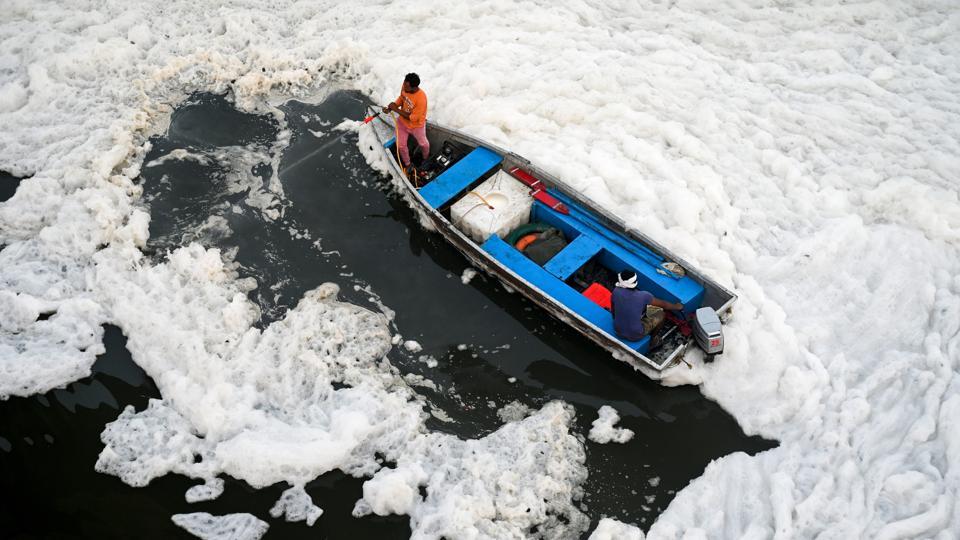
By the time the river exits the city, the river’s pollutants are as high as 30 times the permissible standards, and around this time of the year, there’s a thick iceberg-like block of foam that blankets the surface.
The foam problem
Satellite images reveal two major froth hotspots between Wazirabad and Okhla—the first near the DND flyway and the second at Kalindi Kunj, where toxic froth rises annually, even as devotees immerse themselves in the river side-by-side with the toxic hills of froth.
Experts attribute the foam issue to largely two causes – dumping of detergents in the river, and “churning points” that lead to bubble formation.
Bhim Singh Rawat, an activist with the South Asia Network on Dams, Rivers and People (SANDRP), said the government has been slow to act on evidence of contamination.
“In 2021, the Delhi Pollution Control Committee (DPCC) banned detergents and soaps that did not meet BIS standards to prevent froth formation in the Yamuna, but the ban remains only on paper. The surfactants released from these detergents is one of the key reasons behind froth formation, which completely eats up any oxygen left in the river,” said Rawat.
The National Green Tribunal (NGT) Yamuna Monitoring Committee, in its fifth report on the river in 2021, stated the presence of high phosphates and surfactants, released by detergents was the main reason behind high froth formation.
It had also asked for action against illegal dhobi ghats, operating along the river.
Despite some action by the Delhi Development Authority (DDA) to remove encroachments, Rawat says clothes are still washed near the river around Kalindi Kunj and Okhla, where there were ghats earlier.
“We still have clothes being washed. But more importantly, largescale phosphates are entering the river from different industries and factories. The use of household detergents is also reaching the river, as our drains are still not trapped,” said Rawat.
“Trapping” refers to connecting drains to sewage treatment plants (STPs) to intercept pollutants. [CHECK]
Once the detergents are in the river, any elevation change ends up churning the water, leading to formation of bubbles and ultimately froth.
“There were plans of the government to create a platform to prevent churning in the river, but even that has not materialised,” he added.
The chemical issue
Meanwhile, illegal dyeing operations continue to release toxic effluents into the city’s drains. Many of these facilities, operating in areas not zoned for industry, funnel waste directly into the river, experts said.
Varun Gulati, an activist who filed a petition in NGT in 2019, seeking action against such units, says these continue to operate in the floodplains, particularly near Jaitpur’s Khadda colony and at the Shram colony near Kalindi Ghat. “There is also a hub in Seelampur, which directly discharges its effluents into the Shahdara drain. We see a significant spike in pollution once the Shahdara drain meets the river. Other hubs across Delhi include Khayala, Sarita Vihar, Libaspur, Narela, Bawana and Mukundpur,” he said.
“Our drains are not fully trapped and meeting STPs, but they are also not meant to be handling such toxic effluents in the first place,” Gulati says.
DPCC in a report to the National Mission for Clean Ganga (NMCD) in April this year said 13 out of 18 drains had already been connected to sewage treatment plants (STPs). However, some of the largest drains such as the Najafgarh drain, Shahdara drain and Barapullah drain are yet to be trapped, alongside the Maharani Bagh and Mori Gate drains.
DPCC’s water quality data from its drains in October shows none of the 18 drains met the biological oxygen demand (BOD) mark of 30 mg/l, with levels oscillating from 48 mg/l at the Maharani Bagh drain to 100 mg/l at the Shahdara drain.
The latest water quality report from October, issued on October 28 also corroborates this problem. The BOD, which should be 3 mg/l or less in the Yamuna, was recorded at 4 mg/l at Palla – the first out of eight points where the river’s water quality is measured. This increased to 9 mg/l – three times the standard at Wazirabad, soon after meeting the Najafgarh drain it touches 44 mg/l or 11 times the reading recorded at Palla. By the time the final reading is collected at Asgarpur, BOD is 44mg/l.