New Delhi: The Delhi University (DU) plans to frame guidelines for social media campaigning during the DU Students’ Union (DUSU) elections, a university official said.
The framework is likely to be introduced before the next DUSU elections as the university pushes for paperless campaigning, and aims to ensure cleaner and fairer campaigning on digital platforms.
DU’s chief election officer Raj Kishore Sharma told HT:“During counting, a candidate requested a recount of a particular round, which we agreed to in the interest of transparency. However, another candidate subsequently posted a video claiming that counting had stopped, triggering reactions among students. Similar instances occurred during campaigning, with unverified information circulating on social media. Since we had not collected or verified candidates’ official social media handles, it was difficult to establish the authenticity of such posts.”
“We will hold discussions with experts to explore whether a broader framework can be formulated to address issues regarding the online space,” Sharma said.
Currently, the existing framework — including the Lyngdoh Committee guidelines and Delhi High Court directives — largely focuses on regulating physical campaigning.
It includes a ₹5,000 spending ceiling, the use of handmade campaign material only at designated locations such as the walls of democracy, and the removal of all campaign material within 48 hours of polling. Prohibited activities include involving non-DU students, using loudspeakers or vehicles for parades, and using mascots.
{{/usCountry}}It includes a ₹5,000 spending ceiling, the use of handmade campaign material only at designated locations such as the walls of democracy, and the removal of all campaign material within 48 hours of polling. Prohibited activities include involving non-DU students, using loudspeakers or vehicles for parades, and using mascots.
{{/usCountry}}The voting for the DUSU elections (2026–27) concluded on September 18, with results declared on September 19.
The Akhil Bharatiya Vidyarthi Parishad (ABVP) backed candidates won three of the four central panel posts: Yash Dabas as President with 24, 576 votes, Riya Chhawdi as Secretary with 21,650, and Lakshay Raj Singh as Joint Secretary with 16,615 votes. Independent candidate Deepanshu Shokeen won the Vice-President’s post with 30,615 votes, becoming the first independent candidate to do so in 17 years.
A total of 60,845 votes were polled for the President’s post, including 4,310 NOTA votes. The Vice-President’s post recorded 60,854 votes, of which 4,359 were NOTA. For Secretary, 60,776 votes were polled, including 7,884 NOTA votes, while the Joint Secretary’s post recorded 60,825 votes, including 7,389 NOTA votes. Overall, NOTA accounted for 23,942 of the 243,300 votes polled across the four central panel posts. The option accounted for 9.84% of the total votes cast, meaning roughly one in every 10 voters opted for NOTA rather than choosing a candidate.
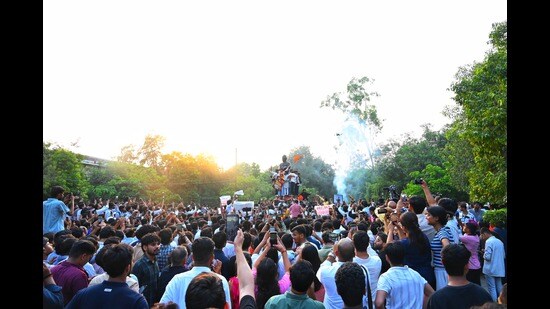
Two of the four central panel posts—President and Joint Secretary—witnessed particularly close contests. Candidates from the ABVP and NSUI were in a tight race for the President’s post, while the ABVP and Samajwadi Chhatra Sabha faced a close contest for Joint Secretary. Following the results, the NSUI staged a protest outside the Arts Faculty, alleging irregularities in the election process.
Stay updated with all top Cities including, Bengaluru, Delhi, Mumbai and more across India. Stay informed on the latest happenings in World News along with Delhi Election 2025 and Delhi Election Result 2025 Live, New Delhi Election Result Live, Kalkaji Election Result Live at Hindustan Times.
Stay updated with all top Cities including, Bengaluru, Delhi, Mumbai and more across India. Stay informed on the latest happenings in World News along with Delhi Election 2025 and Delhi Election Result 2025 Live, New Delhi Election Result Live, Kalkaji Election Result Live at Hindustan Times.