In midtown Manhattan stands a building from the 1920s whose owner declined to sell to developers who planned a large contemporary tower on the block. Because he did not budge the architects had to design around him; that is, a single homeowner was given the standing to make a very large builder adapt to his house. In Delhi that standing runs the other way. At the demolition sites I have visited, a small mark appears on a part of the building, and an official communication follows stating that the property will be taken over and compensation paid. Nothing in the process leaves the homeowner with the option of holding on to his house, especially when the state is taking the land.
The house that flanks a historical site, protected or unprotected, is ill-treated instead of treated with care. It is handed a long list of regulations meant to preserve the facade of the neighbourhood around the monument. The premise is sound but the enforcement is not. One need only walk through any locality beside a monument to see buildings that are beautifully old but barely holding on.
Residents describe enforcers as touts of objections, who do not let a house maintain itself where permissions and permits weather the building more than the rain does. Families eventually give up because they tried, the building slowly becomes fragile. Some parts of a house surrender before others, and the first is usually the plumbing—the fissured pipes that cannot take a pressure pump. This is why the plumber, in a caution funnier than he intends, announces, “Pipe phat jayega.”
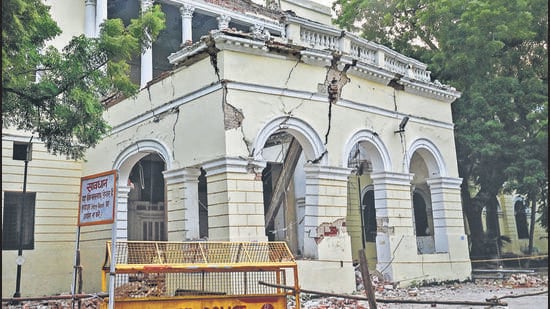
The state is a poor example for the families it regulates. The Town Hall in Chandni Chowk, a Grade-I protected building completed in 1863 and owned by the Municipal Corporation of Delhi (MCD) since 1866, lost its entrance porch roof and two massive beams on October 31, 2026, damaging portions of its first floor and facade. MCD began moving its offices to the new Civic Centre on Minto Road in November 2010, completing the shift over the following weeks. The Town Hall has remained largely unused since, its deterioration continuing through successive proposals for restoration and reuse.
{{/usCountry}}The state is a poor example for the families it regulates. The Town Hall in Chandni Chowk, a Grade-I protected building completed in 1863 and owned by the Municipal Corporation of Delhi (MCD) since 1866, lost its entrance porch roof and two massive beams on October 31, 2026, damaging portions of its first floor and facade. MCD began moving its offices to the new Civic Centre on Minto Road in November 2010, completing the shift over the following weeks. The Town Hall has remained largely unused since, its deterioration continuing through successive proposals for restoration and reuse.
{{/usCountry}}The following day, a three-storey building under construction in Gali Sitara, Chawri Bazaar, collapsed in a neighbourhood where many buildings are eighty to a hundred years old and are used as warehouses and shops without adequate structural oversight. Two deaths were reported. The two collapses are not the same event, nor do they have the same cause, but together they raise a question that the city can no longer postpone: who is obliged to pay for and enable the upkeep that the law demands of private owners? The Hindustan Times has returned the question of a preservation policy to the city pages in its coverage of these collapses. A policy cannot be limited to identifying unsafe buildings after they have begun to fail. It must address the conditions in which they are maintained, occupied and repaired.
The department that would help answer this question is not equipped to. Krishan Murari reported in ThePrint that 13 of the 18 sanctioned posts in the Delhi Department of Archaeology are vacant, that there is no deputy director, that the department is responsible for 75 monuments, and that it has undertaken no major excavation in nearly three decades. A department with most of its sanctioned posts vacant cannot be expected to oversee the city’s archaeological and built inheritance with any consistency.
There is a visible absence of professional depth, institutional continuity and a consistent method of enforcement. Rules are applied selectively, permissions become obstacles rather than instruments of protection, and the agencies entrusted with the city’s history operate without any shared understanding of what constitutes that history. A monument is heritage; the house beside it is a private inconvenience. A historic street is traffic infrastructure; its pedestrian life is an afterthought. A modernist house is simply an old building without any particular value. The result is that Delhi is losing its cultural layers not through one spectacular act of demolition, but through the accumulated indifference of the institutions meant to protect them.
The same indifference greets anyone who enters the city by its northern approach. The old Grand Trunk Road forms part of a much older route into Delhi, but what the traveller meets on the Karnal Road today is the trash heap at Mukarba Chowk, followed by the deteriorating Art Deco facades of Roop Nagar and Shakti Nagar, before the road reaches the university area where the city presents itself to its students. These houses are part of the history of Delhi’s expansion, of the residential city that grew around the old road. They are also part of the everyday landscape through which the city is experienced. Yet the road is maintained as a passage for traffic, while the buildings and neighbourhoods along it are left to decline.
Delhi’s heritage cannot be understood only through the monuments that have been notified and fenced. It also resides in the houses built after Partition, in the domestic architecture of the 1950s and 1960s, in the planned colonies and older settlements, in the lanes and pedestrian networks that connect them. In many of the city’s historic neighbourhoods, courtyards have disappeared, lanes have narrowed, drains are choked and houses have been subdivided. The original spatial centre of a settlement and the relationships between its houses, streets and shared spaces are gradually dislodged. Abadi land is treated as a planning problem rather than as historic urban fabric. The house is assessed as an individual property, while the neighbourhood that gives it meaning is allowed to come apart.
The state has little interest in the survival of privately owned houses. These are somebody else’s problem. Yet it is the state that determines what can be altered, repaired or rebuilt, and it is the state that asks families to preserve buildings without making preservation financially or administratively possible. The burden is currently carried through delay, since delay is often the only instrument available to an owner who is refused permission to repair and is then left to wait for collapse.
The remedy is administrative before it is aesthetic. A single-window process with fixed timelines and deemed approval for like-for-like repairs would allow owners to maintain their houses without entering a cycle of indefinite permissions. A repair fund or tax relief could support families whose properties fall under conservation restrictions. The archaeology department needs the professional staff its own sanctioned strength already allows. The city’s old buildings need structural audits, beginning with those owned by public agencies. And a preservation policy must recognise the value of domestic architecture, historic streets and pedestrian life, not only the monuments that happen to stand within them.
In Manhattan, a developer had to design around one man’s house. In Delhi, a family can spend years trying to obtain permission to keep its house standing. The difference is not architectural. It is administrative.
Walking the city from point A to B, I always ask: can they not see? The buildings are crumbling, the lakes are dead, the river is sewage. They don’t need to see to punish, but they need to see to care; they need to enforce what their role is, before enforcing on the people.
Anica Mann works on archaeology and contemporary art in Delhi. The views expressed are personal
Stay updated with all top Cities including, Bengaluru, Delhi, Mumbai and more across India. Stay informed on the latest happenings in World News along with Delhi Election 2025 and Delhi Election Result 2025 Live, New Delhi Election Result Live, Kalkaji Election Result Live at Hindustan Times.
Stay updated with all top Cities including, Bengaluru, Delhi, Mumbai and more across India. Stay informed on the latest happenings in World News along with Delhi Election 2025 and Delhi Election Result 2025 Live, New Delhi Election Result Live, Kalkaji Election Result Live at Hindustan Times.