New Delhi: More than 85% of the 3.28 million hectares under paddy cultivation in Punjab had been harvested by November 4, according to the latest government data.
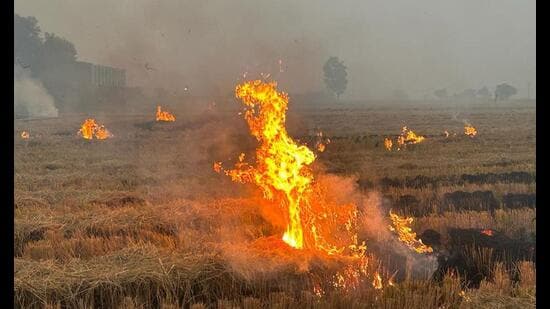
In Tarn Taran, the district with the most farm fires this season, 98% of the cultivated area has been harvested.
Tarn Taran has recorded 558 farm fires so far, more than the combined total in Uttar Pradesh (392) and Haryana (62). District-wise harvesting data submitted to the Commission for Air Quality Management (CAQM) shows that only four of Punjab’s 23 districts have harvested 75% or less of their paddy area. Fazilka has harvested 48%, followed by Bathinda at 65%.
Over the past two weeks, the CAQM has issued notices to seven Punjab districts for failing to take adequate action to control farm fires. Notices went to the administrations in Fazilka, Faridkot, Jalandhar, Bathinda, Barnala, Kapurthala and Gurdaspur because their farm counts were higher than during the corresponding period last year.
In early October, the CAQM also issued notices to Tarn Taran and Amritsar, asking the local administration on what action they had taken.
With much of the crop now harvested, officials expect farm fire numbers to fall soon, reducing the impact of stubble smoke on Delhi.
{{/usCountry}}With much of the crop now harvested, officials expect farm fire numbers to fall soon, reducing the impact of stubble smoke on Delhi.
{{/usCountry}}Ludhiana has Punjab’s largest paddy area, at 257,500 hectares, of which 82% has been harvested till November 4. Bathinda has 244,400 hectares, with 65% harvested. In Sangrur, 80% of the 241,000 hectares has been harvested.
Among other major paddy growing districts, Patiala has harvested 75% of the 231,400 hectares, while Mukstar had harvested 75% of its nearly 208,000 hectares. Tarn Taran harvested 98% of its 179,500 hectares.
After Tarn Tarn, Firozpur has Punjab’s second-highest fire count, with 316 fires. According to the CAQM, 82% of the district’s are had been harvested.
In Haryana, around 71% of the total paddy area had been harvested. “However, farm fires in Haryana have been minimal, so Punjab has been a concern,” the official added.
Farm fires in both Punjab and Haryana impact Delhi’s air quality as northwesterly winds carry stubble smoke hundreds of kilometres to the capital. Punjab recorded 2,347 farm fires between September 15 and November 4, compared with 2,839 during the same period last year. Haryana recorded 62, down from 158 fires in the corresponding period.
Union environment minister Bhupender Yadav had said that more than 70% harvesting had been completed. He said a combination of ex-situ measures and in-situ action was likely to take harvesting close to 100% by next week.
Kurinji Kemanth, Programme Lead at the Council on Energy, Environment and Water said untimely rains had delayed Punjab’s paddy harvest by five to ten days.
However, CEEW research shows that over 33 per cent of Punjab’s farmers are using ex situ management, in which stubble is baled and used by industry boilers, power plants or compressed biogas plants.
“This share is around 38 per cent in Haryana. But baling is only half the job. If bales aren’t lifted from fields on time, farmers could resort to burning due to paucity of time. While the states have made notable progress in deploying and adopting machines, states should focus on fast-tracking the commissioning of approved ex-situ biomass projects and supporting biomass storage facilities where surplus biomass and buyers exist,” she added.
Stay updated with all top Cities including, Bengaluru, Delhi, Mumbai and more across India. Stay informed on the latest happenings in World News along with Delhi Election 2025 and Delhi Election Result 2025 Live, New Delhi Election Result Live, Kalkaji Election Result Live at Hindustan Times.
Stay updated with all top Cities including, Bengaluru, Delhi, Mumbai and more across India. Stay informed on the latest happenings in World News along with Delhi Election 2025 and Delhi Election Result 2025 Live, New Delhi Election Result Live, Kalkaji Election Result Live at Hindustan Times.