Water supply has been disruptedto various parts of the city due to the presence of high ammonia levels, indicating presence of pollutants, in the raw water in Yamuna upstream of Wazirabad, said senior officials on Wednesday.
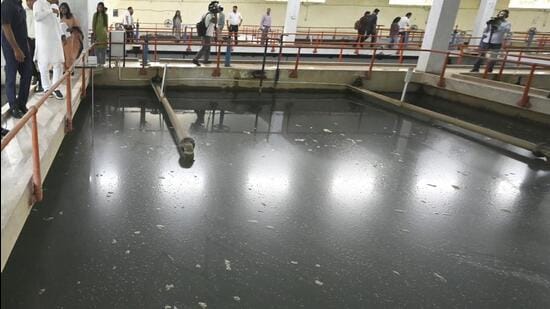
According to officials , the pollution spike has impacted operations of the Wazirabad and Chandrawal water treatment plants (WTPs) where the operations are curtailed by 25% to 50% levels. Both Wazirabad and Chandrawal WTPs directly draw water from Yamuna through Wazirabad pond and supply treated potable water to parts of north, central and south Delhi.
Delhi Jal Board (DJB) on Wednesday said that due to regular receipt of high pollutants in river Yamuna at Wazirabad pond, the water production has been affected by 25-50% at Wazirabad & Chandrawal WTPs. “Therefore, water supply will be available at low pressure till the situation improves. Public is advised to make judicious use of water and water tankers shall be available on demand from DJB helpline, 1916,” said the statement issued by DJB.
A senior DJB official said that the ammonia level in the raw water at Wazirabad on Wednesday morning was recorded at more than 3 ppm which is three times higher than the maximum treatable limit of 1.0 ppm. “DJB can treat up to 0.9 ppm of ammonia level in raw water, but beyond such a high level, neutralisation of ammonia with chlorine gas regularly leads to toxic chloramine compounds therefore the plants are operated at curtailed capacity,” said officials.
{{/usCountry}}A senior DJB official said that the ammonia level in the raw water at Wazirabad on Wednesday morning was recorded at more than 3 ppm which is three times higher than the maximum treatable limit of 1.0 ppm. “DJB can treat up to 0.9 ppm of ammonia level in raw water, but beyond such a high level, neutralisation of ammonia with chlorine gas regularly leads to toxic chloramine compounds therefore the plants are operated at curtailed capacity,” said officials.
{{/usCountry}}Meanwhile, the DJB is diverting raw water from Munak canal towards Wazirabad to enable dilution of the Yamuna water, leading to shortage in water supply in plants fed by the canal.
The areas likely to be impacted under the Wazirabad plant includes Defence Colony, Majnu Ka Tila, ISBT, NDMC area, ITO, Hans Bhawan, LNJP Hospital, CGO complex, Rajghat, Ramleela Ground, Delhi Gate, Subhash Park, Gulabi Bagh, Timar Pur, Punjabi Bagh, Azadpur, Shalimar Bagh, Wazirpur, Lawrence Road, Model Town. Areas in South Delhi like Moolchand, South Extn., Greater Kailash along with parts of Cantonment areas and south Delhi. Areas to be affected under the Chandrawal WTP includes NDMC, Karol Bagh, Jhandewalan, Hindu Rao, Civil Lines, Patel Nagar, Rajendra Nagar, Shadipur among others.
Ashok Bhasin, president North Delhi resident’s welfare association (RWA) said the water supply in many North Delhi areas was coming down at low pressure and it has completely stopped today. “Not only Subzi Mandi and Ghnatghar, we are getting zero water supply complaints from places like Subhash Nagar and Raja Garden as well. People have 1000L tanks therefore the impact is buffered but we are using cans for drinking water,” he added.
Bhasin said that several governments have changed but the solution including upgrading the treatment plants to treating pollutants and increasing buffer water storage has not been implemented yet.
Over the last several years, the periodic spikes in ammonia levels have been a long-standing point of dispute between Delhi and Haryana. DJB argues that the pollutants, such as dyes, chlorides and ammonia-based chemicals, flow from the Panipat industrial dye drain. Besides Panipat, DJB also regularly cites the intermixing of industrial waste in Sonepat, where two canals carrying freshwater and industrial water run parallel to each other, separated by a sand wall of a few inches. However, Haryana has maintained that there are no leaking pollution sources in its industrial areas.
Stay updated with all top Cities including, Bengaluru, Delhi, Mumbai and more across India. Stay informed on the latest happenings in World News along with Delhi Election 2025 and Delhi Election Result 2025 Live, New Delhi Election Result Live, Kalkaji Election Result Live at Hindustan Times.
Stay updated with all top Cities including, Bengaluru, Delhi, Mumbai and more across India. Stay informed on the latest happenings in World News along with Delhi Election 2025 and Delhi Election Result 2025 Live, New Delhi Election Result Live, Kalkaji Election Result Live at Hindustan Times.