Lieutenant Governor Taranjit Singh Sandhu on Tuesday reviewed the New Delhi Municipal Council (NDMC) hi-tech nursery and tulip propagation chamber at Lodhi Garden and directed the civic body to build on indigenous tulip propagation cycle and prioritise native species.
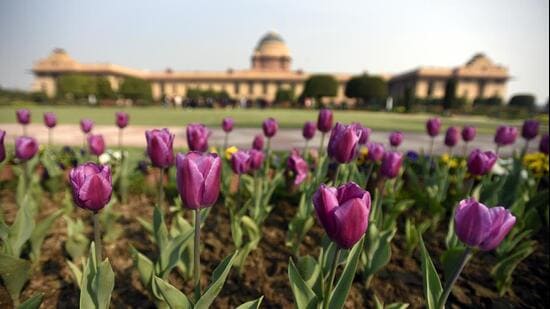
The LG reviewed efforts towards developing indigenous capabilities for growing tulips in Delhi and reducing dependence on imported bulbs, observing that the “initiative could serve as an example for other agencies to promote local cultivation of tulips”.
“Visited NDMC’s hi-tech nursery at Lodhi Garden to review tulip growth chambers, year-round sapling production, modern arboricultural equipment and the tree ambulance for heritage trees…Directed NDMC to build an indigenous tulip propagation cycle, expand seasonal blooms and prioritise native species — preserving and enriching the capital’s ecological heritage,” the LG said in a post on X.
NDMC has stated that for the forthcoming season, it is planning to procure approximately 4.67 lakh tulip bulbs. This will include 3 lakh bulbs for NDMC and 1.67 lakh bulbs for Delhi Development Authority (DDA). The council has harvested around 40,000 tulip bulbs from the previous season.
“The idea of growing tulips locally and gradually reducing dependence on imports began as a small step in 2022,” said an NDMC official. In the previous season, the civic body harvested approximately 40,000 Tulip Bulbs of different sizes, which are now stored in the tulip growth-cum-storage chamber at Lodhi Garden.
{{/usCountry}}“The idea of growing tulips locally and gradually reducing dependence on imports began as a small step in 2022,” said an NDMC official. In the previous season, the civic body harvested approximately 40,000 Tulip Bulbs of different sizes, which are now stored in the tulip growth-cum-storage chamber at Lodhi Garden.
{{/usCountry}}Of these, approximately 24,000 bulbs will be planted in the NDMC area, while the rest will be utilised for trials to enhance the size of bulbs in the growth chamber, the official further said.
Tulip bulbs are generally planted in December, with the flowers typically blooming towards the end of January. The flowering season typically continues until late February to early March, adding vibrant colours to the Capital’s parks, roundabouts and prominent roads.
The NDMC began tulip plantation in 2017, with a pilot project of 17,000 bulbs. It will purchase 62,800 bulbs in 2021, 1.4 lakh in 2022, 2 lakh in 2023, and 3.25 lakh in 2024. Importing each tulip bulb costs around ₹35-40.
For the period 2026-27, NDMC estimates an expenditure of ₹1.8 crore on the import of tulip bulbs from the Netherlands.
NDMC will also sell tulips in pots for the public, officials said.
A parallel project to reuse the bulbs and store them in climate controlled chambers at the Lodhi Garden is being carried out. Last year, 29,000 such indigenous tulips had been cultivated at Lodhi Garden, while 21,000 bulbs came from the Institute of Himalayan Bioresource Technology (IHBT-CSIR) at Palampur in Himachal Pradesh. This year NDMC is also planning to develop a Tulip Garden at Nehru Park this year.
Tulip propagation chambers
The council had set up storage-cum-propagation chambers in Lodhi Garden. Each propagation chamber has two rooms made up of insulated material with temperature that can be carried between 10°C to 20°C, humidifiers and growth units with LED lights.
“The unit is able to hold 240 fiber trays each able to accommodate and grow 150 Tulip bulbs. The capacity of the set up is to grow to 36,000 bulbs at a time,” the official added.
“Once the bulbs are harvested after blooming in February-March, they can be stored in a storage chamber at temperature varying from 15-20°C for three months till July. They are later kept under a low temperature of 5-6 °C for 10 weeks till the first week of October. Around the first week of October these bulbs have been put in the production chain by sowing them in a growth chamber at temperature 17-20°C with the aim to increase the size of bulbs to at least 10cm,” the official explained.
Stay updated with all top Cities including, Bengaluru, Delhi, Mumbai and more across India. Stay informed on the latest happenings in World News along with Delhi Election 2025 and Delhi Election Result 2025 Live, New Delhi Election Result Live, Kalkaji Election Result Live at Hindustan Times.
Stay updated with all top Cities including, Bengaluru, Delhi, Mumbai and more across India. Stay informed on the latest happenings in World News along with Delhi Election 2025 and Delhi Election Result 2025 Live, New Delhi Election Result Live, Kalkaji Election Result Live at Hindustan Times.