E-Paper



OPD, elective services hit in Delhi as doctors at private hospitals join stir
Similar scenes were visible across government hospitals where professionals have been protesting the rape and murder of a trainee doctor in Kolkata

 Prefer HTon Google


Patients that arrived at Sir Ganga Ram Hospital on Saturday were greeted with a banner that stated that the out-patient department (OPD) was suspended for the day. Resident doctors were seen walking around the hospital’s campus, raising slogans demanding safety for their colleagues across the country even as patients visiting the OPD for elective and non-emergency services were turned away.
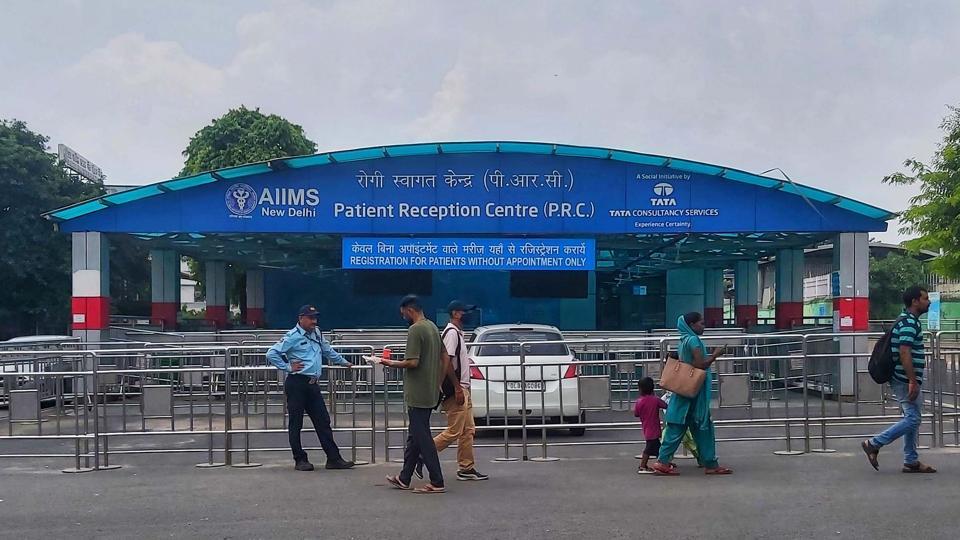
Similar scenes were visible across government hospitals for the past week, where medical professionals have been protesting the barbaric rape and murder of a trainee doctor in Kolkata that has channelled outrage. While the protests have mostly been led by healthcare workers, but have also been joined by tens of thousands of ordinary citizens, led primarily by women.
On Saturday, the strike for the first time involved private hospitals as well as after a call for protest was issued by the Indian Medical Association (IMA) – the country’s largest group of doctors – which put a halt to non-essential services at hundreds of hospitals across the country, including Delhi.
This meant that thousands of patients were turned away from OPDs.
Soumya Mishra, 33, a resident of Uttam Nagar, visited the hospital with her three-year-son who had a large boil on his right leg due to an infection but was turned away. “We came in an auto from Uttam Nagar - just me and my son. My son was in pain. I had no idea about the strike,” Mishra said.
Taufeek Khan, a 35-year-old resident of Jahangirpuri, had come to Ganga Ram Hospital to get a consult over a liver ailment, but was told to return on Monday.
“We have come from so far away. I have terrible pain my liver became of swelling. I’ll have to manage till Monday or look for another hospital now. I went to emergency but they referred me to OPD,” he said.
A 32-year-old woman had brought her five-year-old son for stomach ache. She was also told to come back on Monday. “I understand it’s an important cause, but making patients suffer is not what doctors should do. They should meet higher ups in the government for their demands,” she said. The woman asked not to be identified for this report.
Doctors, meanwhile, insisted that their demands are completely necessary and that they are only protesting because they are left with no option.
“We spend 12-13 years of our life to become a specialist doctor only to be raped and murdered? How shocking it is that one is not safe even at their workplace” said Dr Chahat Verma, a 30-year-old resident doctor. “It [the protest] may be for a day, but we have to start somewhere. We can’t sit here doing nothing.”
By 11.30am, protesting had taken several rounds of the hospital and nearby areas. They covered Shankar Road and Old Rajendra Nagar – raising slogans to create awareness about their protest.
Similar protests were visible at corporate-owned hospitals as well, though the impact was mellow.
At BLK-Max Super Specialty Hospital in west Delhi, a handful of doctors were present in the OPD. There was no demonstration as well.
Paramjeet Kaur, 37, resident of Burari, came for a liver ailment but was turned away. “On Friday, the doctor asked for some tests and told me to come back today. I’ve been here since 9am. Initially, they said that the doctor will come, but later said he won’t,” said Kaur.
Since many corporate hospitals require prior appointments (usually scheduled on their websites), the patient load was significantly lower in OPDs as appointments were not issued for Saturday.
“We tried as far as possible to inform patients to reschedule,” said an executive from Indraprastha Apollo Hospital. The hospital had fully shut its OPD, non-essential diagnostic services, and elective procedures.
“We stand in unwavering solidarity with healthcare providers across the nation. Women comprise a significant majority of our workforce, playing crucial roles at every level of our organization. We are committed to ensuring their safety and dignity,” it said in a statement.
At the Fortis Escorts Heart Institute in Okhla, most doctors turned up for work. Patients said that they had expected that their appointments would be rescheduled, but it was not needed.
“My mother recently underwent surgery and a scheduled follow-up today. We knew about the protest, so we called on Friday to get a confirmation. We were told that the doctor would be available,” said Surbhi Mittal, a 50-year-old resident of Greater Kailash 1.
Staff at the hospital informed that most doctors did their usual round and also saw patients who had prior appointment at the OPD. However, few doctors joined the protests and did not attend their OPDs, and their patients were informed beforehand to avoid any confusion at the hospital.
The spokesperson for Max Health Care that was also partially functioning, said, “…Max Healthcare stands firmly with our doctors and supports those who choose to participate in the Indian Medical Association’s nationwide withdrawal of services…While we respect and support the choices of our doctors, we assure our patients and the community that essential services will remain uninterrupted and we will continue to deliver the highest levels of care to all our patients…”
Dr Suvir Dev, 34, general secretary of Ganga Ram’s resident doctors association, stressed on the lack of legal protection for doctors. “People need to know that they can’t charge at doctors or manhandle them at their whim. In western countries, the punishment for manhandling a doctor is severe but here, there is no protection for us. The situation in government hospitals is worse,” he said.
“A large number of doctors have blocked their OPDs and are only attending urgent patients. Emergency services were normal,” said a spokesperson for Fortis Hospital.