
 E-Paper



‘Oxymoron’: Experts slam ‘green firecracker’ decision
The Supreme Court first allowed their limited use in 2018, following a comprehensive ban on all crackers in 2024.

 Prefer HTon Google


Experts sharply criticised the Delhi government’s decision to seek Supreme Court approval for “green firecrackers” this Diwali, highlighting a string of contradictions. Scientifically, they said, the concept of so-called “green crackers” is an oxymoron. Practically, they said, it will be impossible for authorities to distinguish between who’s bursting green crackers and who’s not. Administratively, the move contradicts other curbs on much more anodyne practices such as burning leaves, while realistically, it will only encourage mass use of fireworks, offsetting any supposed “gains” that these “low-pollution” crackers might bring in the first place.
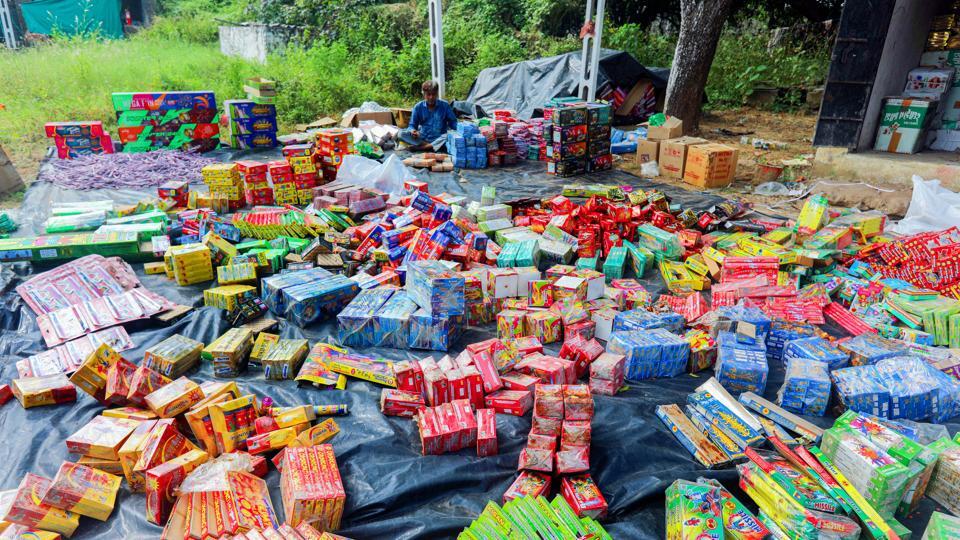
This debate, which environmentalists believed had long been settled, was reignited on Monday when Delhi chief minister Rekha Gupta said that the government believes “a balance between public sentiments and environmental protection is essential,” and that it will “request the Supreme Court to grant permission for the use of certified green firecrackers this Diwali.” Gupta added that the objective was to “strengthen our commitment to pollution control while honouring traditions.”
Delhi’s tryst with “green firecrackers” is not new. The Supreme Court first allowed their limited use in 2018, following a comprehensive ban on all crackers in 2024. But by 2020, the Delhi government had imposed a complete ban once again, finally acknowledging the near impossibility of enforcement.
Fake QR codes, chemical manipulation, and unverified claims of “eco-friendliness” had rendered the classification meaningless. Most so-called green firecrackers available in the market were found to contain the same banned chemicals -- barium nitrate, lead, arsenic, and antimony -- that make conventional crackers toxic. A survey by an NGO submitted to the Supreme Court in 2021 found that many of these “green” variants were indistinguishable from the banned ones and were being openly sold with counterfeit certification labels.
Experts said bringing them back now means taking back the handful of hard-fought gains made over the past few years.
“Green firecrackers are an oxymoron and a small reduction in the air pollution they emit is not going to make a significant difference to air quality, especially if they are widely available,” said Bhargav Krishna, convener, Sustainable Futures Collaborative.
The undisputable science
The “green cracker” label, developed by the Council of Scientific and Industrial Research (CSIR) after the Supreme Court’s 2017 directive, was meant to identify fireworks that release 30% less particulate matter and fewer heavy metals. In theory, these reduce barium and use alternative oxidisers to limit emissions of sulphur dioxide and nitrogen oxides.
Delhi’s Air Quality Index (AQI) has worsened the day after Diwali in eight of the last nine years, barring 2022, when strong winds helped disperse pollutants.
But experts argue that the entire premise is flawed in a city like Delhi, where even a small spike in pollutants during Diwali can send air quality 20 to 30 times beyond permissible limits. Experts pointed out that in a city where the baseline is already toxic, a 30% reduction doesn’t make any meaningful difference.
They warned that Delhi’s air quality, relatively cleaner this year due to stricter controls and favourable weather, could face a sharp reversal if the court allows fireworks again. Even a single night of mass cracker bursting, they said, could push pollution levels into the “severe” zone for days.
Mukesh Khare, air pollution expert at IIT Delhi, warned that any gains from so-called cleaner crackers would quickly evaporate if people use the so-called green fireworks in large numbers on Diwali. “Though these have less sulphur and fewer toxic chemicals, if conventional firecrackers are burst together -- or even if green ones are used in large numbers -- any benefit is immediately offset.”
A nightmare to enforce
Implementation has been the Capital’s biggest stumbling block, especially in years when only “green crackers” were permitted.
“In 2018 and 2019, firecrackers were being burst everywhere, and there was no way for the police to know which were green and which were not,” said environmental activist Bhavreen Kandhari. “Even when we knew people were not using green crackers, the police said they couldn’t tell the difference. On paper, they were green; in practice, they were as toxic as ever.”
Kandhari added that the policy contradiction was glaring. “On one hand, citizens are fined for burning dry leaves in winter. On the other, the government wants to allow burning chemicals and metals in the air for the sake of tradition.”
“Enforcing the blanket ban on firecrackers in Delhi is a task that is next to impossible for the police because of multiple reasons. Firstly, firecrackers are sold openly in Delhi’s adjoining cities like Noida, Ghaziabad, Gurugram and Faridabad. It’s nearly impossible for police to check each and every vehicle entering the city from multiple borders. Secondly, personnel don’t have the expertise to distinguish between normal and green crackers. Further, fifrecrackers are burst during Diwali in such large numbers that it’s nearly impossible for personnel to stop it,” said former IPS officer RA Sanjeev, who retired as a joint commissioner in Delhi Police in 2022.
Resident welfare associations, which have long supported bans, voiced concern that the proposal will blur enforcement lines and lead to widespread violations.
BS Vohra, who heads the East Delhi RWA joint front said that green firecracker was largely a misnomer and there is no difference between the two. “There’s really no difference between the two,” said BS Vohra, who heads the East Delhi RWA Joint Front. “Once you allow one kind of cracker, all kinds enter the market. Enforcement collapses, and we’re back to square one.”
Atul Goyal, president of URJA, echoed the sentiment: “Technically, there’s no such thing as a green cracker. Every cracker pollutes. Some emit light, some noise, some more smoke -- but all contribute to poisoning the air.”



Stay updated with all top Cities including, Bengaluru, Delhi, Mumbai and more across India. Stay informed on the latest happenings in World News along with Delhi Election 2025 and Delhi Election Result 2025 Live, New Delhi Election Result Live, Kalkaji Election Result Live at Hindustan Times.


