E-Paper



Protected water bodies in Delhi may not get wetland status
Sanjay Lake and Smriti Van (Vasant Kunj) are already protected under the Forest Conservation Act, 1980, and will no longer be notified as wetlands.

 Prefer HTon Google


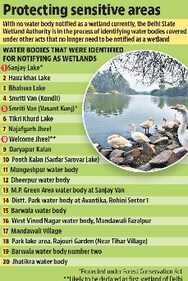
Delhi’s state wetland authority (SWA) has said it is identifying all water bodies in the Capital that are protected under other acts or rules and will therefore not be notified and protected as a wetland under the Wetland (Conservation) Rules, 2017. Though SWA has been working on notifying 20 major water bodies in Delhi as wetlands since 2021, it has now said two of these — Sanjay Lake and Smriti Van (Vasant Kunj) — are already protected under the Forest Conservation Act, 1980 and will, hence, not be notified as wetlands.
The Welcome Jheel in Shahdara, east Delhi, is expected to become the first water body to be notified as a wetland in the Capital, with the process nearing completion, officials said.
“We had sought details from agencies about water bodies we plan to notify as wetlands. Recently, we also sought details on whether any of these were protected under other acts and found that two of these, Sanjay Lake in east Delhi and Vasant Kunj’s Smriti Van, were already protected under the Forest Conservation Act, 1980. Wetland rules state water bodies already protected under other acts no longer need further notification under the Wetland Act and so, we are not notifying them as wetlands at present,” a senior SWA official, requesting anonymity, said.
Despite having over 1,300 water bodies on paper, Delhi does not have a wetland or a Ramsar site. A Ramsar site is a wetland designated as internationally important under the Ramsar Convention, also known as the Convention on Wetlands. The Delhi SWA is a dedicated body aimed at protecting and rejuvenating Delhi’s water bodies constituted in April 2019, as part of the Wetlands Rules of 2017.
Experts, however, said the process of notifying urban water bodies as wetlands was not straightforward, owing to the absence of a defined catchment area. “For water bodies like Bhalswa lake or Hauz Khas lake, we don’t have a defined catchment, which the document brief requires. It also requires the high flood level (HFL) to be defined for the past 10 years, with no construction permitted within a 50-metre radius, but already, we have encorachments or structures within 50 metres of these water bodies,” said Manu Bhatnagar, principal director of natural heritage division, Indian National Trust for Art and Cultural Heritage (Intach).
Bhatnagar said that despite some water bodies already being protected under other acts, it will not be as stringent as the Wetland Act. “The assumption is that there will be absolute protection for the surface, soil and water body in a forest, as no construction is permitted there. However, under the Forest Conservation Act, we don’t have details of the water bodies in terms of area, depth or catchment,” he said.
Process delayed
SWA officials said although the initial plan was to begin notifying water bodies as wetlands in 2020, the pandemic delayed the process. In the first phase, in November 2021, the Delhi SWA identified 10 major water bodies for notification as wetlands. This included Sanjay Lake, Hauz Khas Lake, Bhalswa Lake, Najafgarh Jheel, Welcome Jheel, Smriti Van (Vasant Kunj), Smriti Van (Kondli), Pooth Kalan, Sultanpar Dabas and Daryapur Kalan. The following year, 10 more water bodies were added to the list, which included those at Dheerpur, Mungeshpur, Jhatikra, two at Barwala, Mandawali Village and Rohini’s sector 1, among others.
“For each water body, a brief has to be prepared, complete with details of its area, capacity and catchment among other features. We have been coordinating with water body owning agencies like Delhi Development Authority (DDA), Delhi Jal Board (DJB), Irrigation and Flood Control and revenue department, among others,” the official cited above said.
The official said that notification for Welcome Jheel is nearing completion and should be done by the year-end.
Najafgarh Jheel, which is to be notified as a transboundary wetland by both Haryana and Delhi, is also awaiting notification on both sides. The two state governments have been implementing the environmental management plan (EMP) for its protection, but Delhi has yet to comment on when it plans to notify the Delhi side of the wetland. The Haryana government, in a submission to the National Green Tribunal earlier this month, said it plans to notify only 75 acres of area on its side as a wetland.