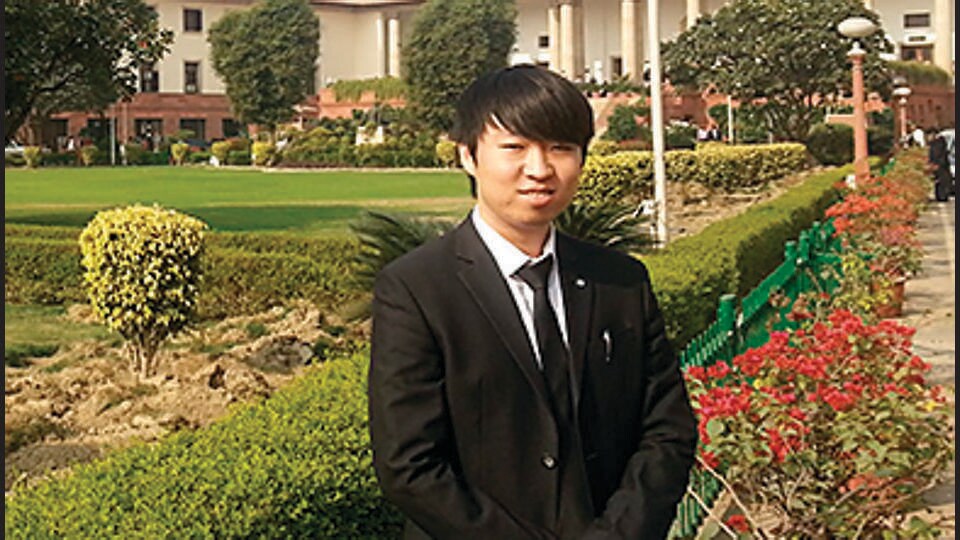
In 2003, Daeyoung Jung landed in Delhi from South Korea’s capital Seoul, all of 10, as his father moved to India for work. In a new land, the young boy quickly took to its customs and languages, even as his mother, with her knowledge of Korean cuisine, opened the Capital’s first such eatery.
Daeyoung Jung said he first started thinking about pursuing law when his father was allegedly harassed by their landlord in Delhi, when they started a Korean eatery. (HT Photo)
While Jung aspired to become a lawyer after completing his schooling and higher education in the country, the family’s Indian dream was cut short in 2020 by the Covid-19 pandemic after his father’s health deteriorated and they were forced to return to South Korea after spending 15 years in the country.
Now 30, Jung is all set to return to India – this time, as an advocate – after a landmark verdict by the Delhi high court allowed him last week to get enrolled in the Bar Council of Delhi, setting aside the law body’s order denying him recognition to practise in India despite an agreement with South Korea.
While BCI was yet to enrol him, the verdict has paved the way for Jung to be the first ever foreign national to be part of the statutory body.
“I would love to, and intend to, come back to India. That’s where all my friends are. I have worked and studied in India for the longest part of my life. Even my mother wants to return with me,” said Jung, who currently works as a project coordinator in Seoul.
In the May 30 judgment, justice Yashwant Verma said that foreign nationals are not barred from being considered for enrolment on a state roll under Section 24 of the Advocates Act if Indian nationals have the right to practise law in that particular country.
“In the absence of a nationality restriction clause being found to exist in a foreign nation, its citizens would be entitled in law to apply for enrolment subject of course to them being compliant with the other parts of Section 24,” the court’s order read. Section 24 stipulates various conditions to be fulfilled by a person who intends to be an advocate on a state roll. The proviso to Section 24(1) (a) adds that a foreign national may be admitted if the citizens of India are permitted to practise law in the foreign country.
Jung’s counsel, advocate Ashim Sood, said that this is the first time that a foreign national will be enrolled with BCI.
“There have been several foreign legal luminaries who have practised in India after independence. But this is the first time that a foreign national has been permitted to enrol in India,” Sood said.
Former Bar Council of Delhi (BCD) chairman, KC Mittal, also said that this is the first foreign national to get enrolled with BCI. He, however, said that they are examining the HC judgment. “We are also opposed to the recent BCI notification which permits foreign lawyers to enter India,” Mittal said.
Family’s legal tussles
Jung said he first started thinking about pursuing law when his father was allegedly harassed by their landlord in Delhi, when they started a Korean eatery.
“During a court hearing, I downloaded the Indian Penal Code and realised that I could understand nothing. That’s when I decided that I need to be a lawyer to help my parents and all other foreigners who face legal problems,” Jung said.
Jung studied law at NALSAR University in Hyderabad and also worked in Delhi at Invest India and the South Korean embassy between December 2018 and April 2021. But his parents, after living in Delhi for nine years and in Mumbai for another seven, were abruptly forced to leave the country in April 2020, and their restaurant was allegedly taken over by the landlord. Later, he too left for South Korea in April 2021.
“...my mother also wants to return to India. But our restaurant, called Sun and Moon and located in Worli neighbourhood of Mumbai, has been usurped by the landlord, who is currently running it,” Jung said.
In Korea, Jung quickly found that he didn’t blend into the local culture nor did he know the language well, which also made jobs difficult to come by. “I did not have any qualification other than the law degree from NALSAR, but it was heartbreaking to see that I was not accepted by the legal community in India. For the first year, we did not get a sense of belongingness because I did not know the culture and did not have any friends. We were mainly considered Indians. That was a tough time… But now things are taking a turn for the better,” Jung said.
Prior to this, Jung said, he had been to Korea a few times mainly for his visa renewal, except once in 2016 for 21 months of mandatory military service. “For the first six months in the Korean army, I kept trying to figure out the language…I could only speak Hindi and English fluently,”he said.
The young man is now getting ready to come back to the country he grew up in. While he says he still needs a job and a place to live, the verdict — if not challenged — can open doors for South Koreans to come to India for education.
While he admits he has a daunting task at hand, the desire to belong is what motivates Jung.
“I think it’s very natural to return to a place where you have a sense of belonging.”
Reports from the Delhi High Court and stories on legal developments in the city. Avid mountain lover, cooking and playing with birds 🐦 when not at work

 E-Paper