E-Paper



Supertech demolition: Neighbours worry about damage to property
Edifice Engineering, which is undertaking the demolition with its South African partner Jet Demolitions, has assured neighbours time and again that there will be no damage to their buildings. To allay concerns, British firm Vibrock Limited also ran a vibration analysis

 Prefer HTon Google


While residents of the National Capital Region await the spectacle of the controlled demolition of the 32-storeyed twin towers, Apex and Ceyanne, in Noida’s Sector 93A, occupants of neighbouring buildings are a worried lot. They fear the implosion will crack their glass windowpanes and even cause structural issues to the buildings.
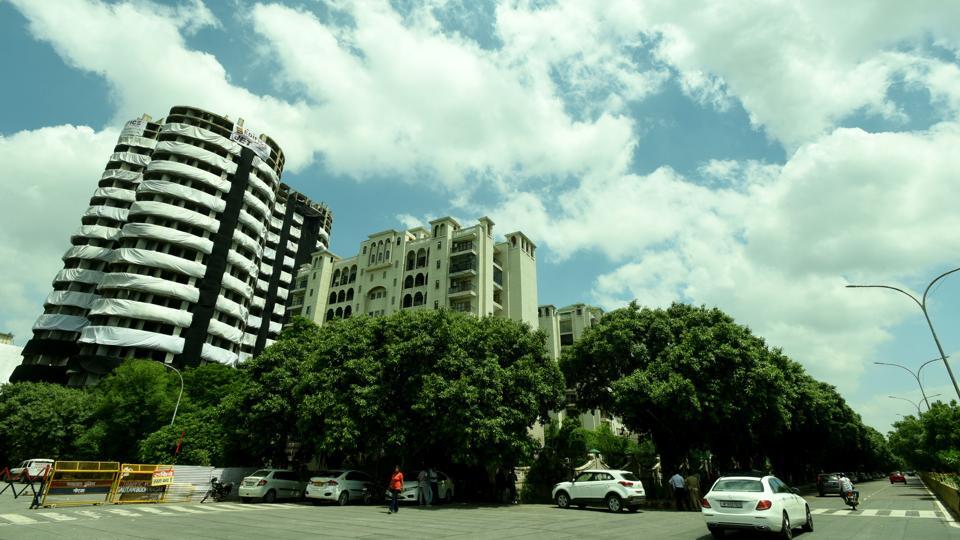
Edifice Engineering, which is undertaking the demolition with its South African partner Jet Demolitions, has assured neighbours time and again that there will be no damage to their buildings, but given that they live just a stone’s throw away from a spot where over a 1,000 implosions are to take place at the same time, the “what ifs” are bound to cross their minds. And the biggest “what if” concerns vibrations from the blast and how that will affect their buildings.
Nikhat Tyagi, a resident of ATS Village, located next to Emerald Court, says, “We have been told about the vibration levels and the air overpressure that are within prescribed levels. However, most residents don’t understand such technicalities. We are trying to be positive, but people are worried.”
To allay concerns, British firm Vibrock Limited ran a vibration analysis at the behest of Edifice recently.
According to their report, only minor damage, if any, will take place in neighbouring buildings during or after the demolition. No structural damage is likely to occur within Emerald Court or any other building in the vicinity. However, a few windowpanes could crack due to air overpressure—the pressure caused by a shock wave over and above normal atmospheric pressure.
When the explosive charge detonates within the twin towers, most of the energy released will be used to break and displace the structures. However, some of the energy will be released in the form of ground vibrations and air overpressure. However, in almost all cases where modern blasting technology is used and regulations are followed, the intensity of air overpressure and ground vibrations are well below levels that can damage nearby structures.
Vibrock Limited’s report has predicted the levels of ground vibration and air overpressure at distances of 10 to 100 metres from the twin towers. To be sure, authorities have declared an exclusion zone -- spanning a 50-metre radius from the towers—which will be completely evacuated before the demolition takes place.
“The predicted ground vibration levels range from 22mm (millimetres per second) to 36mm at a distance of 10 metres (the closest building)—much below the levels that would cause structural damage to the buildings,” the report says, adding that according to research from the United States Bureau of Mines, vibration values well in excess of 50mm are necessary to produce structural damage to residential buildings.
According to experts, the relatively high frequency of the demolition vibration will ensure that the actual ground displacement is so low as to not be problematic. In contrast, very low frequency earthquake vibrations are associated with large, and often damaging, displacements even at relatively low acceleration values. To be sure, comparing earthquakes, which take place under the earth’s surface, and over-ground implosions is not entirely correct.
“The buildings in Delhi-NCR are designed for seismic zone 4-5, as the region experience earthquakes often. The quakes are much stronger than the vibrations from the implosion. We have also conducted simulations and predicted that the impact -- it will be a third of a typical earthquake measuring one point on the Richter scale. There will be absolutely no damage from vibrations. As additional safety measures, impact cushions, berms and old tyres have been kept in the basement to further absorb the vibrations,” says Uttkarsh Mehta, partner, Edifice Engineering.
“This implosion is planned as a sequential blast with a difference of 17 milliseconds between every blast. This technique ensures that not all parts of the building blow up in one go and the entire debris from the building does not hit the ground at once. This ensures that the impact of the vibration is further reduced. Apart from the several precautionary measures planned already, we have also suggested adding old vehicle tyres in the basement and over the GAIL gas pipeline to further reduce vibrations,” says Debi Prasanna Kanungo, senior principal scientist, CBRI, who is leading the expert monitoring team appointed by the Supreme Court.
The report adds that vibrations measuring 18-27mm are expected on the ground above the buried gas pipeline, which is16 metresaway from the towers— also within safe limits, according to British standards.
“According to Indian standards, though, the safe range is about 20mm. These predictions, however, consider the direct impact of the debris hitting the ground and do not account for the several layers of impact cushions, berms, pits in the basement and other measures that have been taken to reduce the impact of the fall. Overall, with these additional measures, the impact of vibration on even the nearest building should be minimal,” says Kanungo.
“In terms of the predicted air overpressure levels, the weakest parts of most structures that are exposed to air overpressure are windows. Poorly mounted, and hence pre-stressed, windows might crack at around 150dB with most cracking at 170dB. Structural damage can be expected at 180dB,” the report says.
The predicted air overpressure level of the blast is 162dB at a distance of 10 metres from the twin towers, 156dB at a distance of 20 metres and so on—progressively decreasing to 142dB at a distance of 100 metres from the towers.
Considering that this may be a factor, Edifice has a repair team on standby that will start repairing cracked windows from the evening of August 28.