E-Paper



Will 221 water bodies in Delhi soon cease to exist?
Yes, but only if an expert committee finds that it is unfeasible to carry out the revival of these water bodies — because of existing structures on them.

 Prefer HTon Google


New Delhi: As many as 221 “water bodies” that once existed in different parts of the capital may soon cease to exist on paper, if an expert committee finds that it is unfeasible to carry out their revival, owing to existing structures such as buildings, parks and hospitals.
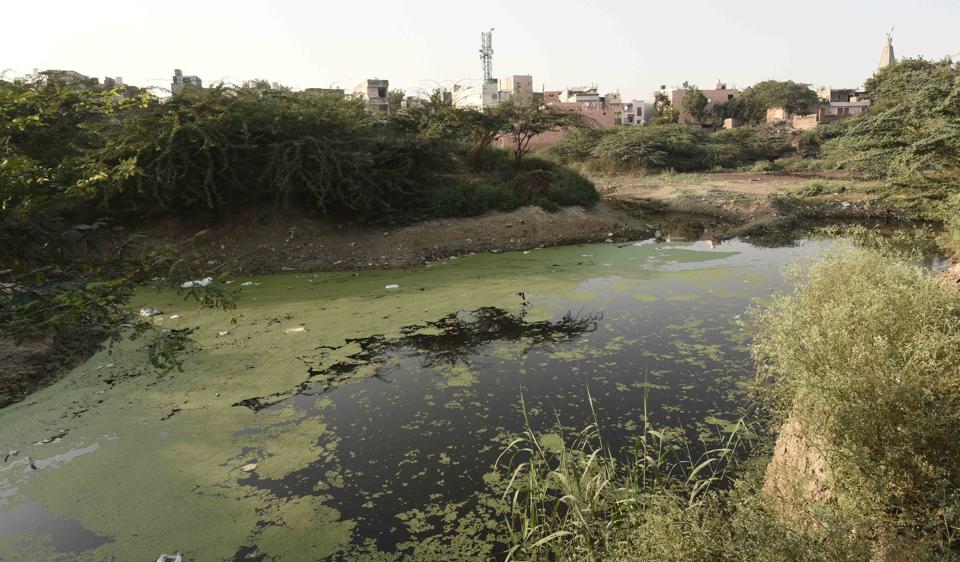
The expert committee was formed by Delhi’s lieutenant-governor Anil Baijal last week, while carrying out a review of the status of the revival of the 1,043 water bodies that have been geotagged and identified by the Delhi government so far. In submissions made to Delhi’s State Wetland Authority (SWA), land-owning agencies such as the Delhi Development Authority (DDA) and the Delhi Jal Board (DJB) said that it will be difficult to revive a water body at these sites as structures exist there. This is an issue towhich the LG has raised a strong objection too.
Prior to last year, Delhi had no concrete records on how many water bodies were present across the capital. The SWA, which was formed only in 2017, along with an existing government body, has since been trying to find the exact number, which has so far reached 1,043. This was done by scanning old revenue maps for different land-owning agencies, which has revealed additional water bodies such as small village ponds or johads which have either dried up or have seen developmental works carried out on them.
As per submissions made to the SWA, of the 1,043 water bodies which have been identified by the Delhi government, a brief document had already been prepared for 684 of them. However, of the 221 water bodies with structures on top of them, 215 fall under the DDA and six under the DJB. Data shows that among these, 62 water bodies currently have a building on them, while sites of 52 such water bodies are now being used to provide public services. An additional 14 water bodies also have educational institutions on them, while 11 sites have parks and recreational centres.
An SWA official, who was also part of the meeting with the LG, said the problem of water bodies partially or wholly encroached has been under the scanner since last year. However, possible solutions were being looked at. “If there is a hospital or a school, or even a park currently standing where a water body once existed, it is not easy to demolish it. Therefore, we were looking at possible solutions, for instance, accommodating water bodies within an existing park. However, for permanent structures, it is difficult to find room for a water body. This issue was also pointed out to the LG, which led to the formation of the expert committee.
The plan
A major chunk of Delhi’s 1,043 waterbodies currently falls under the DDA and the Block Development Office (BDO). Data with the Delhi Parks and Gardens Society (DGPS), which has mapped these water bodies, said 836 water bodies in the city fall under DDA’s jurisdiction, followed by 131 under BDO. The forest department has 18 water bodies, while the Archaeological Survey of India (ASI) has 15 water bodies under them.
Over 500 water bodies were transferred to the DDA from the Delhi government over the last few years, after over 168 rural villages were declared “urban”.
According to a senior DDA official, there are over 200 waterbodies that can’t be revived due to various reasons such as an existing government or private building constructed on the site or it falling in the alignment of key infrastructure projects.
“It is not that we don’t want to revive these water bodies. But there are a lot of cases where there is a private or government building constructed on it. Some waterbodies are falling in the alignment of Urban Extension Road-II. There is a waterbody in Daurala where a police station has been constructed,” said a DDA official.
Professor CR Babu, head of the Centre for Environmental Management of Degraded Ecosystems (CEMDE), who was part of the meeting and is likely to be part of the expert committee, said a meeting will be held as soon as a formal communication is received by them. “The LG has asked for the committee to look into the status of these water bodies. We will study the site and there is a suitable catchment area and the soil is able to hold water, then water bodies could be created next to these buildings that are currently standing in the area. We will try our best to not remove any water body,” he said.
However, alternative sites nearby could also be looked at, in case the structure cannot be removed. “In a village, for instance, a suitable area could be identified to create a johad or a small village pond,” Babu adds.
Data shared by the SWA shows another 37 water bodies are also non-traceable at the moment, owing to inadequate data on its geo-coordinates or Khasra numbers (block numbers).
Encroachments
Diwan Singh, an environmental activist who has revived multiple water bodies in Dwarka by connecting them to stormwater drains, says in 80% of the cases, encroachments were done by government bodies or for government structures.
“This needs to be identified at the permission stage. Even if a water body has dried up, past records need to be checked to see if a water body existed there or not, before allowing a hospital or a building to be built there. Once built, it is difficult to remove,” he says, stating most of these dried-up water bodies would still have a catchment area around them.
“The government has to ensure storm water drains are clean and they connect to a water body. If sewage is the problem, that can be treated using sewage treatment plants (STPs),” he adds.
Aditya Tanwar, a 28-year-old environmental activist from Naraina village has also been tracking “disappearing” water bodies in and around Naraina, having written to the SWA multiple times over the last year.
Tanwar, who also runs an NGO, Sayatna, flagged the disappearance of a water body in Naraina last month, where currently the Naraina Vihar Club and a park stand. He has also used satellite images from 2000, 2004, 2009, and 2021 to track the disappearance of a 12-acre water body in Naraina, where a common effluent treatment plant currently stands.
“It is easy to identify water bodies that have vanished from different parts of Delhi and saving them is not too difficult. People are also willing to assist the government in reviving these water bodies, but action on the ground is required first and if needed, some structures should also be demolished,” said Tanwar.