For every tree felled for the Gurugram Metro’s construction, ten more are to be planted. Marking the start of its compensatory afforestation drive, Gurugram Metro Rail Limited (GMRL) on Thursday began planting 18,000 native and climate-resilient saplings along the Kundli-Manesar-Palwal (KMP) Expressway in collaboration with the Haryana Forest Development Corporation and the forest department.
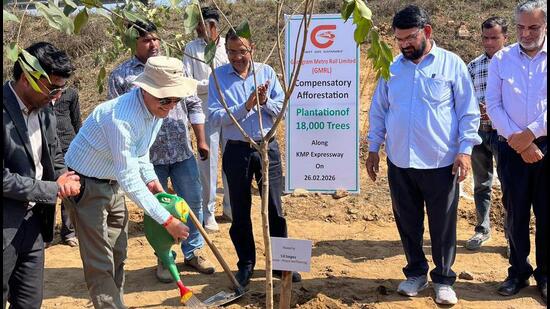
GMRL officials said 18,000 native and climate-resilient trees will be planted as part of the drive, and scientific maintenance protocols will be followed to ensure high survival rates so that the saplings grow into hardy trees and add to the city’s green cover.
According to GMRL, permission was granted for the felling of 1,800 trees for Phase1 of the Gurugram Metro project. In lieu of the felled trees, the agency will undertake compensatory afforestation by planting over 18,000 trees. The Haryana Forest Development Corporation has been mandated to execute the plantation work, with GMRL providing the required funding, a senior official said.
SR Sangwa, director (projects and planning), GMRL, said the plantation drive was launched on Thursday at the KMP Expressway to formally begin the afforestation exercise. “Senior officials of GMRL, the project contractor and the forest department were present at the drive. We planted banyan, white fig (pilkhan), cluster fig, white siris, burflower tree (desi kadam), Java plum (jamun) and bael (stone apple) today as these are local, hardy and resilient species. We will ensure that these plants survive and add to the greenery of the city,” he said.
Earlier, GMRL had been allotted land in Kadarpur village for carrying out the plantation. However, due to the rocky terrain in the area, it was decided that the afforestation would instead be undertaken along the KMP Expressway to improve the survival prospects of the saplings.
{{/usCountry}}Earlier, GMRL had been allotted land in Kadarpur village for carrying out the plantation. However, due to the rocky terrain in the area, it was decided that the afforestation would instead be undertaken along the KMP Expressway to improve the survival prospects of the saplings.
{{/usCountry}}Officials said 11 species will be planted and maintained scientifically to ensure long-term survival. These include peepal (sacred fig), banyan, neem, cluster fig, white fig (pilkhan), golden shower tree (amaltas), tamarind, bael, white siris, burflower tree (desi kadam) and jamun.
Deepinder Gulia, director of the Haryana Forestry Training Institute in Sohna, said scientific plantation methods would help ensure high survival rates and continuous monitoring of the saplings. “Native and climate-resilient species have been selected for the plantation drive,” he said, adding that public participation is also essential for sustained greening efforts in the Aravalli region.
Stay updated with all the Breaking News and Latest News from Mumbai. Click here for comprehensive coverage of top Cities including Bengaluru, Delhi, Hyderabad, and more across India along with Stay informed on the latest happenings in World News.
Stay updated with all the Breaking News and Latest News from Mumbai. Click here for comprehensive coverage of top Cities including Bengaluru, Delhi, Hyderabad, and more across India along with Stay informed on the latest happenings in World News.