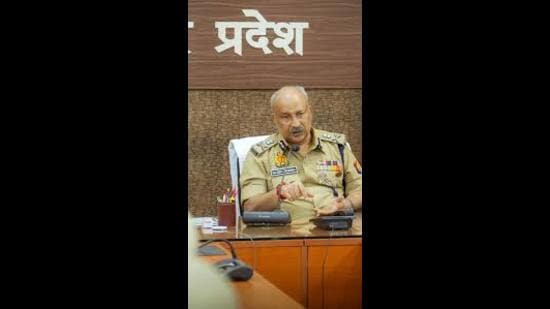
: In a stern move to enforce accountability in public grievance redressal, Uttar Pradesh director general of police (DGP) Rajeev Krishna on Tuesday ordered action against 10 station house officers (SHOs) across nine districts for allowing multiple complaints to remain pending, warning that such negligence at the police station level would not be tolerated.
The action comes amid recent judicial scrutiny of police functioning, including concerns over investigative lapses, police accountability and compliance with court orders.
“Such a negligent approach by police station in-charges cannot be tolerated,” Krishna said, adding that the respective superintendents of police (SPs), senior superintendents of police (SSPs) and police commissioners would decide the action against the officers concerned. The options include removing them as police station in-charges and sending them to police lines, suspending them or reverting them to their original rank.
Krishna said the pendency of multiple complaints indicated that public grievances were not receiving due attention at the police station level. He warned that accountability would remain a priority, with another review scheduled for next month.
The action covers nine districts: Lucknow, Lakhimpur Kheri, Unnao, Etah, Agra, Pratapgarh, Budaun, Bijnor and Mathura. The SHOs concerned are from Babu Banarasi Das police station in Lucknow; Mailani and Fardhan in Kheri; Soharamau in Unnao; Jasrathpur in Etah; Lohamandi in Agra; Maheshganj in Pratapgarh; Usawan in Budaun; Chandpur in Bijnor; and Jait in Mathura.
The directions were issued during a video-conference review on Tuesday with zonal additional directors general of police (ADGs), police commissioners, range inspectors general (IGs) and deputy inspectors general (DIGs), and district police chiefs. The meeting followed chief minister Yogi Adityanath’s emphasis on the prompt and effective resolution of public grievances.
{{/usCountry}}The directions were issued during a video-conference review on Tuesday with zonal additional directors general of police (ADGs), police commissioners, range inspectors general (IGs) and deputy inspectors general (DIGs), and district police chiefs. The meeting followed chief minister Yogi Adityanath’s emphasis on the prompt and effective resolution of public grievances.
{{/usCountry}}District police chiefs have been directed to review complaints pending at police stations and outposts, identify reasons for delays and fix responsibility for negligence. They must submit compliance reports through their respective ranges and zones within three days.
Every SP and SSP office will also establish a central monitoring desk to track complaints received, resolved and pending on a daily basis and follow up with the concerned police stations.
Officials have been instructed to register and hear every complaint received through the Integrated Grievance Redressal System (IGRS), Jan Sunwai, the chief minister’s reference mechanism and other channels. Complainants must be informed about the action taken and the reasons for any delay. Allegations of misbehaviour, favouritism, corruption or deliberate neglect must be investigated and responsibility fixed.
The DGP directed every police station to identify the 10 most pressing land disputes in its jurisdiction and coordinate with the revenue department for their resolution. The concerned assistant commissioner of police (ACP) or circle officer (CO) will monitor these cases in coordination with the sub-divisional magistrate (SDM). Once the listed disputes are resolved, the next 10 cases will be taken up.
Land disputes recorded in Yaksh Beat Reports will also be incorporated into the monitoring system after verification.
Where disputes threaten public peace, officers have been directed to initiate preventive proceedings under the Bharatiya Nagarik Suraksha Sanhita, 2023.