PRAYAGRAJ: Dubbed as ‘banana land’ of Uttar Pradesh for being one of the top banana-producing districts in the state, Kaushambi is struggling to establish itself as a major food processing hub despite promises made to this end for years.
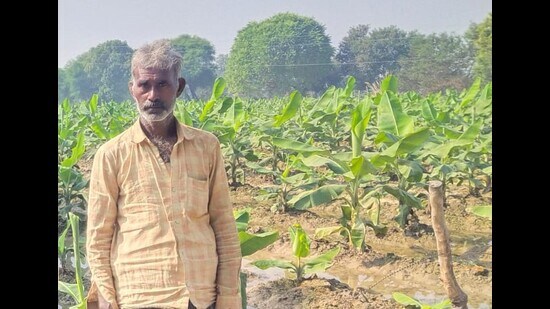
As promises in this regard making headlines again from candidates in the poll fray, locals concede that although banana farming has picked up with support from the state horticulture department and even a modern tissue culture lab has been established but a large food processing unit, which could truly help farmers, create jobs, and usher in development, is yet to take shape even six years after the launch of the One District One Product (ODOP) scheme in the state, under which banana food processing was identified as a focus area for this district.
Demand of food processing units
Currently, over 4,000 farmers and their families are cultivating bananas on 10,000 hectares of land in Kaushambi, especially in its Newada, Kaushambi, and Chail development blocks, which has doubled from 5,000 hectares in 2020.
“Banana cultivation is at a good level in entire region, and we also get decent prices for it as our bananas find takers even in Delhi and cities of Madhya Pradesh. However, the lack of food processing units means that a good harvest brings down the prices, greatly affecting the farmers as excess fruits would rot unless sold immediately,” shares Ajay Pal of Tilgodi village in the Newada block.
{{/usCountry}}“Banana cultivation is at a good level in entire region, and we also get decent prices for it as our bananas find takers even in Delhi and cities of Madhya Pradesh. However, the lack of food processing units means that a good harvest brings down the prices, greatly affecting the farmers as excess fruits would rot unless sold immediately,” shares Ajay Pal of Tilgodi village in the Newada block.
{{/usCountry}}“If such units come up, we can sell the fruits to them at a good price,” he added.
“Food processing units in Kaushambi can result in better earnings for farmers, job opportunities for youngsters, and overall development. Today, bananas are being sent to different parts of the country, but food processing units would ensure that products like banana chips, banana powder used in the confectionery industry, baby food, and ice creams, banana puree used in dairy products like yogurts, milkshakes, and cakes, etc., can all be manufactured and supplied,” said Vinay Kumar Tandon, president of the Eastern UP Chamber of Commerce and Industry.
Locals point out that despite tall promises in every election since Kaushambi emerged as a new district after being carved out of Prayagraj in 1997, it still lacks greatly in basic infrastructure development. The district lacks a good university, its own railway station, or good rail connectivity even 27 years on, and the government medical college is still to start functioning fully.
Interesting contest on cards
This time, the contest in Kaushambi has become interesting. While the BJP has again fielded its two-term sitting MP Vinod Sonkar, granting him an opportunity to score a hattrick of wins, the INDIA bloc has named Pushpendra Saroj, the son of five-time MLA and former UP cabinet minister Indrajeet Saroj, who lost the polls for this very seat by 38,722 votes to Vinod Sonkar in 2019. The Mayawati-led BSP has put a bet on retired DySP Shubh Narayan Gautam, a native of Deoria who received his education in Prayagraj. He has been a member of the Central Committee of BAMCEF (The All India Backward (SC, ST, and OBC) and Minority Communities Employees Federation) for a long time.
The Kaushambi Lok Sabha seat was known as the Chail Lok Sabha seat before 2014. The present Kaushambi district was carved out from Allahabad (now Prayagraj) on April 4, 1997. The Kaushambi Lok Sabha is a reserved seat for a Scheduled Caste candidate.
The parliamentary constituency includes the Sirathu, Manjhanpur, and Chail assembly seats of Kaushambi district and the Kunda and Babaganj assembly seats of Pratapgarh district.
In the last assembly elections of 2019, the BJP could not win any of the five seats, including the Sirathu assembly seat from where UP Deputy CM Keshav Prasad Maurya himself contested as the BJP candidate and was defeated by the SP’s Pallavi Patel.
Voters and caste break up
Kaushambi Lok Sabha seat is dominated by the Dalit community. The Pasi community holds a majority in the Manjhanpur and Chail assembly seats, while there are significant numbers of people from the Sonkar and Pasi communities in Sirathu. Among the backward castes, the Patel, Maurya, Yadav, Lodhi, and Pal communities also have significant representation.
In Sirathu, the alliance of Patel, Maurya, and Pal communities, in Manjhanpur, the Patel, Lodhi, and Pal communities, and in Chail, the alliance of Kurmi and Pal communities influence the election results. Among the general castes, there is a large number of Brahmins in all these three assembly areas.
The alliance of Brahmins and backward castes in Saraswan, Kaushambi, and Nevada development blocks has been influencing the election results of both the Kaushambi assembly and Lok Sabha seats consistently.
The Kaushambi constituency this time has 19,04,466 eligible voters, including 10,09,841 men, 8,94,459 women, and 166 transgender voters.
Out of these, Dalits account for 6,50,000, followed by Muslims at around 2,50,000. Brahmins, Patels, and Yadavs constitute around 1,50,000 each, while Mauryas and Kushwahas number 1,10,000. Pals account for 80,000, Nishads and Kashyaps number 60,000 each, while Kshatriyas and Prajapatis number 50,000 each, and Lodhis amount to 40,000 voters. Besides these, there are around 1,20,000 other voters.