The Rajya Sabha elections in Uttar Pradesh were shaping up as a routine and predictable numbers game in which the BJP was poised to win eight seats and the Samajwadi Party (SP) two. But the sudden entry of Dhanraj Parimal Nathwani, a corporate executive with Gujarat connections, as a Samajwadi Party candidate has spiced up the battle.
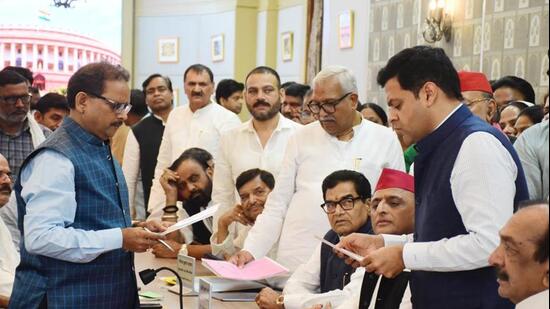
Nathwani, a senior corporate executive associated with Reliance Industries and sports administrator from Gujarat, was a surprise choice for a party when the names doing the rounds included former chief secretary Alok Ranjan and former Union minister Salim Iqbal Sherwani, besides five-term Rajya Sabha member Ram Gopal Yadav.
The SP on Wednesday formally named Ram Gopal Yadav and Nathwani, indicating that it could field a third candidate as well. Nathwani’s candidature has already triggered considerable curiosity in political circles because of his corporate profile, Gujarat connections and sports links.
Besides his corporate role, Nathwani is president of the Gujarat Cricket Association, a position he took over after Union home minister Amit Shah. His father, Parimal Nathwani, is a BJP-backed Rajya Sabha member from Jharkhand.
{{/usCountry}}Besides his corporate role, Nathwani is president of the Gujarat Cricket Association, a position he took over after Union home minister Amit Shah. His father, Parimal Nathwani, is a BJP-backed Rajya Sabha member from Jharkhand.
{{/usCountry}}His entry has obviously fuelled speculation within political circles about the strategy behind the SP’s choice. Some political leaders privately point to Nathwani’s reported proximity to senior BJP leaders in Delhi and his corporate and Gujarat connections, with some even describing him as a “BJP proxy.” However, there is no public evidence so far establishing the allegation.
Another theory doing the rounds relates to the resource requirements of the 2027 assembly election.
“With the state heading into a high-stakes assembly battle, the choice of a corporate figure with extensive business and institutional networks, could potentially help the SP widen its access to resources,” a BJP leader said.
What makes his candidature particularly significant is the numbers game. A candidate requires 37 first-preference votes to win a Rajya Sabha seat. The broader BJP-supporting bloc has 294 votes (MLAs). Going by the arithmetic, the BJP is positioned to win seven seats comfortably, while the eighth requires two additional votes beyond 294. This, experts believe, makes cross-voting/additional support inevitable.
The SP and the Congress together have 103 MLAs on paper, enough to secure two seats with 74 votes, leaving 29 votes surplus but eight short of the required votes to elect a third candidate. It is widely believed that the SP will attempt a third seat. That would require it to mobilise at least eight additional votes and all 103 members must remain available and vote along party lines.
The contest, it is said, will turn out to be more exciting if parties field more candidates than the 10 vacancies. With Nathwani now in the fray, speculation has intensified over whether the SP will bring a third candidate and whether the BJP will field a candidate beyond the eight it can comfortably elect.
In 2024 also, the SP attempted to go beyond its strength by fielding ex-chief secretary Alok Ranjan as a third candidate but lost. The difference this time, according to many, lies in the profile of the surprise candidate whose entry has added a new dimension to an election otherwise dominated by caste and regional calculations.
The last date for filing nominations is October 6. Scrutiny is on October 7 and candidates can withdraw till October 9. If more than 10 candidates remain in the fray after withdrawal, voting will be held on October 16.